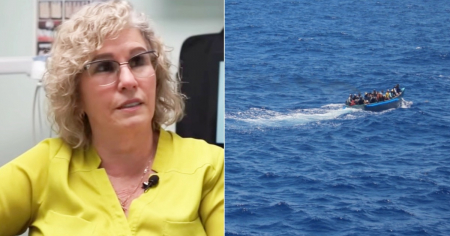
Six Cuban rafters who had set sail from Pilón, in the province of Granma, hoping to reach Jamaica, were found safe and sound at sea, as confirmed on social media by journalist Mario J. Pentón.
The case, initially surrounded by uncertainty and alarming reports, has been updated following a brief episode of family distress and public confusion.
They deny rumors of a crime at sea
For several hours, an unconfirmed version circulated on social media suggesting the possibility of a crime committed at sea, causing significant concern among the families of the migrants.
However, Pentón clarified that “very serious versions” circulated in recent hours “are not true,” in direct reference to those rumors.
“According to what two relatives, whom I just spoke with on the phone, told me, an oil tanker picked them up in open sea and brought them back to Cuba”, the journalist specified, citing Wilmer Leandro Leyva Pérez, identified as the nephew of one of the rescued migrants.
Although he did not provide details about the identity of the travelers or the conditions of the rescue, Pentón emphasized the importance of not contributing to misinformation.
"It is important to note that these versions have not been confirmed by any authority and have already been denied by the family," he stated.
In his final message, he appealed to the collective sensitivity regarding such situations:
"I understand the anguish, fear, and desperation of those waiting for news from Cuba, but it is also crucial not to spread unverified information, because behind every name, there are parents, children, entire families."
Are the same rafters being repatriated to Cuba by the U.S.?
Despite the confirmation of the rescue and return of these six Cubans, it is unclear whether they are the same individuals repatriated this Friday by the United States Coast Guard (USCG), after being intercepted 64 kilometers south of Cuba.
The USCG reported on its official account on the social media platform X that a maritime interdiction operation had resulted in the arrest of six Cuban migrants attempting to leave the island, but they did not mention that it was an oil tanker that rescued the migrants, raising questions about whether this is the same case.
The return to Cuba was made by the crew of the cutter William Trump, a vessel frequently used for patrols in the Caribbean.
"The partners continue to patrol the Caribbean and beyond, deterring illegal migration and protecting the maritime borders of the United States," the USCG stated while reporting on the operation.
A few hours later, the Ministry of the Interior (MININT) of Cuba confirmed the return of the migrants, stating that on the morning of December 19, the return was scheduled through the port of Orozco, in the municipality of Bahía Honda, Artemisa, for six migrants who were intercepted at sea after attempting an illegal departure from Cuba.
The official source specified that with this return, there would be a total of 1,669 repatriated individuals so far this year.
However, neither the Cuban nor the U.S. authorities have confirmed whether these six individuals returned are the same ones who departed from Pilón heading to Jamaica.
The numerical and temporal coincidence raises doubts, but the available data so far does not allow for confirmation.
Context: A declining migration flow, but with intact causes
Since Donald Trump took office in January 2025, Cuban maritime migration has seen a sharp decline.
Reports from the Coast Guard indicate a near-total decline in the number of intercepted and repatriated rafters, a trend that aligns with the tightening of immigration policies implemented by the new Republican administration.
The increase in border controls and maritime interdiction operations has made traditional routes to the United States more dangerous and less navigable. However, the factors driving the exodus from Cuba remain in place.
The ongoing economic crisis, characterized by a shortage of basic goods, collapsed services, unchecked inflation, and a widespread sense of insecurity, continues to drive hundreds of Cubans to risk their lives at sea.
This is compounded by political repression, a lack of freedoms, and the deterioration of the social fabric, all of which make migration a desperate escape route.
Filed under: