
Related videos:
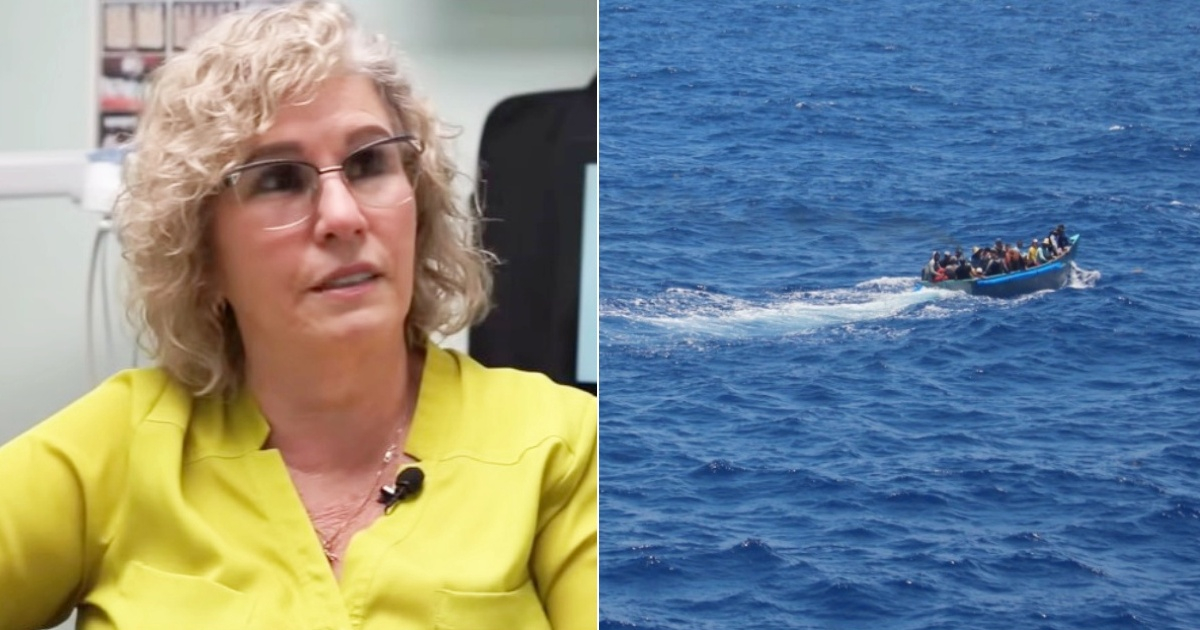
A Cuban who has been living in the U.S. since the mid-nineties shared an emotional testimony about what she went through to support her son: seventeen attempts to flee on a raft, persecution, acts of repudiation, and the certainty that there was no possible future on the island.
The testimony, gathered by journalist Claudia Padrón in an interview published by Cubanet, recounts the journey of Vilma Quintana, a mother and dentist who decided to risk her life time and again to provide a different future for her son.
“I made 17 attempts on a raft”, he confesses. “I did it for him. I bet everything to get him out of Cuba,” he adds.
A professional life with no future
Vilma had followed the path promoted by the system: she studied at the vocational school in Santa Clara, graduated in Dentistry, specialized in Biochemistry, and taught at the university. But soon she realized that her education and degree were not enough to guarantee a dignified life.
“I had spent my life studying, and to get to my family's home, I had to travel by train, by bus, or hitch a ride on the road,” he recalled.
She raised her son alone and survived thanks to what her father earned from the field. She did not have her own transportation and got around by bicycle. That effort to educate herself did not result in opportunities or security.
Aware that her son's future could not depend on a ration book or a symbolic salary, she decided to break away from everything and seek a way out—both literally and symbolically—towards another country.
Seventeen attempts at sea, always with his son
The process was long, traumatic, and clandestine. He tried seventeen times, always with his son by his side.
“We tried to leave many times: in the end, there were 17 attempts”, he said.
Sometimes the boat never arrived; at other times, there were more people than it could hold. On one of those trips, the vessel broke down, and they ended up stranded.
"That time we were detained. I couldn't return to work because they were going to stage a repudiation act against me," he explained.
It was a student who alerted her by phone: "Professor, don't come because they are going to stage a repudiation act against you."
From that moment on, his professional relationship with the university was severed. He took refuge at his parents' house and devoted himself entirely to finding a way to escape.
Leaving legally was not an option.
“If you were a professional, they would punish you with five years without working in your field in order to emigrate,” he explained.
Furthermore, she had no one to claim her from abroad. Everything was done in secret, at the risk of being imprisoned.
The Definitive Journey: Hunger, Rescue, and Detention in Guantánamo
The seventeenth attempt was the final one, but it was not without its risks.
The boat in which she and her son were traveling broke down again, and they spent two days stranded on a cayo, without water or food. Another boat brought them supplies, and then they continued further into the sea.
"Twelve hours later, the U.S. Navy picked us up and kept us for five days on the platform where the helicopters land, while they were gathering other rafters. We ended up being 700 people," he recounted.
However, the Clinton administration had changed the rules: they would not be admitted directly into the U.S.
"The captain spoke to us the night before and said that President Clinton ordered that the rafters would not enter the United States, but rather Guantánamo," he recounts.
They were disembarked there in August 1994 and remained for seven months, until they were relocated to the Homestead base in Florida in March 1995.
Starting from scratch, for him
Arriving in the United States didn't solve anything immediately. Vilma didn't speak English, had no money or support networks, and had to take care of her son on her own.
"I knew I had to work, learn English, and start from scratch, putting aside my career to work for shelter, food, and transportation."
He worked in a café, in a factory, in a pizzeria where he earned 10 dollars a day plus tips. He would walk or take the bus.
"It was difficult to be a single mother and only rely on my salary," she recalls.
He also paid for his son's school transport. It was the toughest phase, but also the most determined.
"Honestly, I was thinking about my son's future, not mine," she asserts.
Regain what seemed lost
Some time later, she found work as a dental assistant. She then studied to become a hygienist, a profession she practiced for seven years while her son was growing up. It was he who encouraged her to validate her professional degree.
“Mom, don't you want to be a dentist?” he asked her.
She thought it was impossible, but her son helped her with the entire application process.
She was finally admitted to Nova University in Miami, and after three years of study, she graduated as a dentist in the United States. It wasn't easy: she had no access to scholarships and took on considerable debt.
The Own Consultation: Independence After Years of Struggle
Vilma worked in several clinics until, in 2011, she was able to open her own.
"We opened this office in 2011. It is small, a general dentist's office," he explained.
It serves local patients, as well as those with private insurance, Medicaid, and Medicare. Veneers and cosmetic work are also performed, but that is not the primary focus.
"I never dreamed of a Rolex or a Lamborghini; I want peace, a place to live, to travel a bit, and a simple life," he affirmed. At his age, he carries physical ailments: damaged cervical discs and shoulder injuries.
"The years of working and the 17 attempts to leave Cuba were made with a heavy backpack and a gallon of water through the hills and mangroves."
Thirty years later: Neither return nor regret
Vilma has not returned to Cuba.
"I have renewed my Cuban passport all these years; it is now valid for eight more years. I have never been to Cuba."
She stays in touch with friends and family, whom she helps from afar. She misses Sagua la Grande, Santa Clara, and the places where she studied. She keeps in contact with old classmates. Still, she has no regrets.
"I feel so much gratitude and happiness for having made the decision to come to this country that if I had to do it again, I would do it without hesitation, just to give my son a future," she asserts firmly.
"And it was also my future, because I have a better life here and I have been able to help my parents, to give back for what they did for us," he concludes.
Filed under: