
Related videos:
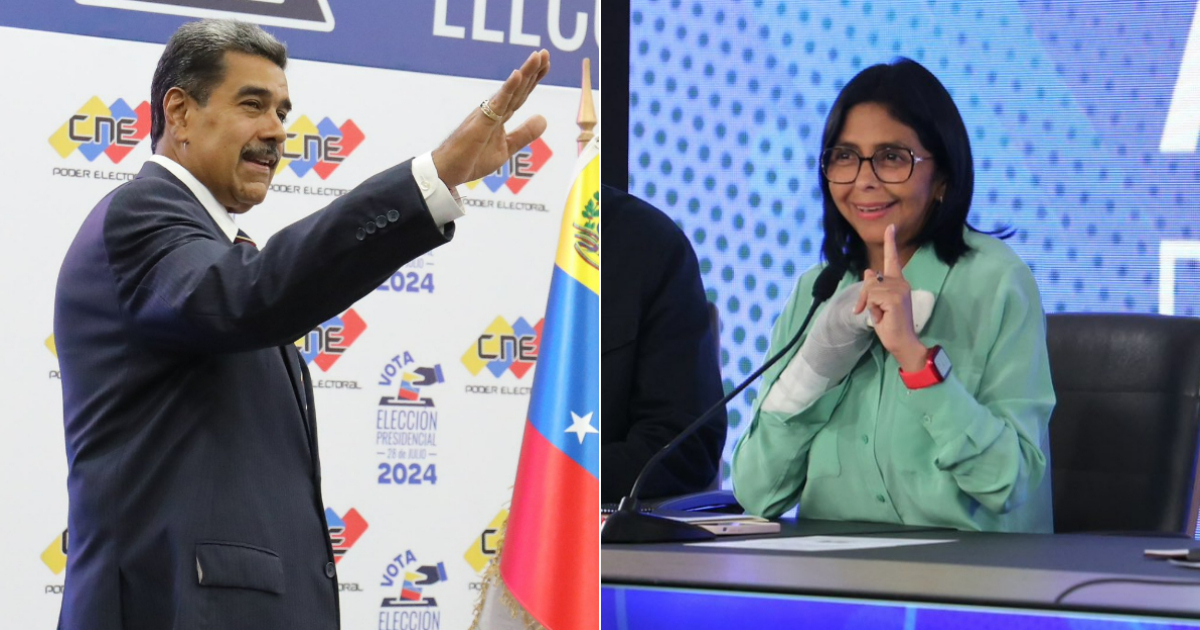
The Supreme Court of Justice (TSJ) of Venezuela ordered in the early hours of this Saturday that Vice President Delcy Rodríguez take over the presidency of the country, after Nicolás Maduro was captured by U.S. forces during the military operation that shook Caracas and several regions of the country.
In an unprecedented decision, the highest court invoked Article 335 of the Venezuelan Constitution, which allows for the guarantee of the continuity of the State in exceptional situations.
The magistrate Tania D’Amelio, spokesperson for the ruling, explained that the court declares the existence of a “forced absence of the president” and, consequently, instructs Rodríguez to exercise “all the powers, duties, and authorities inherent to the position” until constitutional order is restored.
"The objective," D’Amelio explained, "is to ensure the functioning of institutions, the comprehensive defense of the nation, and the preservation of public order in an exceptional and atypical context."
The TSJ recognized that the current situation constitutes a force majeure event, not literally anticipated in the Constitution, which led the court to an expanded interpretation of Articles 234 and 239 to legitimize the temporary transfer of power.
The decision, detailed by the newspaper El Universal, was made after intense internal debates on how to proceed in light of the foreign military intervention and the detention of the head of state.
The measure comes after a night of intense American bombings over Caracas, La Guaira, and Aragua, where military facilities were attacked, including Fuerte Tiuna and the La Carlota air base, as part of the operation that culminated in the capture of Maduro and his wife, Cilia Flores, who were taken to New York.
From his residence at Mar-a-Lago, U.S. President Donald Trump declared that his country "will control Venezuela until there is a fair transition," and announced that the new Venezuelan government will be monitored to ensure "an orderly transition to democracy."
The decision of the TSJ aims to prevent a power vacuum and maintain administrative continuity in light of the instability created by the U.S. operation.
However, analysts warn that the judicial movement reveals the internal fracture within chavismo, as the Armed Forces remain divided between loyalty to the Supreme Court and allegiance to the former leader.
Delcy Rodríguez, one of the most influential figures in chavismo, thus takes over as head of state amid an unprecedented institutional crisis, with the country facing military tensions, isolated protests, and a still uncertain political future.
Washington conditions the transition, and Rodríguez emerges as a key figure in the new Venezuelan landscape
The decision of the Supreme Tribunal of Justice (TSJ) of Venezuela to appoint Rodríguez as acting president following Maduro's capture comes alongside a series of statements from Washington that reveal a strategic shift in U.S. policy toward Caracas.
President Trump confirmed that his administration will "control Venezuela on its own terms," and that Rodríguez will lead a transitional government supervised by the United States.
From his residence in Mar-a-Lago, the president assured that his country will take charge of the country "until there is a fair democratic transition," and insisted that Venezuelan energy resources—particularly oil—will be temporarily managed by the U.S. to "benefit the Venezuelan people" and compensate for "the illegal expropriations of the past."
“Let’s lead this country properly and ensure that the people of Venezuela are taken care of,” declared Trump, who also confirmed contacts between his Secretary of State, Marco Rubio, and Rodríguez herself.
According to the Republican, Rodríguez has shown a willingness to collaborate in stabilizing the country. “She is ready to do what we believe needs to be done for Venezuela to be great again,” he stated, paraphrasing his famous campaign slogan.
For his part, Rubio stated in an interview with The New York Times that the chavista elite has before it "a historic opportunity" to act for the benefit of the country.
“We will make decisions based on the facts and actions we observe in the coming days,” said the Secretary of State, warning that Washington will assess the behavior of Rodríguez and his cabinet before determining the next steps.
The statements generated debate both within and outside of the United States. While some Republicans, such as Congressman Mario Díaz-Balart, celebrated the military operation and highlighted the “real and sustained support” for the opposition leader María Corina Machado, others criticized Trump's plan for concentrating power in a figure from chavismo.
Díaz-Balart argued that military action was "necessary to accelerate political change" and denied that U.S. oversight constitutes an act of colonialism. However, he warned that any negotiation with Delcy Rodríguez would only be acceptable if it facilitates a democratic exit, "never to legitimize the regime."
Meanwhile, from Caracas, Rodríguez described Maduro's capture as an "illegal kidnapping" and demanded proof of life for the former president. Nevertheless, he accepted "relations of respect" with Washington within the "international legality," opening an ambiguous door to cooperation with the United States amid the crisis.
The political future of Venezuela, and by extension the geopolitical balance of the continent, will now depend on the tense interaction between the White House and the surviving Chavismo, in a scenario where the democratic transition promised by Trump is intertwined with energy interests, strategic calculations, and a new phase of competition for power.
Filed under: