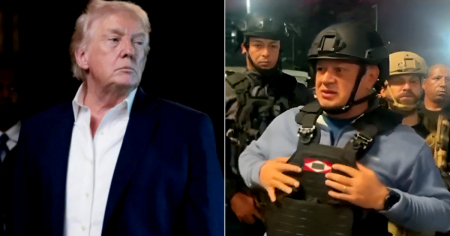
The Venezuelan Interior Minister, Diosdado Cabello, assured this Tuesday in Caracas that the Bolivarian project will remain in place and promised that Nicolás Maduro will return to power. These statements were made during the Great Women's March, amid the political crisis that Venezuela is experiencing following Maduro's capture by U.S. forces.
In a message shared on social media and recorded by users who attended the event, Cabello stated: “It is indeed sad for those who laugh at their own misfortune, because those who laugh thinking ‘they didn't take Nicolás, they kidnapped him, the Bolivarian Revolution will fall,’ do not know this people, they do not understand. We lost Commander Hugo Chávez, we do not have the physical ability to bring him back, because they killed him, but we will bring Nicolás back.”
During his speech on Bolívar Avenue, Cabello reiterated that "the dictatorship will not fall" and urged the population and the armed forces not to fall for "the enemy's game," referring to the capture of the former president. He maintained that "revolutionary unity" remains intact and described opposing narratives as part of an "international destabilization strategy."
The White House, for its part, warned Diosdado Cabello that he could “face the same fate as Maduro” if he does not facilitate the governance of the interim president, Delcy Rodríguez, according to Reuters, cited by El País. According to these sources, Washington believes that Cabello — who controls part of the security forces and armed civilian groups — can play a key role in maintaining stability during the transition process.
The report adds that Cabello, accused by the United States of drug trafficking, is seen as one of the few Chavista leaders capable of disrupting the internal order and, at the same time, as a necessary interlocutor to ensure that the country does not descend into chaos. The administration of President Donald Trump has made it clear that it expects cooperation from the Chavista leaders who remain in the country.
In recent days, U.S. Secretary of State Marco Rubio explained in an interview with CBS why U.S. forces did not capture Cabello or Defense Minister Vladimir Padrino López during the operation that led to the arrest of Nicolás Maduro and his wife. Rubio stated that the mission was “one of the most complex and risky” in years and that carrying out simultaneous captures would have increased military risk. He clarified, however, that both are still wanted by Washington.
Parallely, a civil lawsuit filed in the Southern District Court of Florida accuses Maduro, Delcy Rodríguez, Diosdado Cabello, Jorge Rodríguez, and other high-ranking officials of the chavismo regime of kidnappings, torture, drug trafficking, and state terrorism. The case, based on the RICO Act and the U.S. Anti-Terrorism Act, seeks multimillion-dollar compensations and could have diplomatic and financial consequences for those involved.
Cabello, a central figure within the Venezuelan government since the death of Hugo Chávez, remains one of the main representatives of Chavismo during a period marked by a transition of power and international pressure on the Venezuelan regime.
Filed under: