
Related videos:
After capturing former Venezuelan President Nicolás Maduro in an unprecedented military operation, the U.S. has repositioned some of its naval power just miles from Cuba, in a gesture that redefines regional pressure.
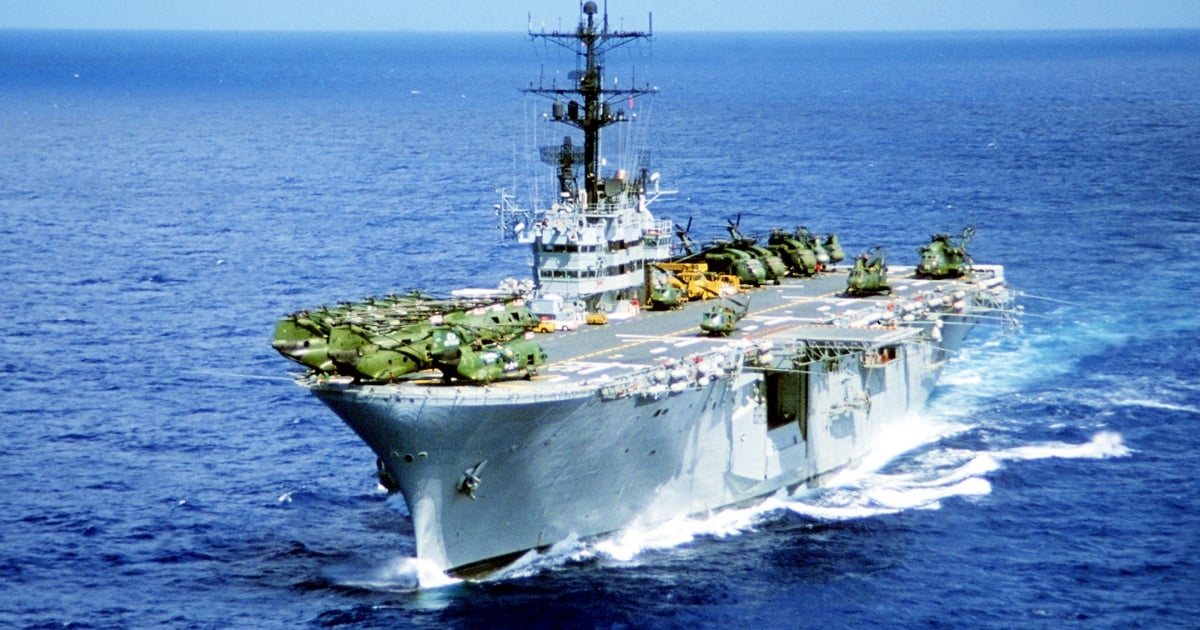
The amphibious ships USS Iwo Jima and USS San Antonio, key components of the deployment that led to Maduro's detention, have been moved to the Atlantic, off the northern coast of Cuba.
Although the bulk of the U.S. military contingent in the Caribbean has begun to withdraw, this movement indicates a new phase: less visible, but equally strategic.
According to recent revelations from The Washington Post, the ships remain under the command of the United States Southern Command and could be redeployed at any time if the situation demands it.
The relocation occurs as the Trump administration weighs whether to deploy ground troops in Venezuela, amid a still tense regional context and with Cuba—historical ally of Caracas—on the front lines of military observation.
"Its main mission has been completed", said a U.S. defense official, referring to the objectives achieved by the fleet, but he warned that the device continues to "balance national security priorities."
From the Caribbean to northern Cuba: a maneuver loaded with symbolism
The transfer of Iwo Jima and San Antonio to northern Cuba occurs just a few days after the operation that culminated in the capture of Nicolás Maduro by members of the Delta Force of the U.S. Army.
The former governor was intercepted on Venezuelan soil, transferred by helicopter to Iwo Jima, and subsequently taken to New York, where he faces federal charges for drug trafficking.
Both ships are amphibious assault units capable of deploying marine infantry, aircraft, and heavy military equipment.
Although at least one could return soon to its base in Norfolk, Virginia, they remain under the operational authority of Southern Command, with the possibility of immediate redeployment in the Caribbean if necessary.
The gesture of keeping them in front of Cuba is interpreted by analysts as an indirect message to the government in Havana, which is closely tied to chavismo and considered by Washington to be a hostile geopolitical actor in the region.
The military contingent is reduced, but strategic control is maintained
The number of U.S. troops in the region has been reduced "by a few thousand," according to official sources cited by The Washington Post, leaving approximately 12,000 personnel in the area.
This partial withdrawal reflects a tactical reconfiguration following the success of the operation, but it does not imply a total retreat or a relaxation of strategic control.
“Any ground deployment would be temporary and would focus on the protection of oil infrastructure”, clarified another Pentagon official, who insisted that Trump has not completely ruled out a presence on Venezuelan soil.
In addition to the naval movement, some key air resources were withdrawn from the region, such as the CV-22 special operations aircraft and the MC-130 refueling aircraft.
Both aircraft were used during the incursion against Maduro for support, transport, and extraction tasks.
An operation with multiple fronts: From the sea to the sky
The scale of the operation was highlighted in statements by General Dan Caine, head of the Joint Chiefs of Staff, who revealed that over 150 aircraft were deployed from 20 different locations – including units stationed at sea – as part of the military operation.
"Among the combat aircraft involved were F-18s and EA-18s," Caine detailed, confirming that both models were deployed aboard the aircraft carrier USS Gerald R. Ford.
The Iwo Jima and the Gerald R. Ford played a central role in the incursion, as confirmed by senior Pentagon officials.
Prior accumulation and naval blockade: The siege of Caracas
The military buildup began during the northern summer, when Iwo Jima was deployed with Marines from the 22nd Marine Expeditionary Unit, along with San Antonio and USS Fort Lauderdale.
The presence intensified in October with the arrival of the Gerald R. Ford, redirected from Europe to the Caribbean.
In parallel, President Donald Trump intensified his rhetoric and operational stance: he announced a complete blockade of Venezuelan oil tankers that are under sanctions and authorized the interception of vessels on the high seas.
"Venezuela is completely surrounded by the largest Navy ever assembled in the history of South America," Trump stated on social media, although experts deemed that claim an exaggeration.
Despite this, several actual interceptions were confirmed, including two oil tankers that were detained this very week.
A military presence that adapts to the regional landscape
Although the most visible operational phase has concluded, the repositioning to the north of Cuba makes it clear that the United States maintains an active response capability in the Caribbean.
The proximity to Cuba, the symbolic axis of Washington's historical opposition in Latin America, suggests a close watch in an environment where balances can shift rapidly.
"The fact that they remain under Southern Command and facing Cuba is more than a sign of retreat: it is a silent warning," noted a military analyst consulted by the aforementioned media.
With the region still under tension, and with no clarity on the next steps of the Trump administration in Venezuela, the presence of these military assets near Cuban territory reinforces the idea that the Caribbean remains a priority in the national security agenda of the United States.
Filed under: