In a powerful interview granted to journalist Mario J. Pentón for Martí Noticias, the Chargé d'Affaires of the United States in Havana, Mike Hammer, provided a clear perspective on the Trump administration's stance regarding the situation in Cuba.
In direct language, the diplomat denounced the regime's repression, criticized the official narrative regarding the embargo, reiterated that the release of political prisoners is "non-negotiable," and warned that "the behavior of that dictatorship will no longer be tolerated."
Conversations with Havana: "When Trump says something, he means it and it’s very clear."
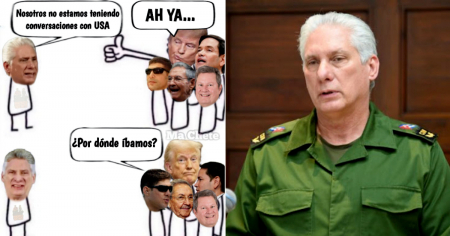
Hammer also referred to the recent exchange of statements between Presidents Donald Trump and Miguel Díaz-Canel concerning conversations between their two administrations.
This is not about rumors, but rather a statement made publicly by President Trump, who claimed that there are negotiations with the Cuban regime. Shortly after, Díaz-Canel firmly denied that such contacts had taken place.
In light of this scenario, Hammer chose not to go into detail, but made it clear where his trust lies: "When President Trump says something, he means it, and it's very clear."
With that statement, he supported the president's version and hinted that any potential rapprochement would be contingent on the political conditions defined by the administration.
“We stand with the Cuban people, with the everyday Cuban”, emphasized the diplomat, making it clear that there will be no room for concessions as long as the fundamental rights of citizens on the island are not respected.
His message, forceful and aligned with Republican leadership, emphasizes a policy grounded in principles rather than dialogue with the ruling elite.
"The revolution has not only failed, it has also betrayed the people."
Hammer, who has traveled through almost all the provinces of the island and has maintained direct contact with citizens in their homes, was blunt when referring to the internal situation.
According to what he explained, his contact with Cuban reality has revealed a widespread sense of frustration among the population: “People tell me that not only has the revolution failed, but it has also betrayed them.”
In that regard, he categorically rejected that the economic and social crisis facing Cuba is a result of U.S. sanctions.
"There are no medicines, there is no electricity, there is no fuel, and trash is not being collected. That is not the fault of the United States. The people know it," he declared.
He also described the regime's insistence on blaming the embargo for the collapse of basic services as "propaganda."
"The chicken comes in, food and medicine are not sanctioned," he noted.
Hammer also highlighted the internal inequality in the distribution of resources, noting that while hospitals are lacking supplies and the streets remain dark, “the luxury hotels are lit up while the rest of the city is in darkness.”
For him, this demonstrates that “the problem is the failed politics of the ruling elite”.
Political prisoners: "This is not a topic for negotiation."
One of the main focal points of the interview was the situation of the more than one thousand political prisoners who, according to independent organizations, remain incarcerated in Cuba.
Hammer was emphatic: "From the very beginning, the Trump administration has made it clear that all these political prisoners must be released. This is not a negotiable issue. It's either yes or yes."
He referred directly to the protesters from July 11, 2021 (11J) who are still imprisoned and denounced the abuses committed against them.
"They are abusing the human rights of the Cuban people, of innocent people who go out to protest because the situation is very bad," he emphasized.
In his opinion, international pressure is vital: “The behavior of that dictatorship will no longer be tolerated.”
Immigration, sanctions, and repressors in the U.S.
The ambassador also addressed the political use of emigration by the Cuban regime, as well as the entry into U.S. territory of officials from the repressive apparatus.
In that regard, he supported the recent immigration restrictions and the travel ban implemented by the White House.
"Cuba is a state sponsor of terrorism. It has terrorist refugees there that they do not return," he explained; and added next that there are repressors who have entered the U.S. while the people suffer, and that this "is being corrected."
Hammer stated that, in coordination with the Department of Homeland Security, deportations are being carried out and that the U.S. Embassy will follow the laws of the country "and the executive orders of the president."
In addition, he revealed that Washington is working on new measures to limit the resources that support the Cuban repressive apparatus.
"With those resources, they repress the people. This cannot continue."
In particular, he noted that new sanctions are being evaluated against entities controlled by the military, such as the GAESA conglomerate, and mentioned the trafficking of doctors in foreign missions as a form of "human trafficking."
Call to the international community and hope for change
In a message directed at other diplomats and governments, Hammer urged them to leave the official bubble: "Get out of Havana, listen to the everyday Cuban, and open your eyes to the reality of the island."
He insisted that the isolation of the regime should not rest solely in the hands of the United States and that greater international pressure is needed, both from Latin America and Europe.
At the end of the interview, the official shared his personal vision for Cuba's future.
“A free Cuba is what I see”, he stated with conviction, and concluded with a promise that echoed both a warning and hope: “That day is drawing near.”
A clear message to Havana
Mike Hammer, leading the diplomatic mission in the Cuban capital, does not limit himself to representing Washington's interests.
His speech aligns with a strategy of political and moral confrontation against the Cuban regime, grounded in the rejection of any concessions without progress on human rights and freedom.
His words leave no room for doubt: "No more violations of human rights will be tolerated."
Filed under: