
Related videos:
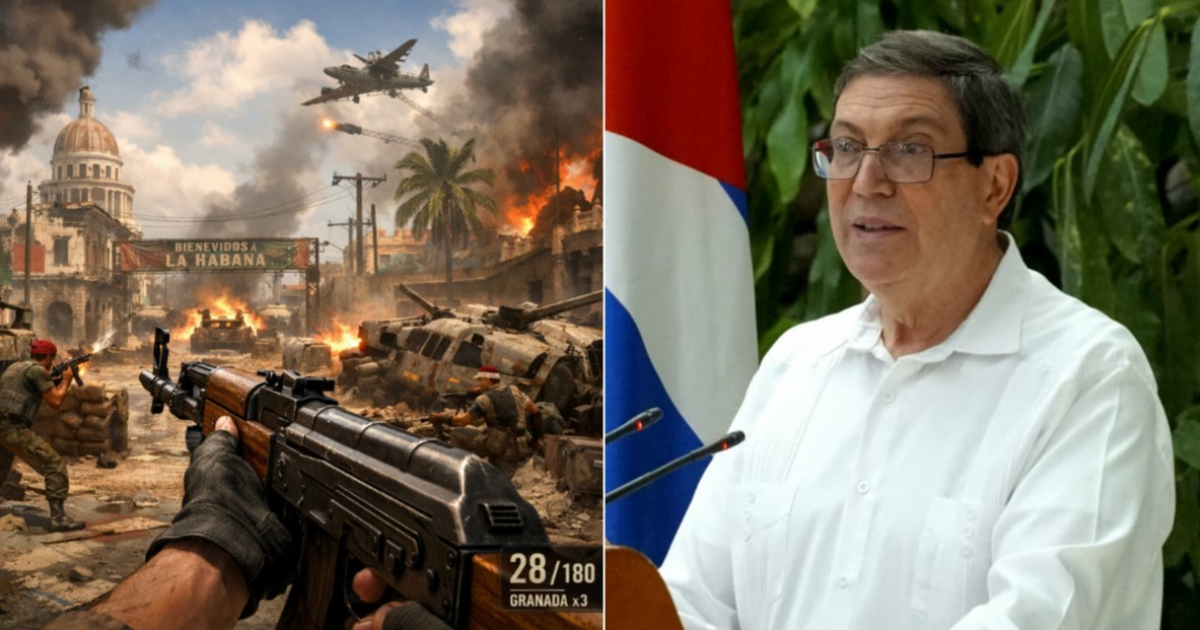
The Cuban government has once again shifted the focus onto an external enemy to explain the perception of the country outside the Island. This time, the target is not only the media or social networks, but also video games.
The chancellor Bruno Rodríguez Parrilla stated on X that an investigation by the Media Observatory of Cubadebate shows that "video games also engage in politics" and depict Cuba as a cliché aimed at a single outcome: foreign intervention or the overthrow of the government.
Rodríguez stated that more than 40 popular video games use Cuba as a setting and create a narrative that is "apparently easy to digest for those who are not familiar with the country," where the Island is associated with decay, scarcity, political control, and a lack of future.
According to the chancellor, this would not be a coincidence, but rather the result of the cultural industry reproducing "Washington" stereotypes.
The article shared by the head of Cuban diplomacy, published on the official site Cubadebate, argues that video games serve as means of communication that "frame" reality through rules, metaphors, and systems of progress.
In that context, Cuba would not appear as a mere backdrop, but as an "idea": a country frozen in time, lacking its own horizon, whose narrative conflict is often resolved through external intervention.
To support its thesis, Cubadebate claims to have analyzed a sample of 45 foreign video games in which Cuba plays a role of varying intensity.
The portal identifies recurring patterns: Cuba as an "exotic" destination for tourism, as a dystopian trigger associated with the October Crisis, as a colonial enclave, or, above all, as a theater of espionage, terrorism, and political crises.
The text devotes a significant amount of space to Far Cry 6, a high-budget video game set on a fictional island called Yara, ruled by a dictator.
Although the game does not mention Cuba, Cubadebate asserts that the cultural and political correspondence is "deliberate and visible": colonial architecture reminiscent of Havana, vintage cars, political signage, and an aesthetic of a "country trapped in time."
According to the analysis, the player experiences a "revolution fantasy" where precariousness is a routine and the deterioration is directly attributed to the political system, while the solution is armed insurrection and the destruction of the state apparatus, even with the presence of a character linked to the CIA as a narrative support.
Another cited example is Cuban Fighters, a fighting game where recognizable figures from the Cuban political and cultural landscape appear as caricatures that engage in combat.
For Cubadebate, this turns politics into a spectacle and establishes a "symbolic violence" that reduces the Cuban reality to mockery and humiliation.
The portal concludes that, through various means, these video games push towards the same image: Cuba as a failed state, frozen in time, with no present or future other than collapse, foreign intervention, or parody.
Additionally, it notes that a significant portion of the audience is young and lacks a solid historical background, which is why the video game serves as a primary source of imagery about the Island and "educates" them on a notion of Cuba while maintaining a facade of innocence.
From the official discourse, this interpretation serves to reinforce the narrative that there is a permanent campaign from abroad to justify sanctions, pressure, and "regime change."
However, the regime overlooks the fact that this international image does not stem from a joystick, but from decades of authoritarianism, censorship, repression, and systematic human rights violations within the country itself.
Instead of questioning the reality that Cubans live, the regime is once again shooting at the messenger, now turned into a video game.
Filed under: