
Related videos:
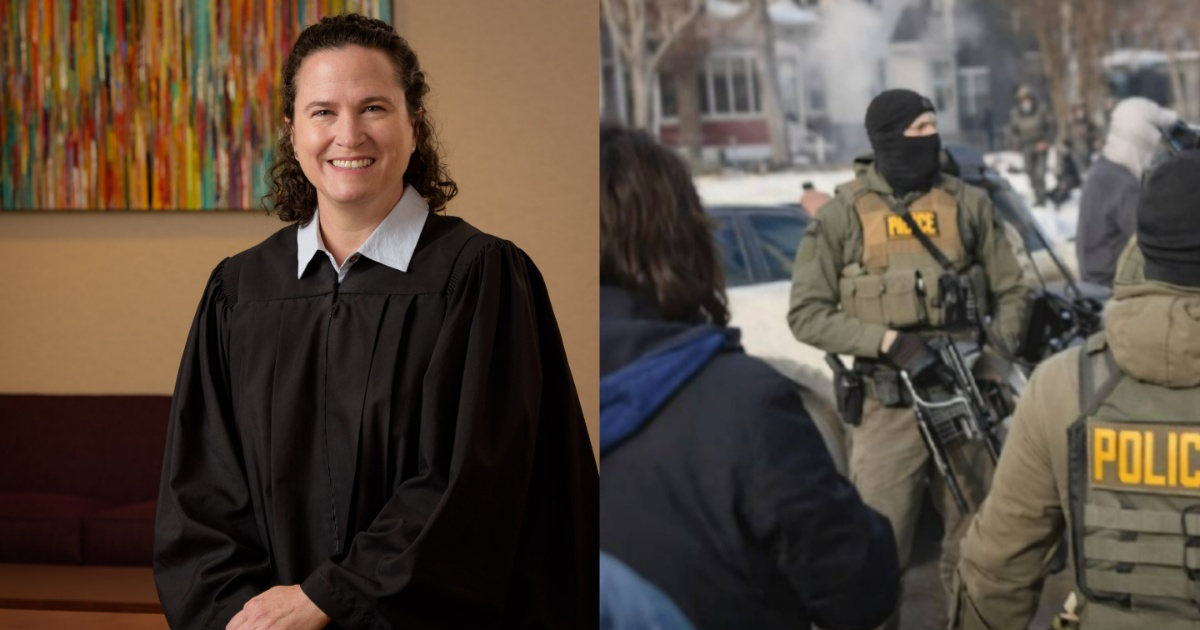
Federal judge Katherine Menéndez denied this Saturday Minnesota's request to immediately halt Operation Metro Surge conducted by the federal government through the U.S. Immigration and Customs Enforcement (ICE) in that state.
The plaintiffs "have not met their burden" of the "extraordinary relief" of a preliminary court order, argues the ruling, according to FOX, which refers to the legal requirements needed to block a federal law enforcement operation at this stage of the case.
The cities of Minneapolis and St. Paul had sued the Department of Homeland Security (DHS), alleging a federal invasion, and requested the court to issue a preliminary injunction to stop the operation.
Menéndez rejected the request, citing the absence in the petition of the high legal standard required for such an extraordinary decision.
Last Wednesday, the federal agents involved in the deadly shooting in Minneapolis (Minnesota) were placed on administrative leave while the investigation into the case progresses, a measure that the Department of Homeland Security (DHS) described as part of the standard protocol following a shooting.
The death of Alex Pretti
The victim has been identified as Alex Pretti, a 37-year-old nurse, and the cited reports indicate that he died after being shot at close range during a struggle with federal agents.
The Border Patrol agents involved in Pretti's death have been placed on administrative leave as part of standard procedure.
It was also specified that the measure applies to two officers who fired during the incident. The reviewed document states that it is unclear whether other federal agents present at the scene—up to eight can be seen in videos—were also placed on leave.
The document indicates that a report presented to Congress (cited by CNN and CBS) states that, during the struggle, an officer shouted, "He's got a weapon!" and, approximately five seconds later, a Border Patrol agent fired his Glock 19 and another agent (from Customs and Border Protection/CBP) fired a Glock 47.
The report does not specify whether the shots from both struck Pretti while he was on the ground, according to the text itself.
The document also states that, after the shooting, an agent reported that he had in his possession Pretti's firearm, and adds that witness videos show that the weapon was taken from his waistband before the shots were fired, although the federal government initially maintained that Pretti approached the agents armed.
The case of Good
In the same context, Jonathan Ross, the ICE agent who killed Renee Good in Minneapolis on January 7, was also placed on administrative leave while that incident is being investigated.
On January 7, 2026, in Minneapolis (Minnesota), Renee Nicole Good, a 37-year-old American citizen, was shot by an agent from the Immigration and Customs Enforcement (ICE) during a federal operation in the city.
Good was a mother of three who had recently resided in Minneapolis, and according to reports, she was acting as a legal observer during a heightened presence of ICE agents in the area under the so-called "Operation Metro Surge."
The incident occurred in the morning when ICE was conducting an operation on a street in Minneapolis.
Official reports and journalistic analyses indicate that Good was inside his vehicle (an SUV) when the confrontation occurred.
According to the Department of Homeland Security (DHS), the officer involved, Jonathan Ross, fired his weapon after claiming that Good attempted to use his vehicle against him or approached him with a weapon (self-defense argument).
Public testimonies and video analysis released later indicated conflicting details, including that Good's SUV moved in the opposite direction or barely turned before the shots were fired.
Good received multiple gunshot wounds—according to autopsy reports and incident records, he had projectiles in several parts of his body, including his head—and died on the scene or shortly after in a hospital.
The death of Good sparked protests and a wave of outrage in Minneapolis and other cities, leading to calls for a review of the tactics and role of ICE in law enforcement operations.
Filed under: