
Related videos:
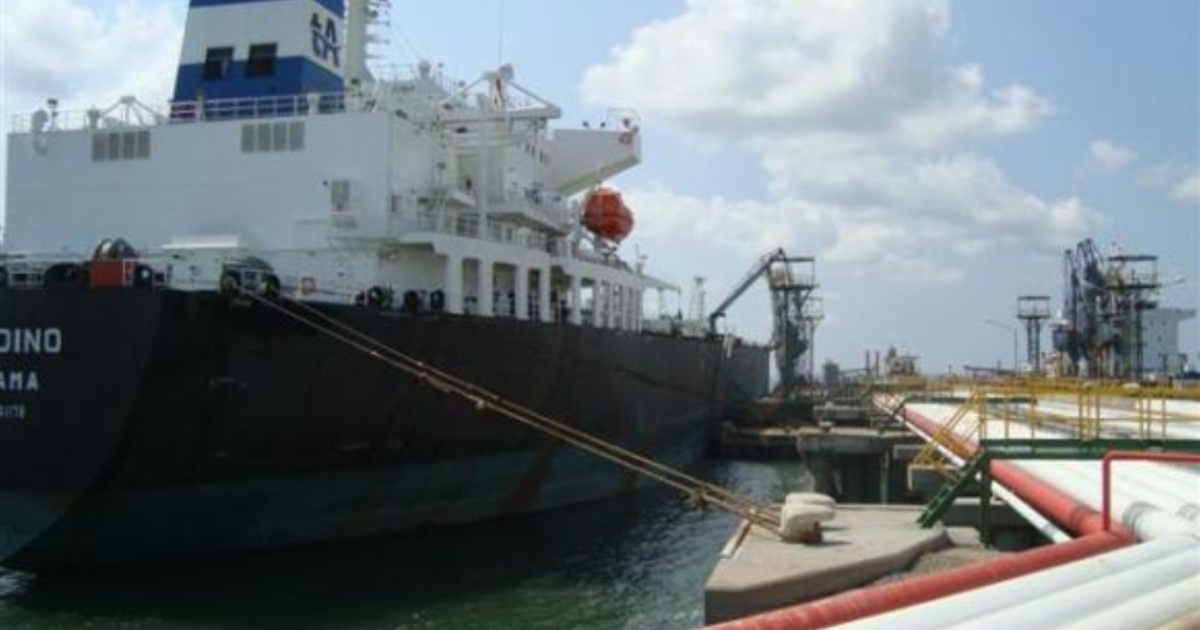
The tanker Sandino arrived this Saturday at the port of Matanzas coming from Nipe Bay (Holguín), one of Cuba's main logistics points for the reception, storage, and transshipment of hydrocarbons.
According to data from maritime monitoring sites, the vessel has an estimated capacity of between 390,000 and 410,000 barrels. However, there are no official details regarding the actual volume transported.
According to the same source, the vessel is believed to have loaded in the bay of Nipe in previous days, although the origin of the cargo at that point remains unknown, so the initial source of the fuel is not specified.
Nipe Bay, in Holguín, serves as one of Cuba's main oil hubs for the reception, storage, and transshipment of imported crude oil. Through the Antilla terminal and its anchorage areas, the country receives shipments on large vessels and then redistributes them using smaller tankers to ports and refineries such as Matanzas, Cienfuegos, Havana, and Santiago de Cuba, in a logistical framework that is crucial for domestic supply.
During the first weeks of 2026, the energy crisis in Cuba has highlighted a deep deterioration in the regime's ability to guarantee fuel supply.
The year began with alarming signs: six ships operated by the military conglomerate GAESA concentrated in the bay of Matanzas the last available oil reserves, according to reports from independent sources.
Experts warned at that time that the country was "draining its own tanks to buy time," while electricity generation and fuel distribution were on the brink of collapse.
In mid-January, the situation worsened with the diversion of the tanker Mia Grace, which had departed from Togo en route to Cuba with a cargo of diesel or fuel oil.
In the midst of its journey across the Atlantic, the ship changed course towards the Dominican Republic, reflecting the difficulties faced by the Cuban government in finalizing supply agreements and the increasing financial isolation that prevents it from accessing traditional energy markets.
Few days later, the tanker LPG Emilia was spotted sailing south of Cuba with a possible load of liquefied petroleum gas.
The reactivation of its movement, after more than a month of inactivity, was interpreted as an attempt by the regime to keep the minimum distribution of domestic energy afloat. However, its journey also highlighted the island's dependence on an aging fleet, almost entirely operated by state-controlled entities.
In February, a new sign of Cuba's energy precariousness emerged from Venezuela.
A tanker linked to the island loaded 150,000 barrels of gasoline at a Venezuelan port, in what analysts regard as an effort to resume fuel shipments under U.S. supervision.
The operation coincided with the intensification of long lines at gas stations, prolonged blackouts, and restrictions on public transportation, symptoms of an energy system on the brink of structural collapse.
The concatenation of these episodes shows that Cuba is experiencing an energy crisis that goes beyond the temporary shortage of fuel.
The lack of solid allies, the reduction of supplies from Venezuela, and the inability to access international credit have led the country to operate with minimal reserves and to depend on sporadic shipments.
In this scenario, the arrival of a tanker in Matanzas, like the Sandino, is viewed less as a lasting relief and more as a temporary reprieve within a landscape of economic and energy exhaustion.
Filed under: