
Related videos:
The Deputy Minister of Foreign Affairs of Cuba, Carlos R. Fernández de Cossío, has once again placed himself at the center of diplomatic and media debate by accusing U.S. and "pro-American" media of lacking objectivity when addressing the critical situation on the island.
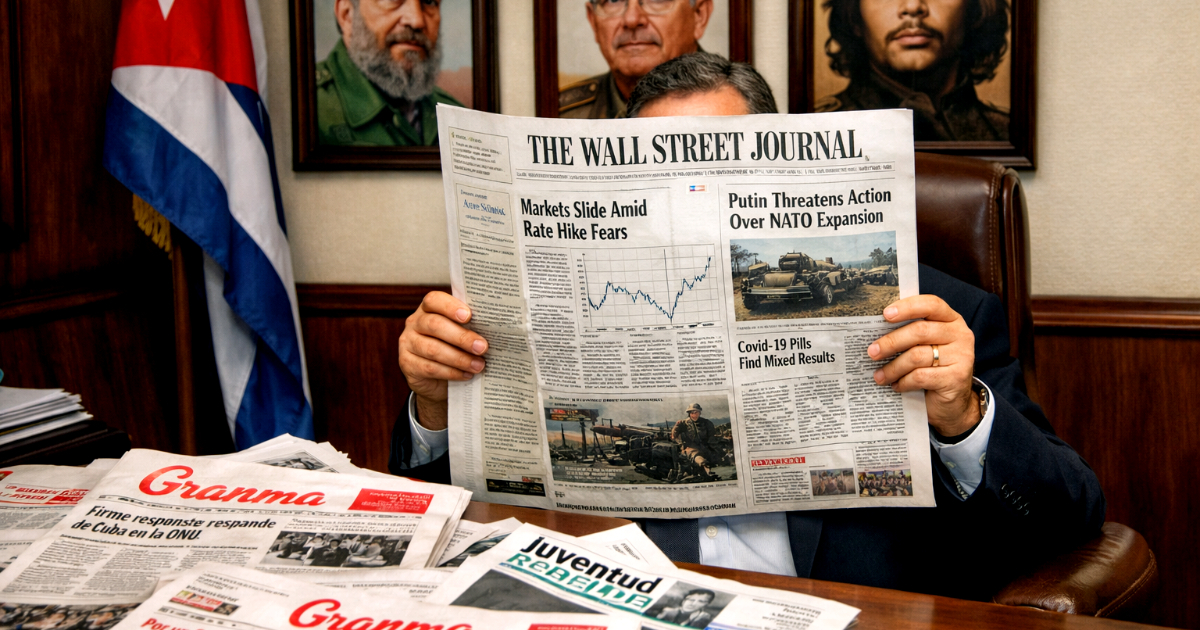
In a recent post on his social media, Fernández de Cossío pointed out that newspapers like The Wall Street Journal and magazines such as The Economist, among others, are not impartial; in his opinion, they display "enthusiasm and bias" when reporting on Cuban reality.
According to the Cuban deputy minister, those media outlets are fully aware that what is happening in Cuba—from the severe energy crisis to the economic and social deterioration—is the result of what he described as a "ruthless, disproportionate, highly asymmetric, unjust, and unwarranted aggression" by the United States, rather than a series of shortcomings inherent to the internal system.
"Nobody can objectively underestimate the immense challenge [posed by the 'blockade']. It would be monumental for any country," he stated, highlighting the long history of confrontation between Washington and Havana.
Fernández de Cossío defended the Cuban socialist system as a shield that allows for the prioritization of resource allocation, facilitates social solidarity, and cushions the effects of the crisis on the population.
In its reporting, the U.S. press does not judge the "aggressor" with the same severity and instead rushes to dramatize the internal situation of the island without historical or political context.
His statements come at a time of high visibility for this official, whose voice has been one of the most prominent in Cuban diplomacy since early 2026, when the United States intensified its pressure on Havana.
Fernández de Cossío has been a spokesperson for the Cuban regime on various fronts: he has denied the existence of formal dialogue with Washington, although he has acknowledged "exchanges of messages at the highest level" between the two governments.
At the same time, it has defended the narrative of the blockade and sanctions as the main cause of the economic deterioration, and has reiterated that Cuba is open to "serious and meaningful" dialogue as long as its social and political sovereignty is respected.
This stance comes alongside the intensification of the internal crisis, characterized by prolonged blackouts, fuel shortages, and an energy collapse that has also been publicly acknowledged by U.S. representatives, such as Ambassador Mike Hammer.
This blend of external pressure and internal deterioration has raised Fernández de Cossío's profile as one of the architects of the official discourse, tasked with responding to both international criticism and the regime's expectations.
The regime's double standard: Demanding impartiality outside while censoring within
In his recent statements, the deputy minister has staunchly defended the official narrative: attributing Cuba's problems to external factors, particularly the policies of Washington, while asserting the system's ability to confront adversities.
His demand for "objectivity" from the U.S. press is not just a direct criticism, but part of a broader strategy from Havana to counter narratives it views as hostile and to reaffirm the legitimacy of its version of events to both national and international audiences.
Paradoxically, while the deputy minister demands objectivity from the foreign press, the practice of independent journalism within Cuba continues to be persecuted, censored, and criminalized.
State media operate under the control of the Communist Party and lack editorial autonomy, while reporters and unofficial platforms face arrests, equipment seizures, and digital blockages.
Organizations like Reporters Without Borders and Freedom House rank the country among the lowest in the world for press freedom, in an environment where critical reporting can lead to expulsion or exile.
Thus, Fernández de Cossío's claim of "objectivity" contrasts with a system that does not tolerate informational diversity or accountability, even in the midst of a national crisis that the regime itself attempts to narrate from a single voice.
The media questioned by Cossío: Among the most reliable in the world
The accusations from the deputy minister contrast with the international assessments of the media that he mentions.
Both The Economist and The Wall Street Journal rank among the most reliable and prestigious publications globally, according to the Digital News Report 2024 from the Reuters Institute for the Study of Journalism (University of Oxford), one of the world's most influential observatories in media analysis.
According to that report, The Economist is among the five media outlets with the highest level of trust in the United Kingdom, alongside BBC News, Reuters, The Guardian, and Financial Times.
The study highlights its analytical rigor, editorial independence, and factual consistency, although it acknowledges that the public perceives it as having a slight liberal centrist bias. Its reputation is linked to in-depth analysis and thorough fact-checking journalism, aimed at a highly informed audience.
In the case of The Wall Street Journal, the report ranks it among the five most credible national media outlets in the United States, especially in economic and political coverage.
Approximately 60% of the surveyed readers claim to trust their reporting, a proportion much higher than that of television or digital media such as CNN or Fox News.
Although its editorial section maintains a conservative opinion line, the report clearly distinguishes between that ideological stance and the informative quality of its writing, which is regarded as one of the most professional in the country.
In terms of journalistic reputation, both outlets are characterized by rigorous fact-checking standards, multiple editorial reviews, and transparency in correcting errors, which have established them as global benchmarks for reliable information.
Its role in the international information ecosystem is precisely to provide contextual analysis and verifiable data about economies in crisis or complex political processes, such as the Cuban one.
Therefore, the viceminister's claim of "objectivity" comes in response to publications that—according to global trust indicators—lie at the opposite end of misinformation or ideological manipulation, and that maintain editorial independence even in relation to the governments of their own countries.
Filed under: