
Related videos:
The Antonio Guiteras Thermoelectric Power Plant (CTE) in Matanzas was reconnected to the National Electric System (SEN) this Wednesday, as reported by the Electric Union (UNE) and the official channel Caribe on social media.
The entry comes in a context of significant generation deficit, a critical situation with fuel supply and prolonged blackouts throughout the country.
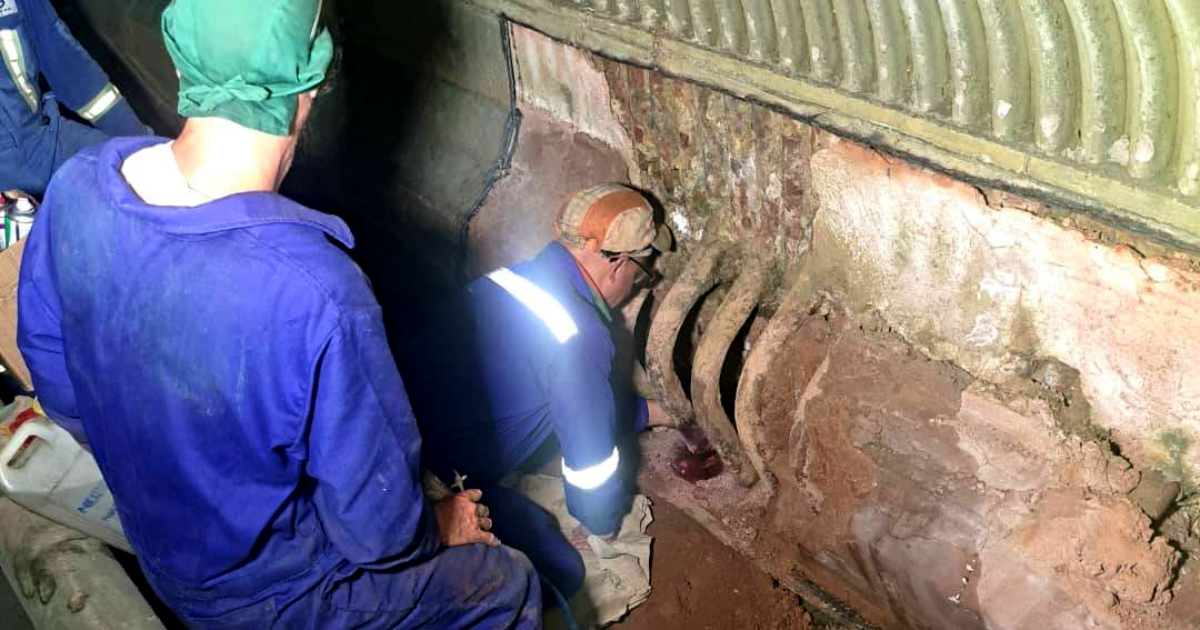
According to an update published by the plant itself, after completing the cooling process, it was possible to access the boiler, where the fault that had caused its recent shutdown was detected and repaired.
Subsequently, a pneumatic test was conducted, and it was specified that the boiler was being prepared for a hydraulic test as part of the technical protocol prior to synchronization.
Later, the UNE confirmed that the unit was "online" and generating power, which provides partial relief for the fragile national electrical system.
For the peak hours of this day, the state-owned company forecasted the entry of the Guiteras with 210 megawatts (MW), still in the startup process, as well as the incorporation of unit 2 of the Santa Cruz thermal power plant with 75 MW.
However, the overall situation remains critical. In its information note on the state of the National Electric System (SEN), the UNE acknowledged that the electrical service was disrupted throughout the previous day due to a capacity deficit, and that the situation persisted into the early hours of today. The highest recorded impact was 1,917 MW at 6:40 p.m.
For this Wednesday, an availability of 1,290 MW is expected against an estimated maximum demand of 3,050 MW, resulting in a deficit of 1,760 MW. If the expected conditions persist, the impact could reach up to 1,790 MW during peak nighttime hours.
At 6:00 a.m., the actual availability of the National Electric System (SEN) was 1,005 MW against a demand of 1,674 MW, with 703 MW already affected. For the midday period, an impact of 1,050 MW was estimated.
The official report also outlined multiple incidents: units in Mariel, Santa Cruz, Felton, and Renté remain out of service, in addition to the Guiteras unit during the startup process. Other units are undergoing scheduled maintenance, while 401 MW are offline due to thermal limitations.
Although photovoltaic generation contributed 4,349 MWh the previous day, with a maximum power of 824 MW at noon, this contribution is insufficient to offset the structural deficit of the system.
The reintegration of the Guiteras represents a temporary relief, but the operational instability and the significant gap between supply and demand confirm that the energy crisis continues to hit millions of Cubans hard.
La Guiteras: 13 days of maintenance, breakdowns, and failed synchronizations
The new online entry of the Antonio Guiteras thermoelectric plant does not occur in an operational vacuum, but rather after almost two weeks marked by outages, technical defects, and unstable reintegrations that have highlighted the fragility of the country's main thermal generation block.
On January 29, the plant was taken offline from the National Electroenergy System (SEN) for a scheduled preventive maintenance of 96 hours. The Electric Union (UNE) then presented the shutdown as part of the usual technical schedule.
However, in an electric system with structural deficits and prolonged blackouts, even a planned outage has an immediate impact on the population.
As his reinstatement was anticipated, on February 2, it was reported that a new defect had been detected in the structure known as the "Nodriza," located at the bottom of the boiler.
A hydraulic test revealed the problem, necessitating complex work within the furnace and delaying the start-up. The situation confirmed that, beyond the scheduled maintenance, the plant is dealing with accumulated deterioration.
Finally, on February 4, Guiteras managed to synchronize with the SEN and began generating around 100 MW, far from its estimated capacity of 250 MW. Its entry was presented as a partial relief amid a national availability significantly lower than the demand, which during those days exceeded 3,000 MW.
But the stability was short-lived. On February 9, just five days after synchronizing, the unit went offline again due to a crack in the boiler. The UNE did not provide any clear timelines for its reinstatement, as the electrical deficit continued to grow.
The sequence — maintenance, unforeseen defect, partial synchronization, and new malfunction — reflects a repeated pattern at Guiteras over the past few months: each attempt at stabilization uncovers new technical failures.
In a system where this plant represents the largest unit block of generation, its instability amplifies the national impact.
Therefore, the entry announced today should be understood within this recent cycle of failures and repairs, which keeps the operational sustainability of the SEN in suspense and directly affects the intensity of blackouts across the country.
Filed under: