
Related videos:
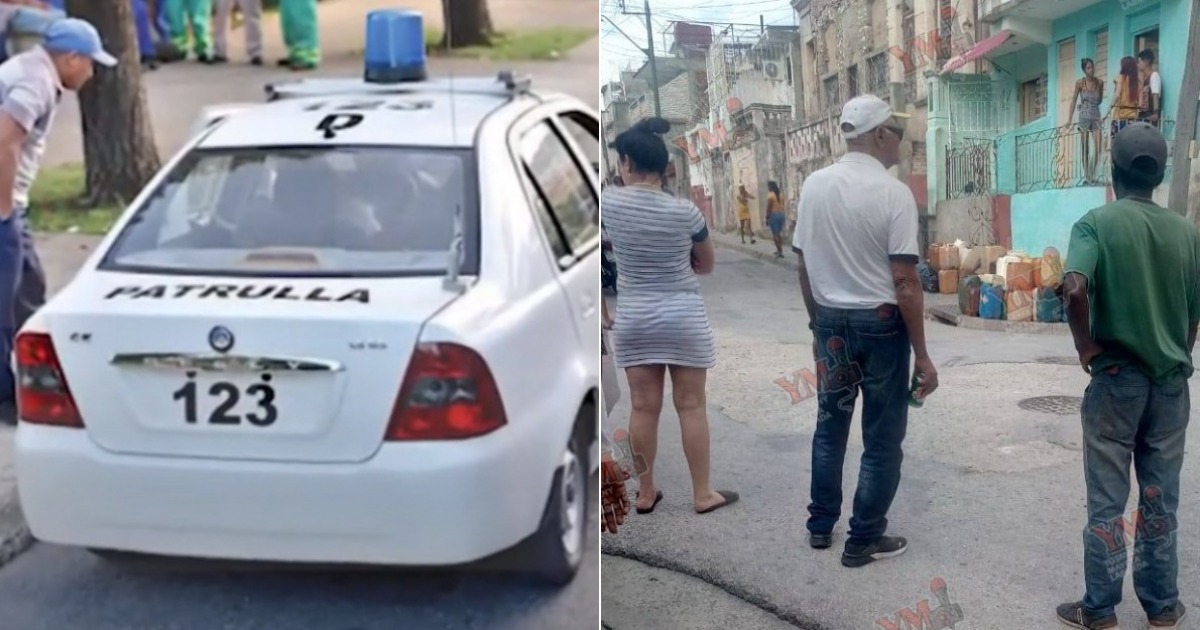
A large police operation was carried out on Monday on Mejorana Street, between Princesa and Santa Rosa, in the heart of Santiago de Cuba, in what residents describe as a significant intervention in at least two homes in the area.
The action, reported by independent communicator Yosmany Mayeta on Facebook, reportedly resulted in the seizure of several fuel containers - both full and empty.
The deployment of patrols and police left residents on edge, watching all the activity without receiving any official explanation.
According to various testimonies, the operation would be led by an officer identified as Maykel Sanz, allegedly linked to the DTI, although there is no public confirmation regarding the reasons for the operation or potential arrests.
Although initially tension and curiosity took over the neighbors, the presumption gradually spread that the intervention was aimed at curbing the illegal resale of fuel, amid a crisis that has left the country practically paralyzed.
The scene cannot be understood apart from the energy collapse and the shortages that Cuba is experiencing.
With a system unable to secure basic supplies for transportation, production, and services, gasoline has become a scarce and expensive commodity, and the informal market is proliferating in response to this shortage.
It's not new: when the state fails to organize distribution or ensure equitable access, informal networks step in, setting prohibitive prices and turning daily survival into an obstacle course.
The comments accompanying Mayeta Labrada's post reflect that discontent.
Several users agree that the root of the problem is not the existence of resellers, but rather the structural disorder that drives people to seek solutions outside of official channels.
An emigrant from the United States questioned the "spectacle" of police presence when fuel is sold in dollars and is only accessible to those who have family abroad and can obtain cards, which makes reselling a direct consequence of economic policy.
"That person surely had the chance to buy it in USD and sell it to those who can't acquire it. I don’t understand why they play that role when the culprit is the president, who is putting everything in dollars, a currency that doesn’t belong to the country," he emphasized.
Another highlighted the hypocrisy of the authorities: when there was fuel, no one was pursued; now that there isn't any, "it's about taking it from those they know have it to support their parasitic police."
There were also voices that called for organization before punishment.
A family man wrote that if the sale had been structured as established, "none of this would have occurred," emphasizing that the solution is not just to detain someone, but to "prevent their causes and conditions."
In that regard, a doctor summarized the feelings of many by stating that "the only ones authorized to steal are them (the government)," while the people "have to continue living in misery," a phrase that encapsulates the perception of impunity for those at the top and harshness for those at the bottom.
Other comments, on the other hand, welcomed the pursuit of those who profit from scarcity.
A user spoke of an "organized mafia" surrounding CUPET and the speculation on fuel prices, and called for action against these networks.
Even among those who applaud the operation, however, an uncomfortable truth emerges: without sufficient fuel and a transparent and efficient distribution system, the black market will continue to exist.
In that context, the deployment on Mejorana Street is not a solution to anything. The energy crisis cannot be resolved with isolated raids, but rather with policies that ensure supply, real control, and affordable prices.
Meanwhile, each police intervention is interpreted by many as confirmation that the state has lost its ability to manage the essentials and is now trying to contain, with an iron fist, the consequences of its own inefficiency.
Mayeta Labrada's publication concluded that it was "a developing story."
In the absence of official statements, it is evident that the image of police occupying gas canisters in homes in the center of Santiago adds to a series of similar scenes throughout the country: a nation halted by a lack of fuel, where daily life is tied to uncertainty, and where an economy drives those seeking to continue functioning into illegality.
Filed under: