
Related videos:
Amid the worst energy crisis Cuba has faced in decades, the maritime map around the Island woke up virtually empty.
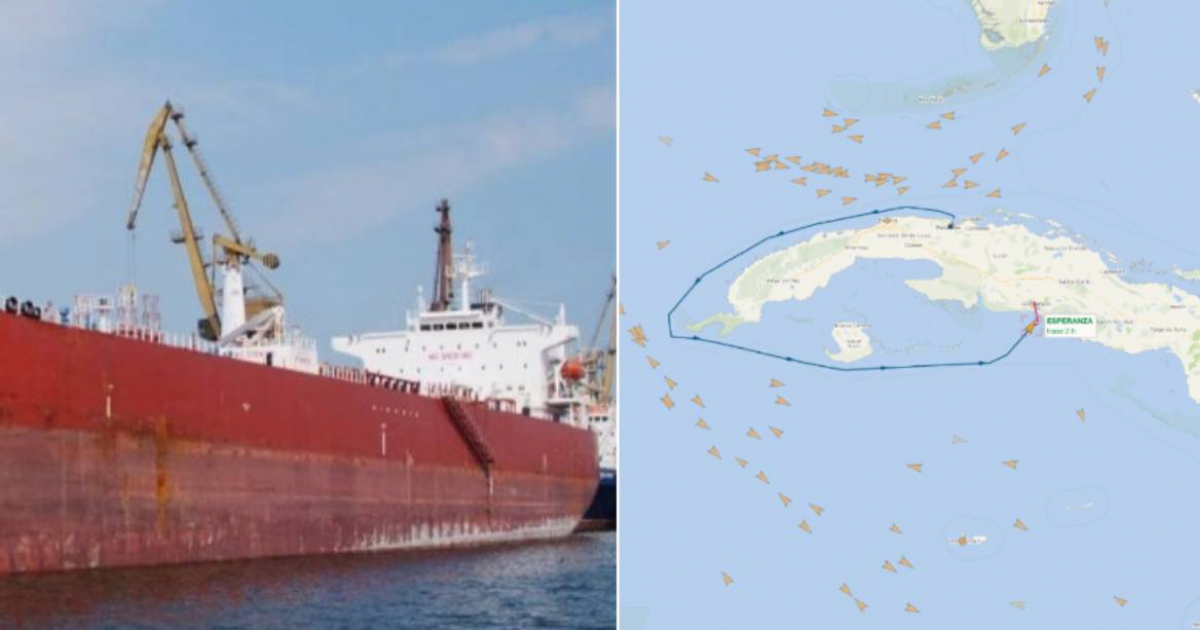
Naval monitoring data indicates that only one vessel is showing significant movement towards the port of Cienfuegos. This is the tanker Esperanza, a Cuban-flagged oil tanker sailing from Matanzas.
The information available on maritime tracking platforms like VesselFinder indicates that the Esperanza is a crude oil tanker built in 2005, measuring 213 meters in length, 32 meters in width, and currently has a draft of 9.2 meters.
The vessel is reported to be heading to Cienfuegos, Cuba, with an estimated time of arrival (ETA) on February 10 at 6:00 AM, following a coastal journey along the southern part of the country.
The recorded route shows that the tanker left Matanzas, the port where days earlier the oil tanker Sandino had docked, coming from the bay of Nipe in Holguín.
El Sandino would have unloaded between 390,000 and 410,000 barrels of fuel. There is no official confirmation, but it is likely that the Esperanza is transporting part of that shipment to the Cienfuegos refinery and the energy system in the central part of the country.
The Cuban government has not provided public information about the exact origin of the fuel, its type, the volumes transported, or the distribution plan.
In a context of blackouts lasting over 15 to 20 hours daily in large areas of the country, endless queues to obtain gasoline, and a virtually paralyzed public transport system, this silence strengthens the perception of opacity and poor state management.
Movement of the ship Esperanza in a delicate moment
During the first weeks of 2026, at least six vessels operated by the military conglomerate GAESA concentrated the last available reserves in Matanzas.
This was compounded by the diversion of the tanker Mia Grace, which departed from Togo bound for Cuba but ended up changing course towards the Dominican Republic, highlighting the regime's difficulties in securing supplies.
Experts agree that even a shipment close to 400,000 barrels cannot resolve the structural issues of the Cuban electrical system. The near-total dependence on imported fuels, the obsolescence of thermal power plants, and the lack of maintenance turn each arrival into a mere temporary fix.
Filed under: