
Related videos:
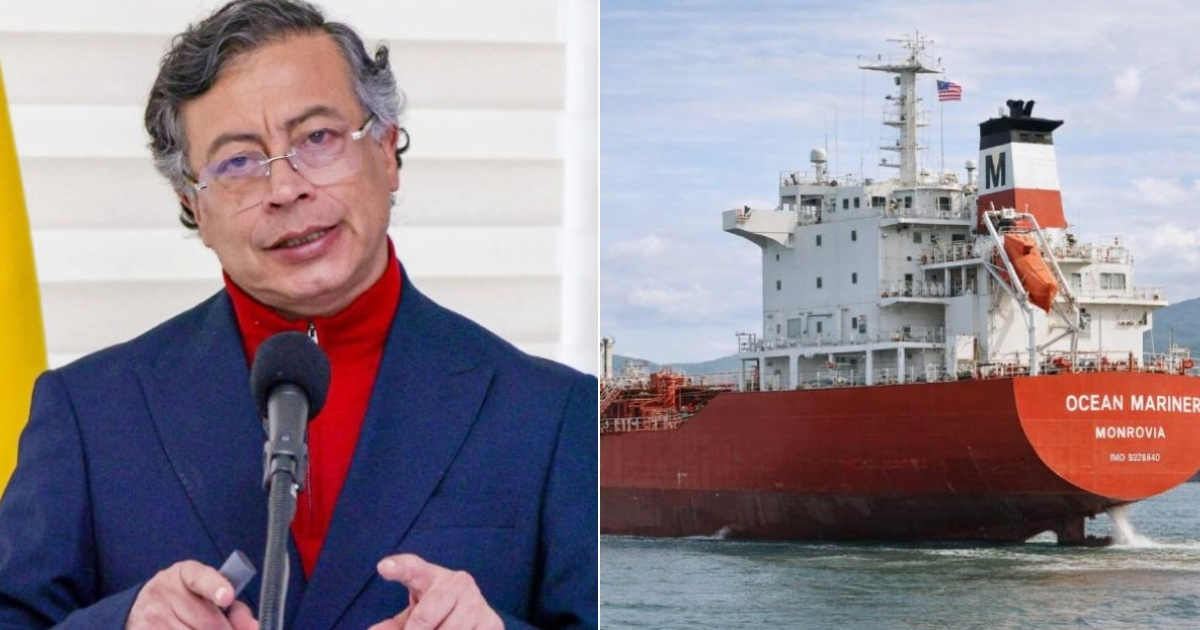
The Colombian president, Gustavo Petro, acknowledged this Sunday that a private company in his country loaded oil onto the ship Ocean Mariner, the tanker that was intercepted in recent days by the U.S. Coast Guard in the Caribbean after straying twice into waters near Cuba.
However, the president clarified that there was no irregularity, and rejected the notion that his Government acted as a "accomplice" of the island.
The controversy erupted after it was revealed that the ship— which had departed from a port near Barranquilla with a declared destination of the Dominican Republic— altered its course in the Caribbean, prompting intervention from U.S. authorities.
The episode took place amid President Donald Trump's warnings to impose tariffs on countries that sell crude oil to Cuba.
From his account on X, Petro has responded to the allegations made by journalist and presidential candidate, Vicky Dávila, who described his government as "corrupt and complicit."
“Accomplice of what?”, the leader first questioned.
Subsequently, he defended the legality of the operation, emphasizing that it was a private transaction.
“The one carrying the vessel is a private company, and that private oil company is given documents for the ship that purchases the oil, stating that it is headed for the Dominican Republic,” he pointed out.
Petro insisted that the Colombian state did not participate in the logistics or the sale of fuel, and rejected any irregularities: “There are no irregularities, either public or private, from Colombia.”
According to press reports, the commercial operation would have been agreed upon for about 6.9 million dollars, and the ship was inspected by customs authorities before departing.
However, off the coast of the Dominican Republic, the tanker performed maneuvers that brought it closer to Cuba, after which it was intercepted and escorted by the U.S. Coast Guard.
Defense of Cuba and criticism of the embargo
In his extensive message, the Colombian president not only addressed the commercial clarification but also took the opportunity to question the U.S. embargo on the island.
“The practice of one country blocking another only leads to genocide and extortion against the people,” he stated.
He also defended Cuba's role in international processes, stating: "I thank Cuba for collaborating with Norway for the peace of Colombia."
In that same vein, he recalled the production of Cuban vaccines during the pandemic: "Did you forget that Cuba produced a COVID vaccine on time and saved tens of thousands of lives around the world?"
Petro even went further by proposing a shift in U.S. policy toward Havana: “I invite the U.S. to change its policy toward Cuba and I urge it to launch a solar energy program across the island.”
A precedent in the same controversy
Hours before that central publication, the president had already spoken on X about the case, in another message in which he defended the free transportation of oil in the Caribbean and reiterated his commitment to replacing crude oil with solar energy as a regional energy cornerstone.
That statement marked the stance he would take before directly addressing the accusations of “complicity.”
The case of the Ocean Mariner occurs at a time of intense economic pressure on Cuba, which is facing fuel shortages and a profound internal crisis.
It also adds a new element of potential tension in trade relations in the Caribbean, in a context where Washington has intensified its rhetoric towards countries that maintain energy exchanges with the island.
Meanwhile, Petro maintains his position: the operation was private, there was no illegality, and the debate, in his opinion, should focus not on sanctions, but on cooperation and energy transition.
Filed under: