
Related videos:
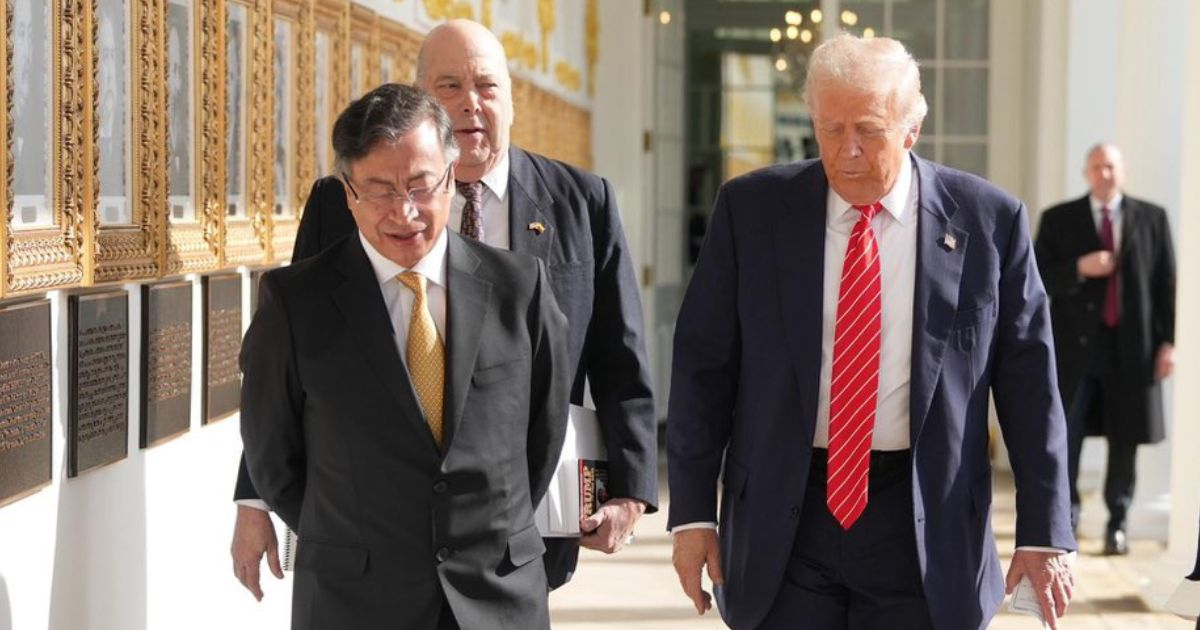
The President of Colombia, Gustavo Petro, held a meeting lasting over two hours with the President of the United States, Donald Trump, at the White House, where he proposed an ambitious joint strategy with Venezuela to combat drug trafficking in the region.
In an interview with Caracol Radio, Petro rated the meeting as “a nine out of ten” and emphasized the atmosphere of respect and mutual understanding between both leaders.
"It was a great honor, a frank and enriching dialogue," said the Colombian president, who remarked with a laugh that during the conversation "a rich Colombian tinto was served."
The meeting was attended by high-ranking officials from both governments. Colombia was represented by Foreign Minister Rosa Yolanda Villavicencio, Ambassador Daniel García-Peña, and Defense Minister Pedro Sánchez.
Accompanying Trump were Vice President J.D. Vance, Secretary of State Marco Rubio, and Ohio Senator Bernie Moreno, regarded as a key figure in the bilateral relationship.
One of the central topics of the meeting was Venezuela. Petro revealed that he proposed coordinating intelligence, police, and armed forces actions with the Venezuelan government to transform the Catatumbo area, currently dominated by coca crops, into a territory dedicated to food production and agribusiness.
According to him, the initiative aims to "defeat the enemies of change," reminding that more than 200 farmers have been killed during his term for opposing the interests of drug trafficking.
Petro assured that Trump understood and supported his proposal, especially regarding the economic revival of Venezuela through joint projects with Colombia.
The Colombian president also announced that there is a possibility of a combined operation between the Venezuelan and Colombian armies to capture ELN leaders who are taking refuge in Venezuelan territory.
"They are the ones who cause the most harm to Colombia and who have bowed down to drug trafficking," he stated.
Regarding his Total Peace policy, Petro rejected claims that drug trafficking has increased under his administration and presented a map that —as he explained— shows that coca cultivation expanded in 2021, before he took office, but has started to decrease since the second half of 2025.
The leader criticized forced eradications, calling them ineffective and costly, and defended a strategy based on voluntary eradication by rural communities.
He showed Trump videos of Afro-Colombian farmers on the border with Ecuador pulling coca plants out “by the roots” as an example of an alternative approach.
Petro insisted that the success of this policy depends on farmers taking the lead in the process.
"We either pull out the plants ourselves, or the drones will calcify us," he said, warning about the risk of mafia groups regaining control of the territory.
Filed under: