
Related videos:
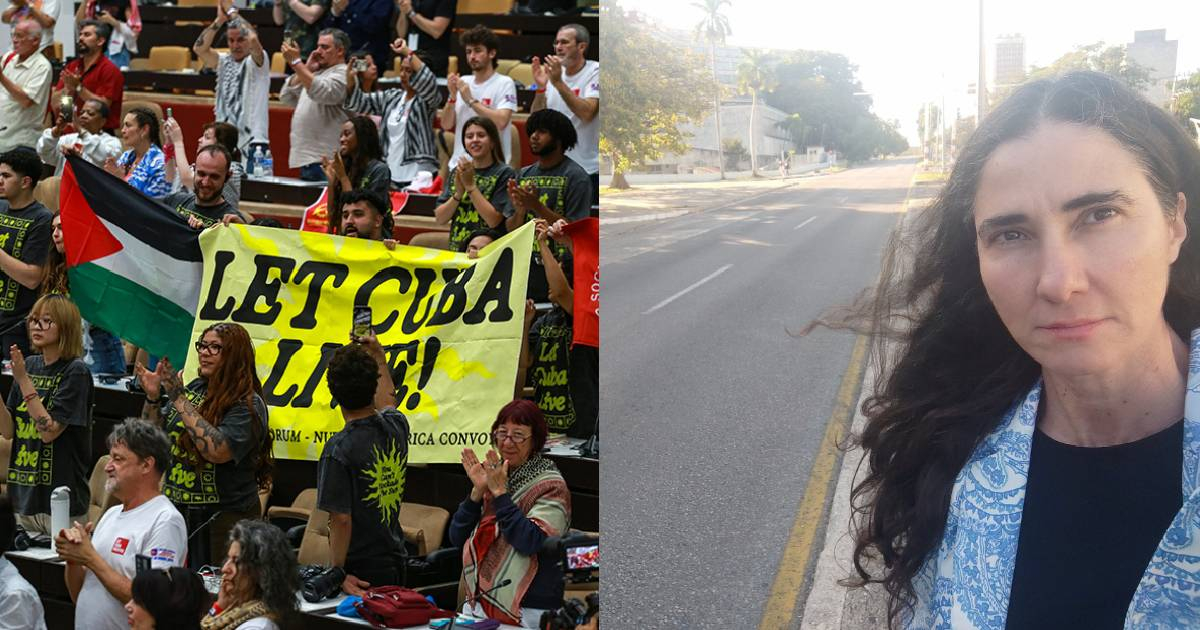
The Cuban journalist Yoani Sánchez stated this Saturday that Cuba is not a “theme park” and urged those who visit the island to defend the government to go “to engage in ideological tourism elsewhere.”
The director of the digital newspaper 14ymedio reacted on social media to the recent statements and visits by foreign activists and politicians who have defended the Cuban government during their stay on the island.
Through a message posted on social media platform X, the communicator issued a direct critique of those who use the Cuban scenario to promote ideological narratives while the population faces a profound economic and social crisis.
"We are not a theme park. Go do ideological tourism somewhere else. Here we are suffering," Sánchez wrote in his post, accompanied by the hashtags #Cuba and #SOSCuba.
His comment comes amid the presence in the country of activists and politicians linked to the so-called Convoy Nuestra América, an international initiative that promotes actions of solidarity with the Cuban government and recently held meetings with the ruling Miguel Díaz-Canel.
Visits and statements from some of those participants have sparked controversy among Cubans inside and outside the island, especially after European political figures downplayed the severity of the economic situation or attributed the crisis solely to external factors.
The debate has also extended to the intellectual realm. The Cuban musicologist and historian Rosa Marquetti questioned the media-driven nature of certain international solidarity initiatives with Cuba and denounced that many end up exploiting the country's crisis.
In a reflection published on social media, Marquetti recalled that for decades, churches and citizens have channeled humanitarian aid to Cuban communities without political prominence or media coverage.
According to the researcher, contributions of medicines, food, and clothing have arrived directly to parishes and communities in a discreet and consistent manner, in contrast to initiatives promoted by government-associated figures that receive extensive official promotion.
The intellectual also criticized what she termed the “folklorization of Cuban misery,” a narrative that, in her view, transforms the country's precariousness into an ideological symbol for foreign visitors who stay just a few days on the island without experiencing the real living conditions of the population.
"I'm tired of Cuba being viewed as the theme park of resistance," she emphasized.
The criticisms arise in the context of an increasing debate about how sectors of the international left are addressing the situation in Cuba.
Recent statements from Havana by the former leader of Podemos, Pablo Iglesias, who claimed that the country's situation "is difficult but not as it is presented from the outside," provoked reactions of rejection among many Cubans on social media.
A controversial video by Swedish climate activist Greta Thunberg also sparked debates, where she solely blamed the United States government for the crisis on the island and called for international support for the Cuban government.
For many citizens, this type of pronouncement disregards the everyday reality faced by Cubans and simplifies the complex crisis of the country to an ideological debate.
In that climate of discontent, Sánchez's message joins other voices that challenge the use of the Cuban crisis as a political stage by foreign visitors and demand that attention be focused on the real situation facing the population on the island.
Filed under: