
Related videos:
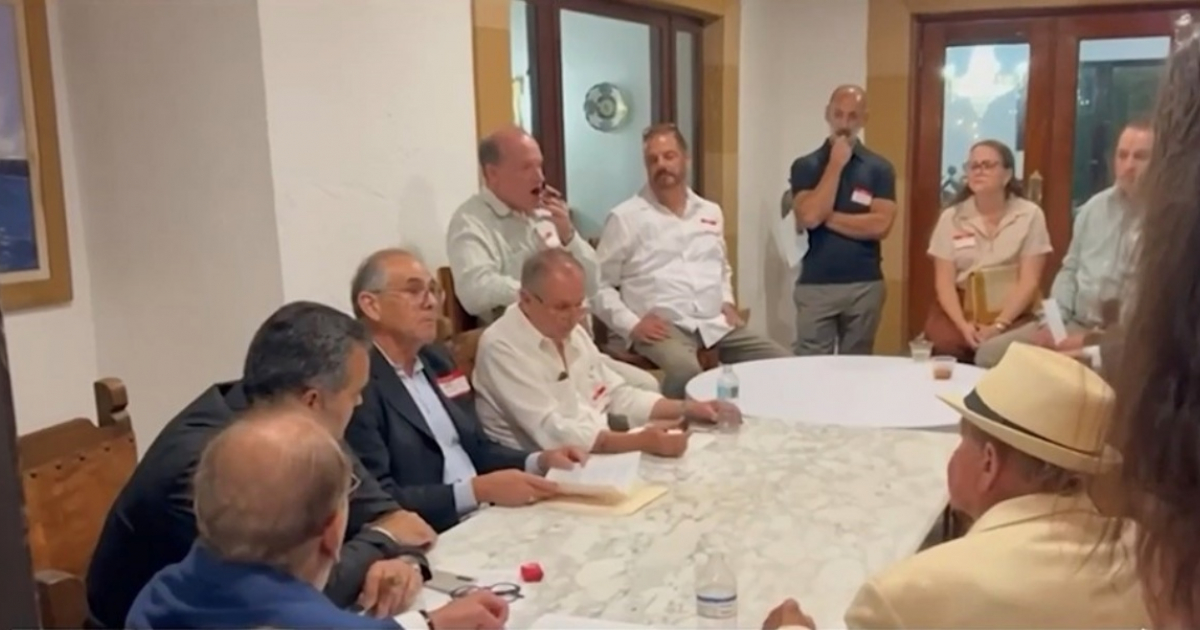
A group of influential Cuban-American businessmen met on Tuesday in Miami with a common goal: to design concrete strategies for the economic reconstruction of Cuba in a scenario of political change.
The meeting, described by its participants as the beginning of a broader process, was marked by a clear message: capital is available, but it is contingent upon the existence of democracy, legal security, and economic freedoms on the Island.
The event —covered by Telemundo 51 and other local media— brought together figures associated with the Republican Party such as Ernesto Rodríguez, Michael Fux, Omar Sixto, and Nick Gutiérrez, among other entrepreneurs with extensive backgrounds in the United States.
Everyone agrees that there will be no investments under the current Cuban political system, but they claim to have plans ready to act in the event of a transition.
Ernesto Rodríguez, an executive member of the organizing committee, explained the purpose of the meeting: it is to "support the Trump Administration for a real and effective change in a democratic Cuba." The businessman also noted that this will be just the first of several meetings: they anticipate at least three additional meetings and hope that the current Secretary of State, Marco Rubio, will participate in the last one.
The meeting sparked great interest among the attendees, several of whom expressed their willingness to invest million-dollar sums in the Island, always under clear political conditions.
In that regard, Michael Fux—an entrepreneur born in Havana who emigrated in 1958 and built his fortune in the mattress industry—went so far as to suggest the need for initial support from the United States in a transition scenario.
“At least until Cuba gets fixed. Once it gets fixed, I believe it can continue on its own, because it did so long before Castro and can do it again,” Fux stated, referring to the country's historical ability to sustain its economy without the current political model.
The demand for a solid legal framework was one of the most frequently mentioned points during the meeting. Omar Sixto was categorical in establishing the minimum conditions for any investment from the exile:
"If Cuba becomes free and sovereign and there is a Constitution that protects private enterprise, the Cuban-American exile community will be united with the Cuban nationals who wish to start businesses. And that is the essence of today's meeting."
His statements represent a direct rejection of recent attempts by the regime to attract capital from the exiled community without structural changes, such as the proposal by Cuban Deputy Prime Minister Oscar Pérez-Oliva to open certain spaces for investment from Cubans living abroad.
Another participant, attorney Nick Gutiérrez, a specialist in claims for assets confiscated after the Revolution, emphasized the historic nature of the political moment that, in his view, Cuba may be experiencing.
“I am relatively a newcomer to this topic,” he acknowledged. “There are people here much older than me who have longed for seven decades for what is happening now. The freedom of the Cuban people is close. It is the first time I can say that, and I have been involved in this issue for at least 35 years.”
Gutiérrez also openly defended the role of the current U.S. administration in increasing pressure on Havana:
"Now we have an Administration that has helped us more than any other. We have not yet won, and there are people, both within and outside this Administration, who support and oppose our ideals. We must remain steadfast to our ideals, which are not radical. We are not asking for anything special, no special privilege. We are asking for the same as what the majority of the people in the world enjoy: democracy, freedom, and the rule of law."
The political nature of the meeting was also reflected in its composition. When asked about the absence of businesspeople connected to the Democratic Party, Ernesto Rodríguez clarified that the invitation was specifically directed at conservative profiles, although he did not rule out future additions.
“We are looking, through the Trump Administration, for strong economic support to place our nation, the Island that we cherish so much, where it should have been a long time ago, and for that we need resources,” he explained.
The overall atmosphere of the meeting was described as optimistic, with a shared vision of national reconstruction.
Lawyer José Villalobos encapsulated that collective sentiment:
"I believe the meeting is very positive; there is a great deal of interest in making progress and a strong desire to rebuild the Cuba that we fled from."
Participants agreed that the reconstruction of Cuba will require not only capital but also profound transformations: from the creation of a modern financial infrastructure to a shift in the economic mindset within society.
The meeting takes place against a backdrop of intense political and economic pressure from Washington on the Cuban regime, with recent measures that have affected the Island's energy supply and intensified the debate about a potential system change.
Meanwhile, the meeting coincided with a controversy in Miami regarding the authorization of fuel exports from the United States to the Cuban private sector, a measure promoted by the Trump Administration and supported by some companies in Florida, including that of Cuban-American Hugo Cancio, an advocate for a negotiation approach without preconditions with the government of Havana.
However, the entrepreneurs gathered in Miami distanced themselves from that approach. Their message was clear: the investment from the diaspora will not be a lifeline for the current system, but rather a bet on a future Cuba that is free and governed by clear rules.
In summary, the diagnosis is shared among the participants: money exists, strategies are underway, and business willingness is ready. But everything is contingent on a fundamental condition: the end of the current political model on the Island.
Filed under: