
Related videos:
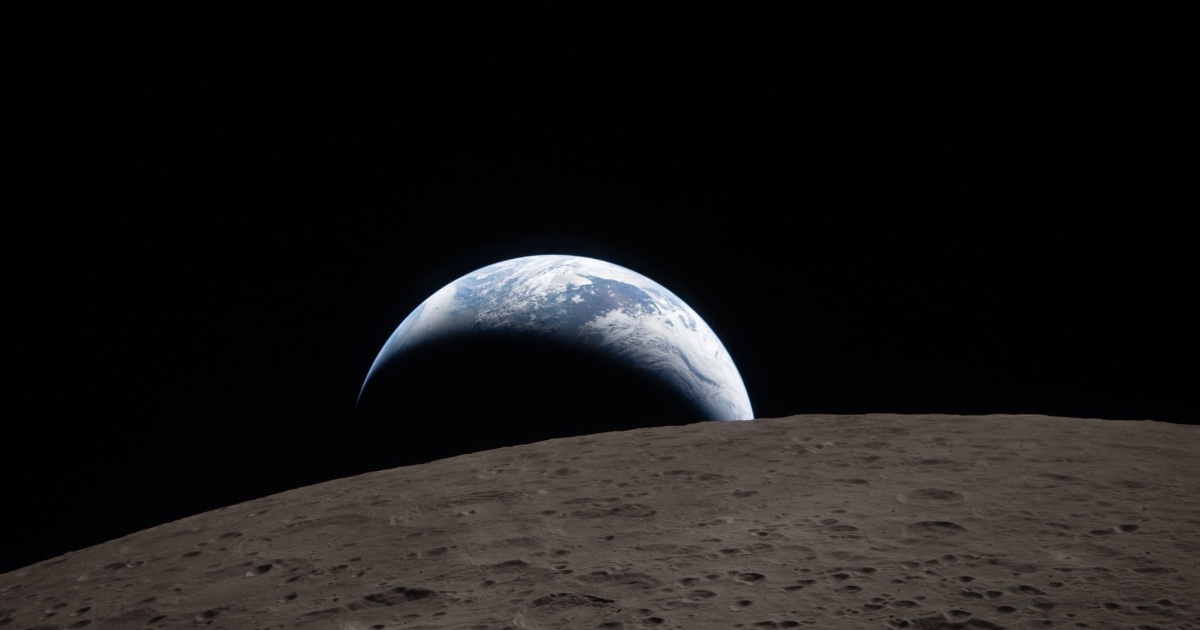
The NASA captured an unprecedented image called "Earthset": the Earth sinking behind the lunar horizon as seen from the far side of the Moon, taken aboard the Orion spacecraft of the Artemis II mission.
The White House published the photograph today on X with the text: "EARTHSET. April 6, 2026. Humanity, from the other side. First photograph from the far side of the Moon. Captured from Orion while the Earth sinks below the lunar horizon. Photo: NASA". The post was reshared by President Donald Trump.
The image shows the gray, cratered surface of the Moon in the foreground, with the Earth in a waxing phase, displaying white clouds, blue oceans, and a bluish atmospheric halo, set against an absolute black background of space.
It is the first photograph of this kind taken by a crewed human mission from the far side of the Moon, the side that is never visible from Earth and where spacecraft lose direct communication with the planet.
The term "Earthset" is the opposite phenomenon to the famous "Earthrise" captured by astronaut William Anders during the Apollo 8 mission on December 24, 1968, regarded as one of the most influential photographs in history. While the former depicted the Earth rising over the lunar horizon, this one shows it disappearing behind it, from the side that had never been photographed by humans from a crewed spacecraft before.
Before this mission, only robotic probes like the Chinese Chang'e-4 had photographed that region of the Moon.
On the same day the image was captured, Artemis II set the record for the longest distance traveled by humans from Earth, reaching 406,773 kilometers at 7:07 p.m. UTC, surpassing the 56-year record of Apollo 13.
During the lunar flyby, the spacecraft came within 6,543 kilometers of the surface and lost communication with Earth for about 40 minutes while passing behind the far side.
The crew of Orion, named "Integrity", consists of commander Reid Wiseman, pilot Victor Glover —the first African American astronaut on a crewed lunar mission—, mission specialist Christina Koch —the first woman to participate in such a mission— and Canadian Jeremy Hansen, the first from his country to travel to the Moon.
The first crewed mission close to the Moon since Apollo 17 in December 1972, more than fifty years later, does not include a lunar landing: its goal is to validate the systems of the Orion capsule with human crew in preparation for Artemis III, which aims to take humans to the lunar south pole in 2027.
"Now we are falling toward the Moon... It's an incredible milestone that people can relate to", Koch stated as the record for distance was set.
Filed under: