
Related videos:
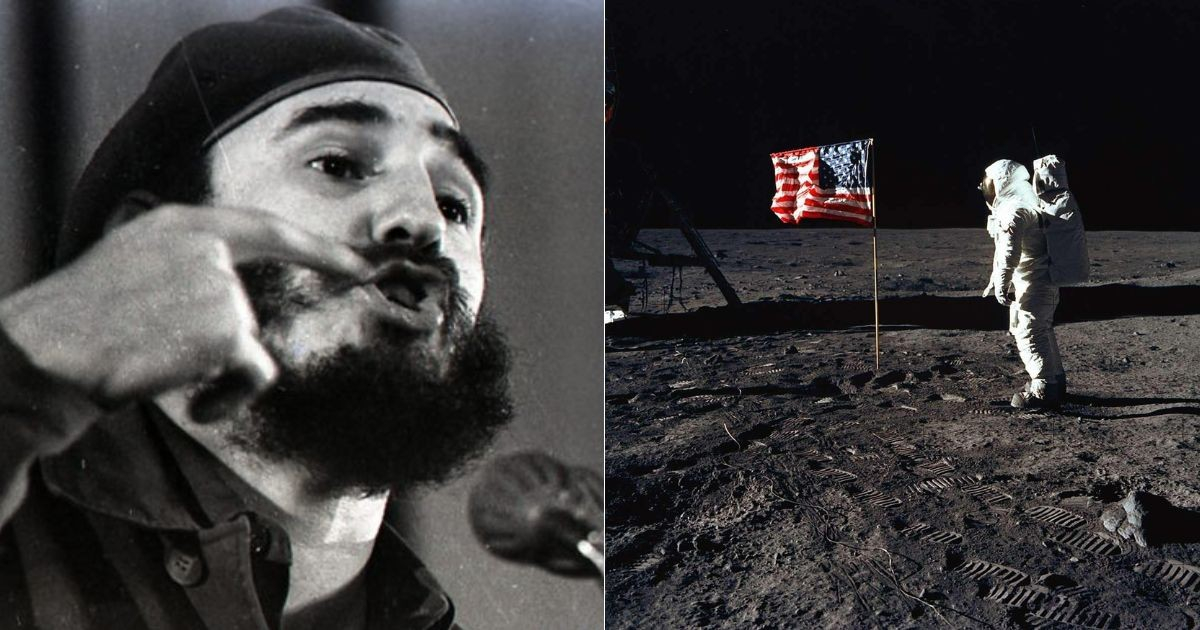
The regime of Fidel Castro censored the live broadcast of the Apollo 11 moon landing on July 21, 1969, as recounted in a recent testimony by Cuban screenwriter, producer, and writer Eugenio Antonio "Yin" Pedraza Ginori, former director of television programs on the Island. Thus, Pedraza noted, the people of the nation were prevented from witnessing one of the greatest milestones in human history.
The testimony, extracted from the first volume of his book Memorias Cubanas, was published on the occasion of the NASA's Artemis II mission, launched this past Tuesday with four astronauts on board: "The matter is being widely covered in all the world's news outlets, except those in Cuba," wrote Pedraza, pointing out that the pattern of censorship from 1969 is repeating itself to this day.
"The broadcast of this historical event, viewed live by millions of viewers across all continents, was withheld from the Cuban people. It was decided, for obvious political reasons, that our people would not be able to see that achievement of science," the author recounts.
Days before the moon landing, the management of the Cuban Institute of Broadcasting (ICR) set up a satellite viewing station on the sixth floor of Radiocentro, featuring American television signals, which was accessible only to a select group of privileged individuals. On the day of the event, the hallway door was locked and guarded by an employee from the National Television News, as recalled by the experienced writer.
"They closed the hallway door and placed a loyal guard there who made every effort to prevent us from passing," describes Pedraza Ginori. Those who wanted to follow the Apollo 11 mission had to do so clandestinely, tuning into The Voice of the United States of America or other shortwave stations, he noted.
In the comments on her post, several users recounted how, in a few rare Cuban households equipped with homemade and clandestine television antennas, they managed to watch the event. This demonstrates that, alongside the strict censorship, irreverent mechanisms have always emerged to circumvent it, even at the risk of being discovered and repressed. Notably, one can mention the "juggling" many have done in the country to watch Major League Baseball games, which have been censored for decades.
Months after the moon landing, in October 1969, Pedraza Ginori recounts that he was tasked with directing the program "Tuesday Panel – The Conquest of the Cosmos," in which the moon landing was mentioned only in passing and downplayed, while emphasizing Soviet achievements in the space race. The ICR once again refused: this time it denied permission to use the video of the moon landing in the program.
The guest specialist, Engineer Luis Larragoiti Alonso, from the Astronomy Group of the Academy of Sciences of Cuba, brought to the study a special edition of the magazine Life from August 11, 1969, featuring an extensive photographic report on the Apollo 11 mission. "Like almost all the Cuban people, we had never seen those images," the author recalls. The magazine mysteriously vanished during the recording, which triggered an investigation with interrogations at the militia garrison of all participants.
"It was considered internally a matter of utmost seriousness, practically sabotage that called into question the security of Radiocentro," recalled Pedraza Ginori. The case was closed without resolution.
The testimony illustrates a pattern of structural censorship that the Cuban regime has maintained since 1959, when it closed independent newspapers such as Prensa Libre and Diario de la Marina and centralized all media under the control of the Communist Party. During the Cold War, the Soviet achievements in the space race received extensive coverage in Cuban media, while American accomplishments were minimized or silenced. The landing of Apollo 11, the greatest propaganda triumph for the United States in that field, was politically uncomfortable for the regime allied with Moscow.
Today, Artemis II —the first crewed mission to the Moon in over fifty years— is progressing on its ten-day journey around the natural satellite, with a landing expected on April 10 in the Pacific. This Sunday, its crew captured a photograph of the Orientale basin, a lunar geological formation measuring 930 kilometers that has never been seen in its entirety by human eyes.
With internet on their cell phones, even in the poor connection conditions of the Island, Cubans manage as best they can to stay informed about this and other events. The regime's power of censorship is cracking for the better with the unstoppable new technologies.
Filed under: