
Related videos:
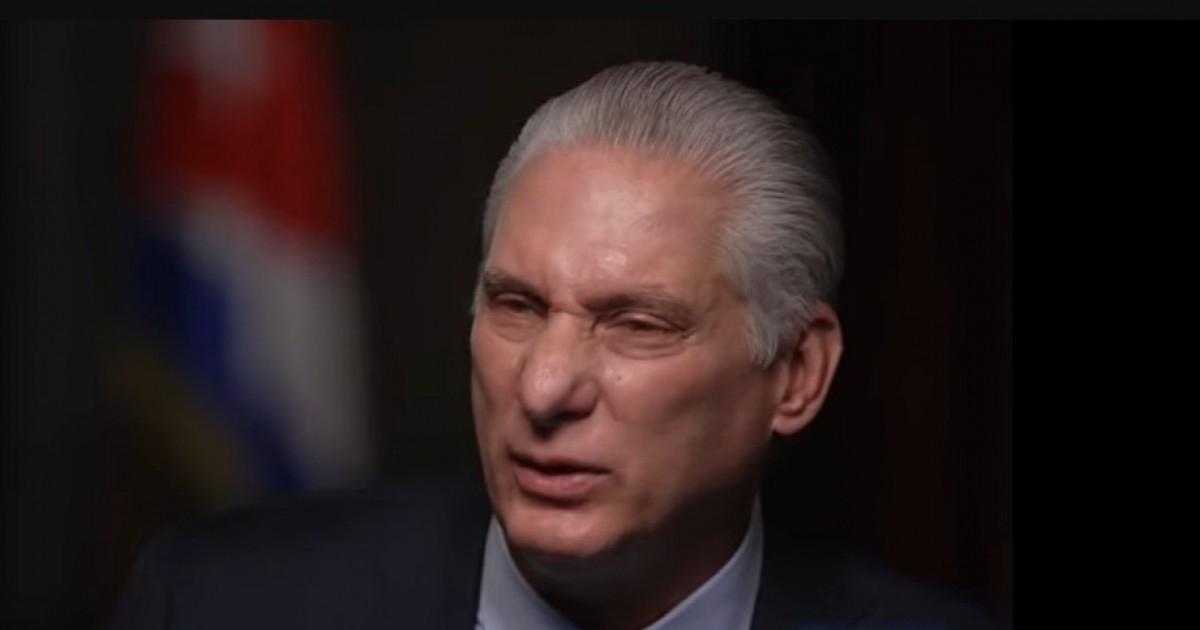
Miguel Díaz-Canel stated that the United States government lacks the moral authority to demand anything from Cuba and urged for an unconditional dialogue, in comments made on the program "Meet the Press," from the American broadcaster NBC News, recorded in Havana.
This appearance of the Cuban leader comes at a time of maximum pressure from the Trump administration on the regime.
Díaz-Canel expressed that those in leadership positions in Cuba are not elected individuals and do not respond to the interests of the United States. "We are a free and sovereign state, with self-determination and independence, and we are not subject to the designs of the United States."
"The United States government, which has implemented a hostile policy against Cuba, has no moral authority to demand anything. It has no moral authority even to say that it is concerned about the situation of the Cuban people or that the Cuban government has led the country to this situation, when they bear significant responsibility," he noted.
He then concluded his argument by urging Washington to be "willing to engage in dialogue and discuss any topic without conditions, without demanding changes to our political system, just as we do not demand changes to the American system."
The first segment of the interview aired on Thursday at 4:00 PM, and the extended version is scheduled for Sunday at the same time.
The most tense moment came when journalist Kristen Welker asked Díaz-Canel if he would be willing to resign "to save Cuba," referring to Washington's demands for political change on the Island.
He responded with visible irritation: "Have you asked that question to any other president in the world? Could you ask President Trump that question? Is this your question, or does it come from the U.S. State Department?" he said.
After the exchange, Díaz-Canel was categorical: "When we take on a leadership responsibility, we do so as a mandate from the people. The concept that revolutionaries abandon or resign is not part of our vocabulary."
He conditioned his eventual departure from power on the decision of the people and assured that he would only be accountable to the Cubans and not to Washington.
"If the Cuban people believe that I am not fit for the position, that I have not lived up to expectations, then I should not hold the presidency. I will be accountable to them," he added.
Immediately afterward, he invoked a supposed popular legitimacy: "We are elected by the people, even though there is a narrative that seeks to deny it."
That statement clashes directly with the reality of the Cuban political system: the Communist Party is the only legal political organization, constitutionally recognized as the "superior leading force" of the State. There are no opposition parties, electoral campaigns, or independent press.
The Cuban people do not have real power to decide who governs them.
While Díaz-Canel spoke of popular mandate before the cameras of NBC, Cuba is experiencing its largest wave of protests since July 11, 2021. Since March 6, 2026, at least 156 demonstrations have been documented across various provinces, featuring pot-banging, roadblocks, and attacks on Communist Party headquarters. On the same Thursday, protests were reported in Guantánamo with a deployment of black berets and plainclothes police.
The Cuban Observatory of Conflicts recorded 11,268 protests, complaints, and criticisms of the regime in 2025. In January alone, 953 critical expressions were counted, the highest monthly figure in history.
The crisis is both economic and energy-related: the Cuban GDP has fallen by 23% since 2019, with an additional contraction projected at 7.2% for 2026. The Island is experiencing blackouts of up to 22 hours daily, exacerbated by the interruption of subsidized Venezuelan oil supplies that sustained the regime for more than twenty years. More than 600,000 Cubans have emigrated since 2022.
The interview generated an avalanche of reactions among Cubans both on and off the Island. "He is not used to being asked unscripted questions", wrote a user on social media. "The problem is not the question; it's that there is no answer," noted another.
Filed under: