
Related videos:
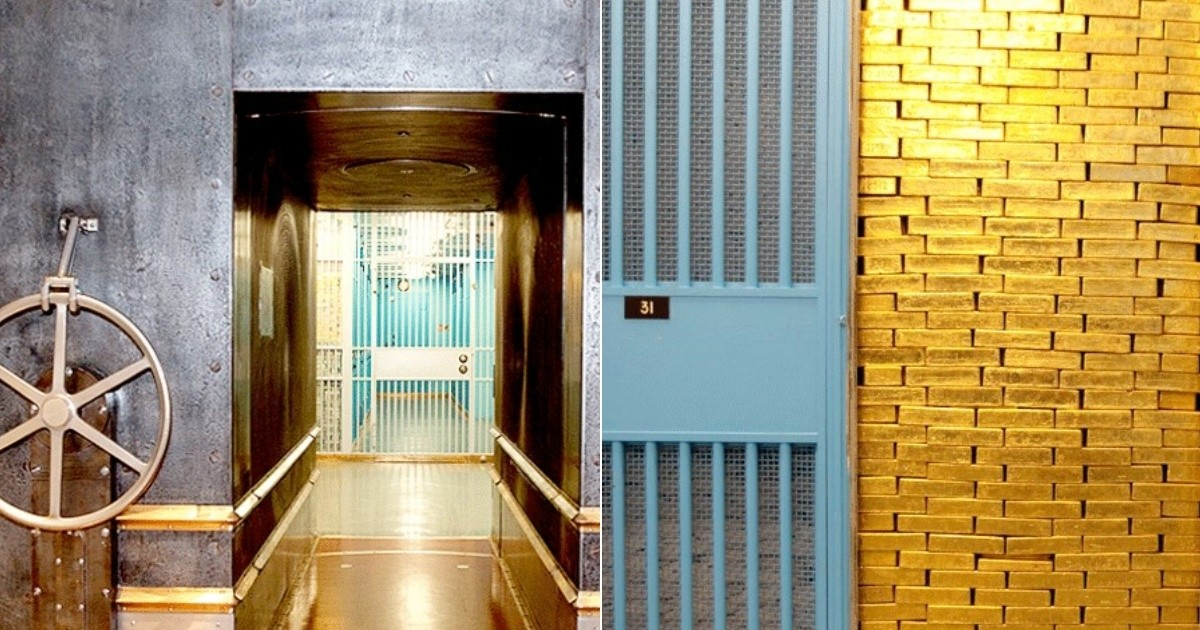
At a depth of 25 meters underground, in the heart of Manhattan, New York, a massive vault protects one of the world's most strategic treasures: the gold from dozens of countries.
For decades, this place was a symbol of trust in the financial leadership of the United States.
Today, however, it has also become the center of a growing debate in Europe about whether that gold should return home.
The largest gold deposit in the world
In Liberty Street in New York, in the basement of the Federal Reserve, is the well-known Gold Vault.
There lie more than half a million bars belonging to central banks, governments, and international institutions.
According to the BBC, this deposit holds about 6,300 tons of gold, valued at over a trillion dollars, which is approximately equivalent to 4% of the Gross Domestic Product of the United States.
Security is extreme: the camera is protected by a 90-ton steel cylinder whose lock, once activated, cannot be opened until the next day.
More than a warehouse, this vault has been a key component of the global financial system for decades.
Gold continues to be regarded as the ultimate safe-haven asset in times of crisis, inflation, or geopolitical tensions.
The economist Barry Eichengreen, an expert in the international monetary system, explains it clearly: “It is one of their most important assets because, in the face of adverse geopolitical events, it allows them to act as lenders of last resort for banks and companies and to intervene in the foreign exchange markets.”
How European gold made its way to New York
The massive presence of European gold in the United States is not a coincidence. It dates back to the post-war period and the economic order that emerged after World War II.
Starting in the 1950s, economies like the German one began to amass large reserves due to their exports.
“Germany and other European countries whose economies were recovering were increasingly exporting to the United States and receiving payments in a combination of gold and dollars,” explains Eichengreen.
Transporting that gold to Europe involved high costs and risks. For this reason, many countries chose to leave it in New York.
“It costs money to put gold on a ship or a plane and hire insurance to protect the shipment, so it seemed like a good idea to store it in the vault of the Federal Reserve, which also doesn't charge for custody,” adds the expert.
This economic factor was joined by a key geopolitical one: the Cold War.
With the Soviet Union as a threat, keeping gold on U.S. soil provided an additional guarantee of security.
From trust to mistrust
For decades, that decision went unchallenged. However, the context has changed.
The return of Donald Trump to the White House has reignited tensions with European allies over trade, military, and territorial issues.
These tensions have raised concerns about the safety and access to the gold reserves held in the U.S.
In Germany, one of the most exposed countries, the debate is becoming increasingly visible.
The economist Emanuel Mönch has warned: “Given the current geopolitical situation, it seems risky to hold so much gold in the United States”; this refers to the approximately 1,200 tons that the Bundesbank holds in New York.
More emphatic was Michael Jäger, president of the German Taxpayers Association: “Trump is unpredictable and capable of anything to generate revenue. That’s why our gold is no longer safe in the Fed's vault.”
It has even raised scenarios of diplomatic tension: "What would happen if the provocation over Greenland continues?... The risk increases that the Bundesbank may not be able to access its gold."
France takes a decisive step
The debate is not just theoretical. France has gone further.
Recently, the Bank of France completed the total withdrawal of its reserves stored in New York, through a financial strategy that avoided the massive physical transport of bars.
Instead, he sold the gold on the U.S. market and acquired new bars in Europe.
The result was twofold: on one hand, it concentrated its 2,437 tons in Paris; on the other, it achieved million-dollar profits in a context of high metal prices.
Although the governor of the central bank, François Villeroy de Galhau, assured that the decision was not "politically motivated," the organization itself acknowledged that the process accelerated with Trump's return.
This movement has been interpreted by analysts as a possible turning point.
The French precedent adds to previous decisions such as that of the Netherlands in 2014, or the partial repatriation by Germany in the same decade.
The historical precedent that worries Europe
Current doubts also have historical roots.
In the 1960s, French President Charles de Gaulle decided to repatriate his country's gold out of fear of a devaluation of the dollar.
His decision proved to be correct: in 1971, Richard Nixon ended the convertibility of the dollar into gold, dismantling the Bretton Woods system.
France, having already regained its reserves, managed to avoid part of the impact that affected other countries with gold stored in the United States.
That episode continues to resonate today in Europe as a warning that international financial balances can change abruptly.
Is it feasible to repatriate the gold?
Despite the growing doubts, repatriation is not a simple decision.
Moving thousands of tons of gold involves immense logistical challenges, high costs, and security risks.
Moreover, some experts warn that a massive withdrawal could be interpreted as a sign of distrust and generate unnecessary tensions.
The economist Clemens Fuest believes that repatriating gold “would only add fuel to the fire of the current situation.”
Others emphasize that the independence of the Federal Reserve serves as a safeguard against potential political decisions by the U.S. government.
However, that confidence is not unanimous.
Eichengreen acknowledges the lack of clear signals from Washington: “I haven’t heard any reassuring words, and I believe they would be timely.”
A symbol of a changing order
Beyond logistics or politics, the debate over gold reflects a deeper change.
For decades, the United States provided key services to the international system at no cost, from safeguarding reserves to the role of the dollar as a global currency. However, that model appears to be under pressure.
Eichengreen summarizes it this way: the custody of gold has been “a global good that the United States has provided for free (…) in exchange for making friends and commercial partners.”
However, he warns that "anything that feeds allies' doubts about the safety of their deposits in the United States further erodes their goodwill toward the country."
So far, no major European country - beyond the French case - has announced a massive withdrawal of its gold.
However, the debate is growing alongside global uncertainty.
In this context, the words of the President of the European Central Bank, Christine Lagarde, gain importance: “In the history of the international monetary system, there are moments when the foundations that seemed unshakeable begin to wobble.”
The vault in New York remains closed, protected by tons of steel. However, outside of it, the confidence that made it the largest gold repository in the world no longer seems as solid as before.
Filed under: