
Related videos:
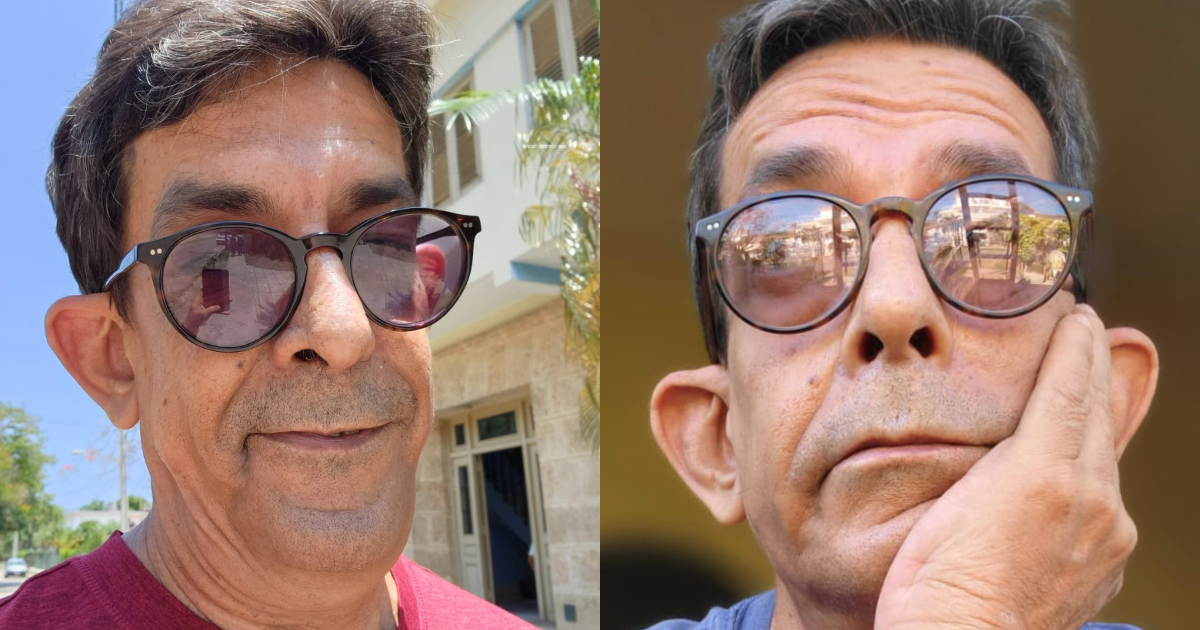
CiberCuba would have liked to interview Cuban comedian Ulises Toirac for the program Transición en Cuba, but the connection with the Island makes everything challenging, and we have had to settle for the answers to a questionnaire that we would have preferred to discuss live.
In statements to CiberCuba, Toirac rejects the idea of a military intervention in Cuba and questions the expectation that change must come from outside. He also asserts that the Cuban case cannot be compared to Venezuela and doubts any real progress in the dialogue between the United States and the Cuban regime. From Havana, he perceives a country without a clear direction and admits that, for the first time, he does not rule out the possibility of leaving.
Many Cubans in exile are feeling down because it seemed that change in Cuba was just a matter of days, but it has stalled, and it looks like we'll have to postpone our dreams and celebrations. How do you see and experience this from the Island? What is hope or despair like during a blackout?
Betting on a change based on military intervention from Cuba seems to me, personally, to be absurd. For several reasons, in addition to the danger that a war represents. Perfect military operations do not exist when there is an opponent. In Cuba, there will be military opposition.
But regardless of that (which many do not understand and see as depicted in movies and series, from the comfort of a massage chair), there is something deeper and more complex. It is the maturity required to embark on a path different from the one our country has followed thus far. It is true that it is a disaster and that it brutally stifles the economy and freedom. However, simply waiting for others to take the necessary steps to achieve freedom makes it clear how little capacity we have to know what to do with it afterwards.
It's a complex issue. I believe that conditions could eventually arise that lead to something of that nature. And I think it would be the only way to prevent an epic humanitarian disaster. However, I find it very unlikely, and in my personal opinion, I wouldn't wish for it.
"Here they come" is an old longing. And each time a crisis arises, "it's just around the corner." Yet that corner remains as distant as the first time it was mentioned.
Are you one of those who wants a change at any cost, even if it means going down a route like Delcy Rodríguez, or do you prefer a clean slate? Do you believe we are in a position to choose?
I was telling you that it's complex. Drawing parallels with other experiences is not serious. Neither Venezuela, nor Iran, nor Panama have a history or circumstances similar to Cuba. Thinking about solutions and, especially, about similar results is not logical.
The Cuban process is the most complex and significant. We are talking about a society that emerged in the sixties in response to a historical moment when the left and guerrilla movements in Latin America, Asia, and Africa were at their peak. The social movements for racial equality in the U.S., the hippie movement... Amid all this, Fidel's triumph, the Bay of Pigs, the Missile Crisis... The Cuban Revolution became a paradigm. The results of attempting to perpetuate the immense symbol it became can explain the labyrinth and the estrangement and divorce of the country's leadership from concrete realities.
None of this is common to any other experience anywhere else on Earth. And it is something we must be clear about.
What do you think the Marco Rubio team might discuss with El Cangrejo? How do you envision that negotiation?
No clue at all. And I’ve come to think that it’s a psychological warfare tactic and that the negotiations don’t actually exist.
In an era of artificial intelligence, lies from political spheres, disclosures aimed solely at manipulating statistics, and diminished analytical capacity... everything becomes fictional and one must verify a lot of information. And yet, you can still end up with the short end of the stick.
In my opinion, neither party in this case is in a position of complete freedom and maturity to find comprehensive and definitive solutions to the disagreement. I do not see it happening.
Josefina Vidal has told AFP that the "dialogue" with the U.S. is in a "very preliminary" phase, and we have seen signals from both sides, but none that are significant: a Russian ship, a pardon for 2,010 prisoners, for example. Why do you think the talks are not progressing? What do you believe is the obstacle?
It is an "approach" between two animals that distrust each other, having spent their entire evolutionary period attacking one another. With languages from different galaxies...
The obstacle is that, and I believe, a distorted view of the Cuban reality on both sides. Those who were supposed to provide relevant and objective data to the leaders convey more wishes than realities. There are many interests to safeguard. Many powers for whom the current status quo is convenient. Even if they think otherwise, that they desire something different. The reality is that "something different" takes them out of the game.
What do we do with those who represent a burden for the negotiations between Cuba and the U.S.? Where do we begin?
The question should be what we do with those who represent a burden for the country's development. To be able to undertake viable paths for growth.
I am no longer the optimist I was seven years ago regarding whether we were still in time to catch the necessary bus. Now we are in a "confrontation." The possibility of catching any bus is gone. Let me give you just one example: assuming all resources were available to develop an energy industry capable of meeting a peak demand of 3,500 MW, it would take years (at least until 2031) for production to meet national demand. I believe there is no time for that. The social situation is explosive concerning the issue of electricity. And we haven't even entered the summer of 2026 yet...
What to do? In an environment as polarized as the one we live in, with no clear leadership in sight to tackle the monumental task of reviving this country? I don't know.
You haven't missed a single crisis in Cuba. You've lived through them all. Why? When can we expect a memoir?
All of them... In the audience. I've explained this before: the sacrifice of leaving for another country to live (better) from my talent and effort was outweighed by several factors: nearly all my family lived and still lives in Cuba, I had stable employment, my own home, and that additional benefit of walking the same streets I've known since childhood and receiving the warmth of the people at every turn.
I attempt to write a memoir in my own way. There is a saga of a first published collection of stories: "Locos de barrio," available for sale on Amazon and other sites, followed by a second volume that, at the time of this interview, is in the final layout stage of preparation, and a third volume that is already about 30% of its final length. In these works, I share many of my experiences and other stories that, in summary, recount what I have lived through in this "gallery" from which I have witnessed all these crises.
How would you like the Cuba of the future to be? How do you envision the next president of Cuba? What qualities would you like to see in the person who guides us through a transition?
I'll summarize it in one name: Nelson Mandela. A person with incredible strength and a vast soul to embrace everything. Otherwise, it will be impossible. Or too problematic.
We were all very nervous when State Security agents interviewed him. Have they bothered you again? Why do you think they risk giving visibility to the repression by interrogating one of Cuba's great comedians? How did you feel when you had them in front of you?
That happened because in a post on my social media, I advocated for university students. When the Etecsa rate hike. People often project their aspirations onto the struggles of others. The truth is that they weren't trying to overthrow the Government or anything radical; they were focused on their proposals regarding the rates. It was a brave confrontation. We hadn’t seen anything like that in the last 65 years in this country. But those were the terms of their demands. I defended in that post that their demands should not be misinterpreted. Among other things, because it placed them in greater danger than what stemmed from what they were already demanding in the manner they were doing it.
And someone who identifies themselves as the Security companion who manages humor calls me and "invites" me to have a conversation for that reason. I didn’t notice them to be belligerent or aggressive. Really. We met at the Karl Marx theater, in one of its offices. The person who called me attended (who ultimately proved to be more uncompromising about what I said) along with their boss.
The conversation remained within the bounds of respect. And although it started from the perspective of the students (perhaps they imagined I was supporting Etecsa, I don't know), it evolved into a debate about almost everything that was happening. I didn't lower my language or shy away from my convictions. I expressed what I believed and what I think. It was intense and at times very tense. And although I didn’t feel threatened, the repeated question "Do you feel threatened?" was an alarm ringing in my ears.
Nothing else happened. And they didn’t try again. The only agreement from the meeting was that they would find out who was exerting pressure to prevent me from working in public since 2019... It hasn’t been fulfilled... I don’t think they considered the visibility I could bring to the situation. I don’t think they calculated it.
If you had the opportunity to leave now, would you leave Cuba? Why?
Probably. I've already explained to you the reasons why I was determined to live in Cuba. Unfortunately, many of those reasons no longer exist. Additionally, the fact is that my lifespan no longer aligns with the time needed to see a better future walking these streets.
It’s not something I want or that makes me happy. I’m still in love with these streets, these people, and the memories I can touch with my hand.
Many years ago, a very nice guy told me about a potential "salpafuera": "I buy ten boxes of cream cheese soda crackers and guava bars, and I lock myself in the basement waiting for them to come to an agreement outside." Honestly, I don't think they'll reach an agreement before I die.
Filed under: