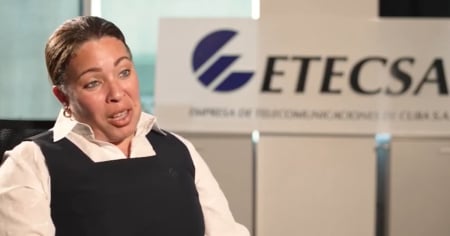
Amid the growing unrest over the progressive dollarization of telecommunications services and the announcement by the Telecommunications Company of Cuba (ETECSA) regarding the monthly limit of 360 Cuban pesos for mobile top-ups, a young Cuban identified as Alex Umur has gone viral for explaining the new rules “in good Cuban,” using humor, irony, and sharp social critique.
In a video circulating on Facebook, Umur quotes Lidia Esther Hidalgo Rodríguez, the executive vice president of ETECSA, who stated that “the balance can continue to grow, using balance transfers or international top-ups”.
However, the directive clarified that, through Transfermóvil, it will only be possible to deposit 360 pesos per month, which is a drastic limitation for thousands of Cuban users who do not receive remittances or top-ups from abroad.
This is part of a scheme by which ETECSA separates the national balance from that coming from international top-ups, prioritizing access to services in dollars.
Alex Umur resumes the official announcement with sarcasm, warning that now Cubans will have to rely on third parties to connect. "Previously, you could recharge as much as you wanted and whenever you wanted from Transfermóvil. Now, it's not the case. Only once a month and up to 360 pesos. That's bad."
And it presents a scenario that reflects the digital inequality in the country. "Juancito's family sends him a recharge, Juancito sells the balance from that recharge, you buy balance from Juancito, and you'll be able to stay connected. Now, what needs to be seen is how much Juancito will sell that balance for."
In his viral monologue, Umur deconstructs the logic of the system: international top-ups are maintained, and all data packages can be purchased as long as the balance comes from abroad. Meanwhile, for those reliant on the national salary, connectivity becomes an unattainable luxury.
“The only ones who will truly suffer are those of us without a relative in the afterlife. We will have to rely on those who do, and on how much they will charge for that connection, because we all know that everything is turned into a business, and a Cuban is a Cuban.”, he concludes.
Dignity against "digital jineterismo"
But beyond the mockery, the measure has generated a strong rejection from Cubans who refuse to continue supporting a system they consider unjust. On social media, decent citizens both inside and outside the island have begun to openly reject international recharge services as a form of protest.
“I will not accept that a single peso be put in my name for ETECSA. I want ETECSA to starve, even if I never use a cell phone again,” wrote the lawyer Manuel Viera.
For his part, art critic Jorge de Mello announced that he will be leaving social media as he cannot afford the new prices, and he accused ETECSA of being a company that engages in "digital hustling."
From exile, activist Saily González Velázquez proposed a "total halt" on remittances to Cuba. "Today it's remittances, tomorrow they'll start charging even for water in dollars... If we don't do something now, we will be accomplices of digital apartheid."
The new policy by ETECSA has been described as a scam orchestrated from power, which restricts national access to a minimal amount of data while privileging the influx of dollars through top-ups from abroad.
The cheapest packages in MLC — 4 GB for 10 USD — are well beyond the reach of the average Cuban. At the same time, the new prices in Cuban pesos are unaffordable for most, with rates such as 3 GB for 3,360 CUP, equivalent to several months' worth of minimum wages.
The FEU speaks out: an unprecedented gesture of internal criticism
In response to the wave of criticism from civil society, the exile community, and social media, an unusual critical stance from the University Student Federation (FEU) has emerged, marking a significant moment in the public reaction to the so-called "rate hike."
The Federation of University Students from various faculties of the University of Havana and the ISRI broke the silence with a joint statement in which they openly rejected the measure.
“The increase in the cost of data top-ups beyond 6 GB poses an obstacle that hinders our ability to meet our educational and professional responsibilities,” they stated.
The statement was signed by the student representations of FCOM, Chemistry, Philosophy and History, Mathematics and Computer Science, InSTEC, and ISRI, and is circulating on social media. In it, the young people demand an urgent review of the rates and real alternatives that do not exclude those living on the national salary.
“These provisions are detrimental to the holistic development of youth and society as a whole”, they added, emphasizing that access to the Internet should be a right and not a privilege reserved for those who receive remittances or access the informal market.
Filed under: