
Related videos:
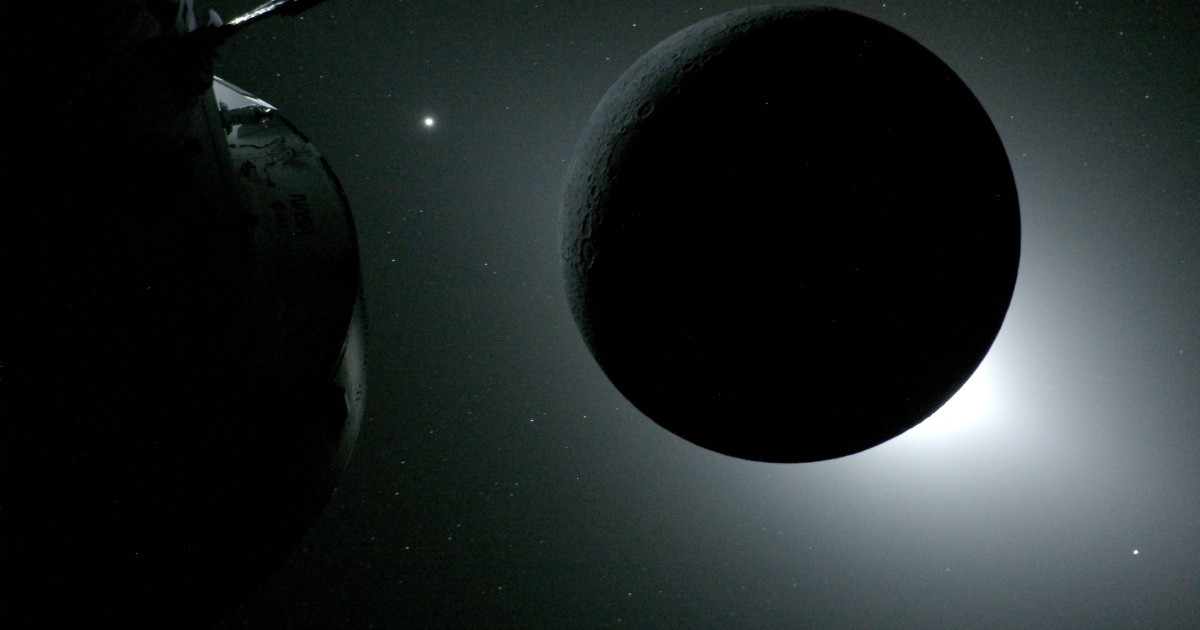
The NASA published today a image taken during the lunar flyby of the Artemis II mission showing a mysterious halo of light surrounding the Moon during a solar eclipse, and scientists have yet to determine its origin.
The space agency shared the photograph on its official X account along with a reference to the song "Eclipse" by Pink Floyd —"And everything under the Sun is in tune"— and explained that researchers are investigating whether the glow comes from interstellar dust or the solar corona.
The eclipse was captured on April 6 from the Orion spacecraft "Integrity" when it was just 6,543 km from the lunar surface during the mission's closest approach.
From that unique position in space, the Moon completely blocked the solar disc and revealed the corona as a bright halo around the dark edge of the satellite, in an event that NASA officially referred to as "Solar Eclipse of the Heart".
The eclipse was exclusive to the crew: from the spacecraft, the Moon appeared to be five times larger than the Sun, which ensured a perfect totality that lasted between 50 and 60 minutes, well above the seven minutes maximum observable from Earth.
The images were captured by cameras installed on the wings of the solar panels of the Orion capsule, which also recorded six flashes of light caused by meteoroid impacts on the unlit surface of the Moon.
During the eclipse, the crew was able to observe the planets Mars, Saturn, and Venus alongside the solar corona, in a view impossible to replicate from our planet.
The astronaut Victor Glover described the moment of the Sun being obscured by the Moon as the appearance of "an almost halo around the entire Moon."
The research on the origin of the halo has two main hypotheses: the solar corona, the outer atmosphere of the Sun that is usually invisible to the naked eye, and the interstellar dust that forms the so-called zodiacal cloud and scatters sunlight, producing a diffuse glow.
The mission itself provided a significant detail for that research: on April 3, just two days after the launch, the Orion cameras had already captured zodiacal light alongside terrestrial auroras, demonstrating that both phenomena are observable from that position in space.
Artemis II, launched on April 1 from the Kennedy Space Center with the SLS rocket, was the first crewed mission to orbit the Moon since Apollo 17 in December 1972.
His historic crew consisted of commander Reid Wiseman, pilot Victor Glover —the first African American astronaut on a lunar mission—, specialist Christina Koch —the first woman on a lunar mission—, and Jeremy Hansen, the first Canadian to orbit the Moon.
The mission concluded on April 11 with a water landing in the Pacific Ocean near San Diego, after ten days of flight and a distance of over 1.1 million kilometers.
The last time humans observed a solar eclipse from the vicinity of the Moon was during the Apollo missions, which makes the images of the "Solar Eclipse of the Heart" the first of this kind obtained in over half a century.
Filed under: