
Related videos:
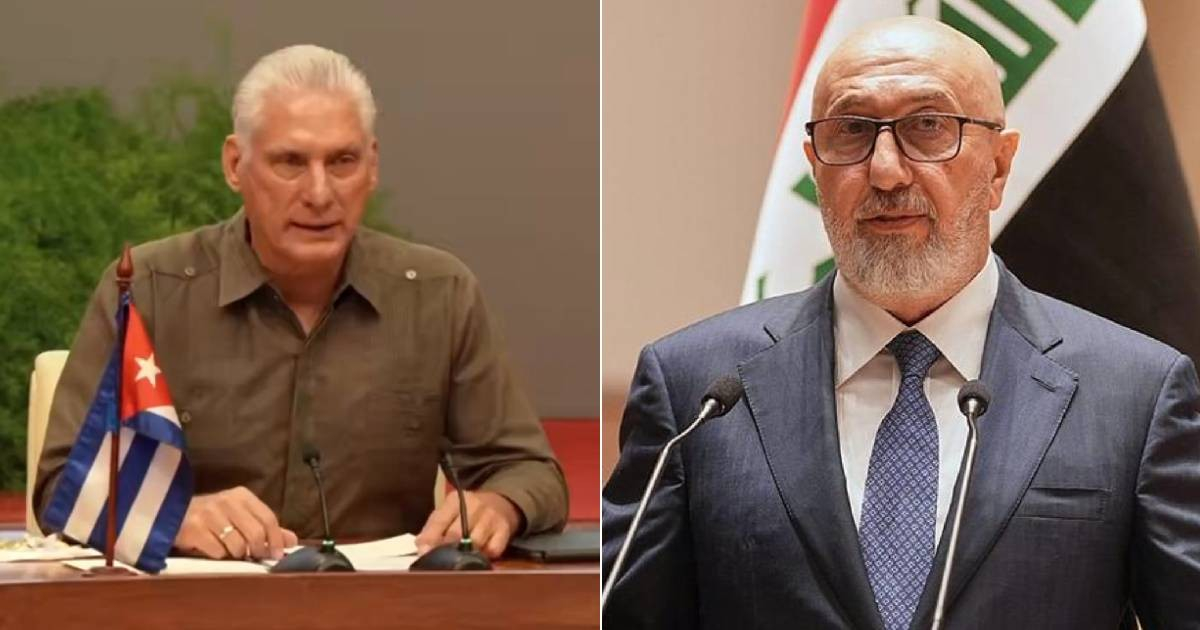
While his people suffer daily from blackouts and hardships, the leader Miguel Díaz-Canel published on Monday a message on X to congratulate Nizar Amedi on his election as president of the Republic of Iraq, and expressed Cuba's willingness to continue developing friendly relations between both countries.
"I extend my sincere congratulations to Nizar Amedi on his election as President of the Republic of Iraq, wishing him success in his high responsibility," he wrote, focusing on his politics and forgetting the suffering of the families on the island.
Amedi, aged 58, is a Kurdish politician born in Duhok and a member of the Patriotic Union of Kurdistan (PUK), elected this past Saturday by the Iraqi Parliament in a second round with 227 votes, compared to only 15 for his rival Muthanna Amin.
In the first round, Amedi had received 208 votes, falling short of the two-thirds required from the 329 members of Parliament.
The election was marked by the boycott of the Kurdistan Democratic Party (KDP), the leading political force in the semi-autonomous region of Iraqi Kurdistan, which cited legal violations in the calling of the election and announced that it would not recognize Amedi as the representative of the Kurdish majority.
The Rule of Law coalition, led by Nuri al Maliki, and the Hoqud Movement also boycotted the session.
Amedi has a long institutional background: he was an advisor to the former Iraqi presidents Fuad Masum, Barham Salih, and Jalal Talabani, served as Minister of the Environment until October 2024, and has been the head of the Political Office of the UPK in Iraq since that same year.
According to the Iraqi Constitution, the new president has 15 days to designate the candidate from the largest parliamentary bloc to form a government, replacing the acting prime minister Mohamed Shia al Sudani.
The election takes place in a regional context of high tension, marked by the war with Iran and the actions of pro-Iranian militias in Iraqi territory.
Diplomatic relations between Cuba and Iraq have a history of more than six decades, established on April 5, 1960, under the government of Abdul Karim Kassem, and were strengthened within the framework of the Non-Aligned Movement.
Both countries closed their embassies in the 2000s and reactivated their ties in March 2015 through the accreditation of concurrent ambassadors.
Díaz-Canel has an established pattern of congratulating elected leaders with whom Cuba maintains diplomatic relations, as he did with Gustavo Petro in Colombia in 2022 and with Luiz Inácio Lula da Silva in Brazil that same year.
The president of the European Council, António Costa, also congratulated Amedi and emphasized that strong and stable state institutions are essential to address the serious challenges ahead.
Filed under: