
Related videos:
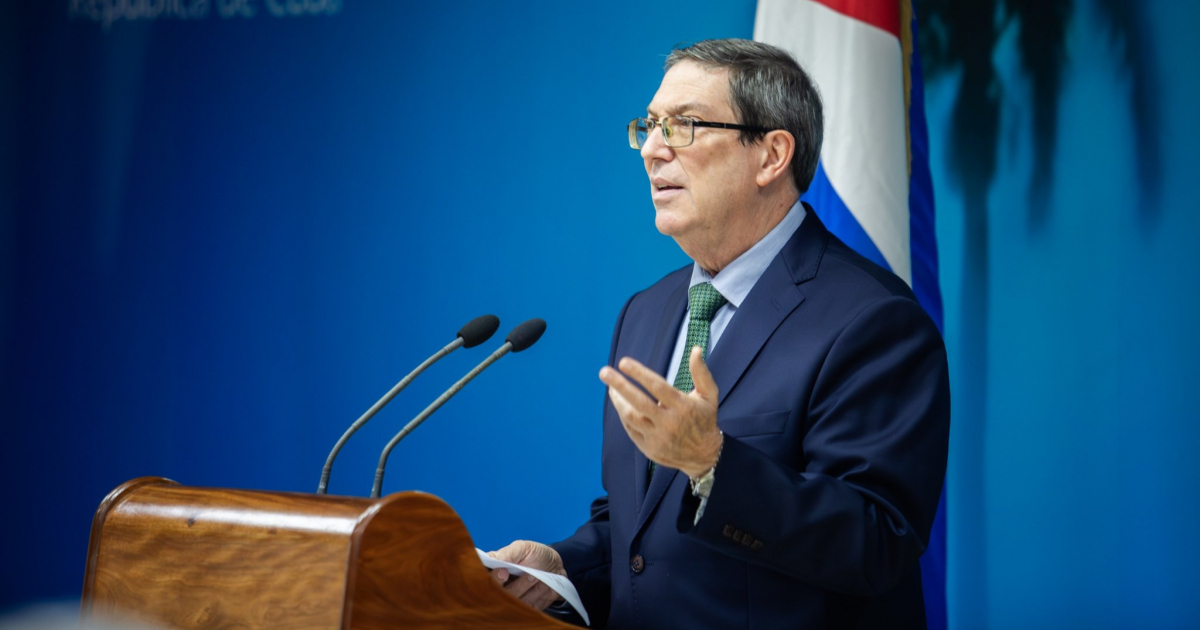
The Cuban Chancellor Bruno Rodríguez Parrilla expressed gratitude this Sunday for the joint statement issued by the governments of Spain, Mexico, and Brazil, in which they express their deep concern over the serious humanitarian crisis in Cuba, and he described it as "worthy and supportive."
The document was signed on Saturday at the conclusion of the IV Summit in Defense of Democracy, held in Madrid, by the Spanish president Pedro Sánchez, the Mexican president Claudia Sheinbaum —who participated via a recorded message— and the Brazilian president Luiz Inácio Lula da Silva.
"We recognize the dignified and supportive joint statement issued by the governments of Brazil, Spain, and Mexico, which expresses concern, calls for avoiding actions contrary to international law that worsen the living conditions of the Cuban people, and urges respect for the territorial integrity of Cuba," wrote Rodríguez on his X account.
The chancellor framed the gratitude in what the regime refers to as the "escalation of the U.S. blockade to extreme levels" and the "current energy siege," without ever mentioning the dictatorship's responsibility for the collapse experienced by the population.
The joint statement, however, maintains a striking silence regarding the systematic repression that the Miguel Díaz-Canel regime exerts against its own people.
The text does not mention the more than 1,200 political prisoners documented by Prisoners Defenders in February 2026, does not demand any specific political reforms from the Cuban government, and does not refer to the 46 deaths in prison of 11J protesters due to lack of medical attention, reported to the Inter-American Commission on Human Rights.
The paradox is hard to overlook: three governments that come together under the banner of defending democracy and reaffirm their "unwavering commitment to human rights" do not dedicate a single line to demanding that the Cuban regime release its political prisoners or cease the repression against dissent.
Lula, Sheinbaum, and Sánchez have maintained a consistent pattern of silence regarding Cuban repression: the Mexican president insists on dialogue without mentioning political prisoners; the Brazilian leader remains silent about arbitrary detentions; the Spanish president has not made any specific statements about the situation of those detained on the island.
The language of the statement regarding "territorial integrity" is aimed directly at preventing any potential U.S. military intervention, in a context where the Pentagon, as revealed by USA Today on April 15, has intensified operational plans in Cuba at the directive of the White House.
Trump responded on Saturday to those reports with an ambiguous statement: "It depends on what you understand by military action".
Rodríguez himself, who has systematically denied torture and disappearances in Cuba and has used international forums to attack Washington while ignoring internal repression, received the statement as a boost to the official narrative of the regime.
The document does include a phrase that the regime would prefer not to apply to itself: that "it is the Cuban people who should decide their future in full freedom," an aspiration that the dictatorship has been preventing for 67 years.
Filed under: