
Related videos:
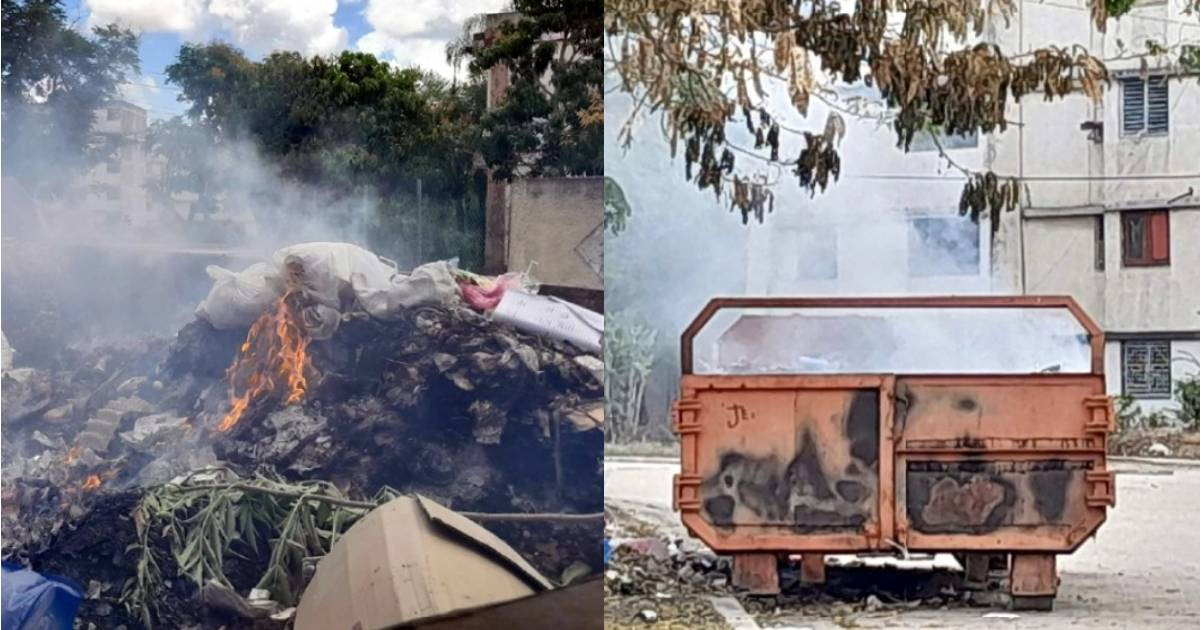
When night falls, makeshift trash bins begin to burn in the city of Holguín, a practice that is becoming increasingly common in neighborhoods where the accumulation of garbage has turned containers and vacant lots into open-air dump sites.
Neighbors describe that the waste, accumulated over days or weeks, ultimately turns into smoke and ashes.
In those improvised fires, practically everything burns, from broken LED tubes, plastic bottles, food scraps, to decomposing animals and expired medication containers, reported this Sunday the digital page of the provincial broadcaster Radio Angulo.
The combustion of these materials generates toxic gases that people living near those areas end up breathing.
Known as the City of Parks, which for years was regarded as one of the cleanest in Cuba, is now facing a visible decline in its urban hygiene.
The proliferation of improvised dumps in neighborhoods and public spaces has altered the everyday landscape in various districts, where the smell of smoke and burnt waste has become part of the routine.
The existing environmental regulations, including the standards set by the Ministry of Science, Technology, and the Environment (Citma), are effectively unenforced when these makeshift landfills go unattended for days and eventually catch fire.
The burning of waste not only poses an environmental threat but also a direct risk to the health of nearby communities, the media outlet emphasized.
The problem is linked to the irregularity in waste collection. On social media, residents from different neighborhoods have repeatedly reported that communal services do not operate with the necessary frequency, leading to overflowing containers and garbage accumulating in any available space.
A recent cleanup of an improvised dump in the Alcides Pino neighborhood, shared on Facebook by the page Soy Holguín, sparked a broad discussion among residents.
Although some celebrated that the area was cleared, many warned that without a systematic waste collection, debris will accumulate again in just a few days.
"How are they going to keep it clean if they don’t come to pick up the trash?" questioned one of the users, reflecting a concern repeated in the comments.
Others recalled that when municipal services operated regularly, improvised trash heaps were not part of the urban landscape.
Complaints also highlight the health risks associated with these garbage hotspots. Residents warn about the proliferation of pests, unpleasant odors, and diseases in communities where waste remains piled up for long periods.
In November 2025, residents of the Lenin neighborhood reported that the accumulation of garbage and the presence of mosquitoes were causing illness among adults and children amid an outbreak of arbovirosis affecting the province.
The urban deterioration in Holguín is also reflected in other historical infrastructures and public spaces.
Recently, a video shared on Facebook showcased the interior of the old Holguín-Gibara train station, founded in 1893, transformed into a dumping ground filled with plastics, papers, and debris.
The images sparked outrage among users who recalled the various uses the building had in past decades, ranging from an art studio to an agricultural market known as the "Mercado Mambí."
Many lamented that a building of historical value has been reduced to a dump.
Other recent episodes have strengthened the perception of decline in the city. Residents reported that the sculpture known as "the woman with the umbrella", the only decorative element remaining in the pedestrian boulevard of Holguín, is at risk of falling due to the deterioration of its base.
Vandalism has also been reported in public spaces, such as the theft of sections of the metal fence from the Major General Julio Grave de Peralta Park, known as the Park of Flowers.
Filed under: