
Related videos:
Inside a narrow metal container measuring just six meters long and a little over two meters wide, in the West Bay area of the Cayman Islands, a Cuban family is trying to hold on to hope amid uncertainty.
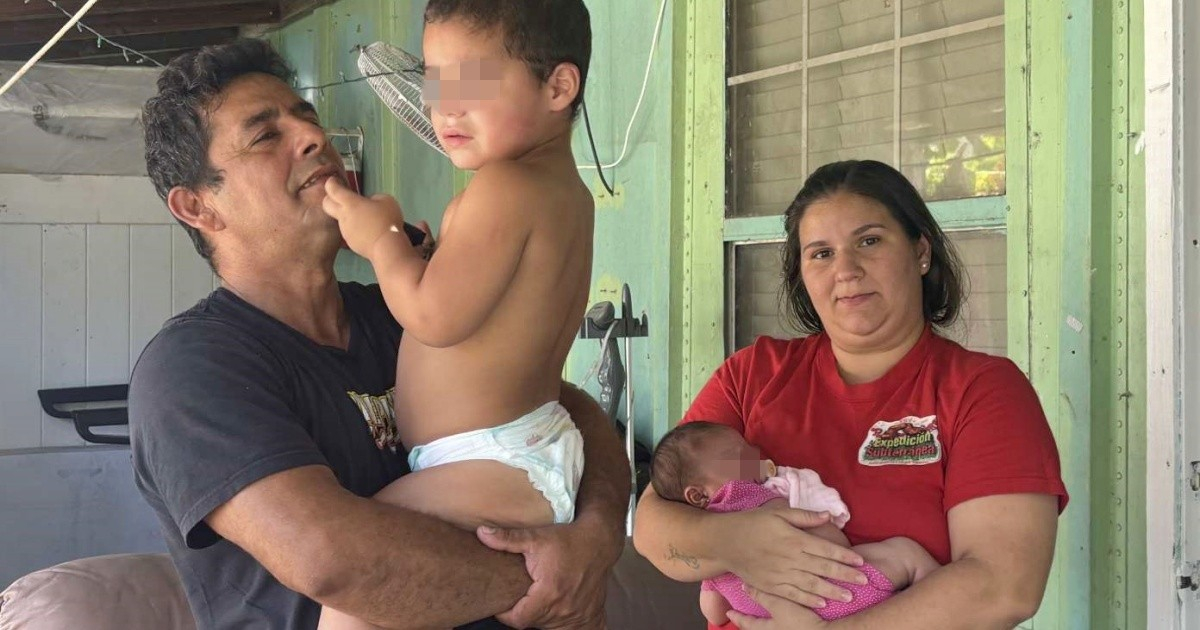
There live Richard Hernández and Mailemy Hernández Marchena along with their two children: a three-year-old boy with autism and a newborn baby girl.
Their greatest fear is not the current precarious situation, but the possibility of being sent back to Cuba.
"I am more scared for him than for myself. If we go back, things will not improve. They will worsen," Mailemy said in a statement to Cayman Compass.
An improvised home and a daily struggle
The space where they reside was provided by the local government, but the conditions are far from adequate.
Still, the family has tried to adapt: in the small courtyard, they have tamed wild chickens and planted fruit trees to supplement their diet.
Friends have helped paint the walls and improve the insulation, while a local church supplies them with diapers and basic necessities.
Sometimes, they also receive food from a nearby restaurant whose owners consider them part of their family.
But solidarity does not compensate for scarcity.
The government assistance, which the couple estimates to be between 260 and 300 dollars per month, barely covers their survival needs. The formula for the baby alone costs 45 dollars every two weeks. In addition, there are diapers, wipes, and other essential expenses.
The situation is even more critical due to the child's needs. Diagnosed with autism, his diet is extremely limited: he only consumes milk and yogurt, and from specific brands.
“Every two days, it's about 25 dollars. That's all he eats,” Richard explains.
The diagnosis that changed everything
Mailemy clearly remembers the moment she realized something was wrong.
"He was a normal baby. He ate everything. He said 'mom', 'dad'. And then, suddenly, nothing," he explained.
The boy stopped speaking, ceased to accept most foods, and began to display repetitive behaviors: walking on tiptoes, flapping his hands, running nonstop.
"I knew something was wrong. I had to seek help."
In the Cayman Islands, that assistance arrived. The child receives weekly therapy subsidized by the government, support that the mother deems essential.
In Cuba, on the other hand, there are fears that he would not have access to such specialized care, especially amidst the deep economic and social crisis the country is experiencing, characterized by shortages of food, medicine, prolonged blackouts, and the deterioration of the healthcare system.
From an extreme journey to legal limbo
The story of this family began to take an uncertain turn in April 2022 when they left Cuba on a raft journey that lasted 15 days and, as they recount, nearly cost them their lives.
After being rescued, Mailemy discovered in the hospital that she was pregnant. This fact, far from alleviating the situation, intensified her anxiety about a possible return.
The couple claims that their departure from the island was motivated by political pressures related to Richard's adult son, a military officer close to President Miguel Díaz-Canel who defected in 2021.
Upon arriving in the Cayman Islands, they remained detained for about 30 days in an immigration center before being transferred to a shelter.
Later, thanks to the help of friends, they lived in a house for nine months, until after the birth of the baby.
They were then relocated to the container where they currently reside.
Asylum denied and without legal recourse
Both applied for asylum in 2022, but their request was rejected at both the initial stage and on appeal in 2023.
They attempted to continue the legal process, but faced significant obstacles.
They report that they did not have free legal representation and had to attend their first hearing alone. Later, friends managed to raise about $8,000 to hire a lawyer.
Still, the process did not succeed. The family claims that they were not informed in time about the possibility of filing a lawsuit in the High Court, whose 14-day deadline had already expired by the time they learned about that option.
The Cayman Islands Customs and Border Control authorities have stated that they cannot comment on individual cases, but they maintain that all applications are assessed in accordance with the law and international obligations, including humanitarian considerations.
Without the right to work
One of the biggest obstacles they face is the inability to generate income. According to local legislation, asylum seekers are not allowed to work, which forces them to rely on aid and donations.
"We don’t want to rely on anyone. We want to work. We want to live," Richard states.
In Cuba, he worked as a mason and later as an inspector for the electric company, but he claims that political pressure forced him to leave his job.
A future in suspense
Today, the family remains in a legal limbo. The repatriation has not been finalized due to documentation issues related to their children, which has delayed any definitive decision.
Meanwhile, they live with the constant uncertainty of being sent back to a country where, they fear, their child will not receive the care he needs.
The authorities assure that humanitarian factors are taken into account, especially in cases involving minors or individuals with medical needs.
They also claim to respect the principle of non-refoulement, which prohibits sending someone to a place where they may face persecution or severe harm.
But for Mailemy and Richard, those guarantees do not dispel the fear.
Your request is simple and urgent: "Let us stay. Allow us to remain together. Let my children have a future."
Filed under: