
Related videos:
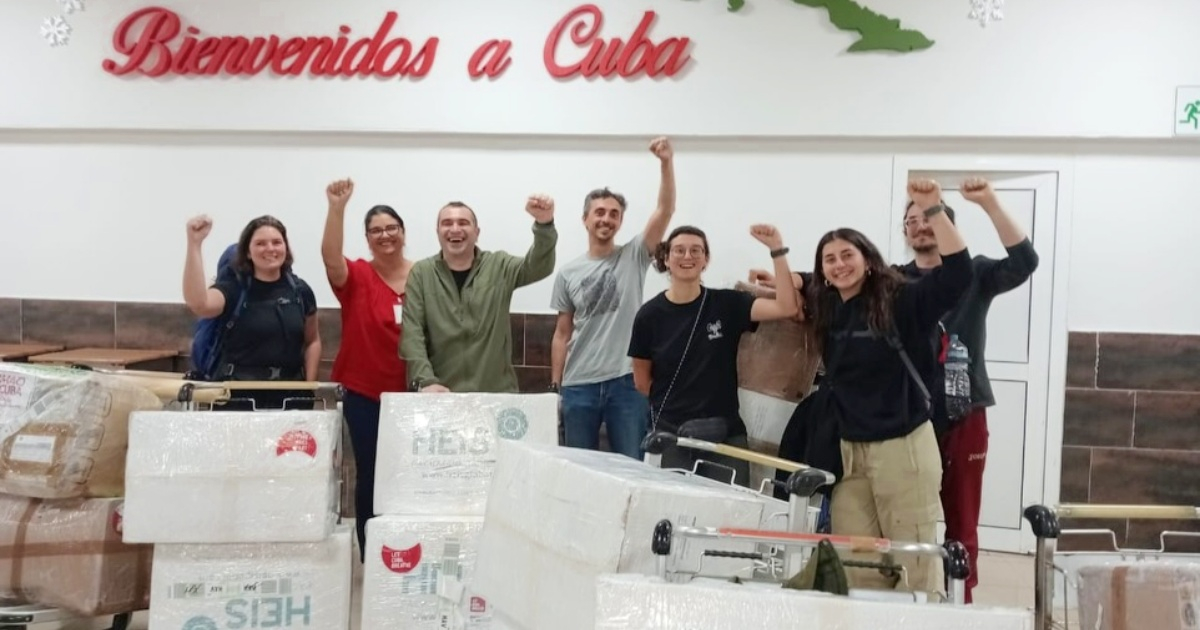
The Cuban Institute of Friendship with the Peoples (ICAP) announced this Wednesday the arrival in Cuban territory of the “advance group of the II European May Day Convoy,” coming from Italy. According to the institution, the first members of the group arrived with donations of food and medicines, as well as with a “message of commitment to the Revolution” and under the usual narrative that “Cuba is not alone.”
According to a statement cited by Prensa Latina, the convoy departed from Rome and Milan with dozens of representatives from European solidarity organizations.
Participants from Spain will join them, arriving in Havana to take part in a program that includes political activities, visits to institutions, and participation in the events for May Day.
The group transports diagnostic equipment, ventilators, defibrillators, and other supplies intended for hospitals, especially in eastern provinces affected by Hurricane Melissa, in late 2025.
It also includes food and solar panel systems donated by Italian organizations, a contribution aimed at alleviating - at least temporarily - the critical energy situation faced by numerous health centers in the country.
The arrival in Cuba of a new European solidarity convoy is once again being presented by the authorities as a sign of international support in light of the severe crisis the country is facing.
However, behind the official messages of "brotherhood" and "resilience," the arrival of these brigades also exposes the island's ongoing dependence on external donations to support basic sectors such as health and food.
The scene often repeats itself: foreign delegations arrive with humanitarian aid amid an official discourse that attributes the internal hardship almost exclusively to the United States embargo.
Nonetheless, the reliance of hospitals and communities on timely deliveries of basic supplies—from medications to medical equipment—highlights the structural deterioration of the Cuban healthcare system, which is unable to ensure stable supplies on its own.
The convoy is part of the campaign "Let Cuba Breathe" and continues a similar initiative held in March, which brought together about 120 delegates from 19 European countries.
On this occasion, in addition to health assistance, sports materials are being provided for schools.
According to the released program, participants will stay in Cuba for about ten days.
After initial activities in Havana, they will travel to Santiago de Cuba and other eastern provinces to distribute donations, before returning to the capital to attend the May Day parade, one of the most important political events on the official calendar.
In parallel, the Cuban government has promoted the arrival of the XIX International Brigade Primero de Mayo, made up of over 200 activists from 19 countries, who will also participate in support activities, volunteer work, and political meetings.
These brigades, also organized under the coordination of ICAP, combine the distribution of donations with an ideological program that includes lectures on the impact of U.S. sanctions and spaces for political training.
This second convoy continues from the first, which took place in mid-March 2026 under the name "Convoy Nuestra América," which gathered around 650 activists from 33 countries.
The institutional emphasis on the "blockade" as the central cause of economic difficulties contrasts with the growing criticisms—both within and outside the Island—that point to internal management issues, structural inefficiencies, and a lack of deep reforms as key factors driving the crisis.
Meanwhile, the arrival of international aid, while it alleviates specific needs, does not resolve the daily hardships faced by millions of Cubans.
In that context, each new convoy of solidarity operates both as a political gesture and as a symptom: evidence that, beyond the official discourse, the country continues to rely on external support to sustain essential services that the State itself fails to guarantee reliably.
Filed under: