
Related videos:
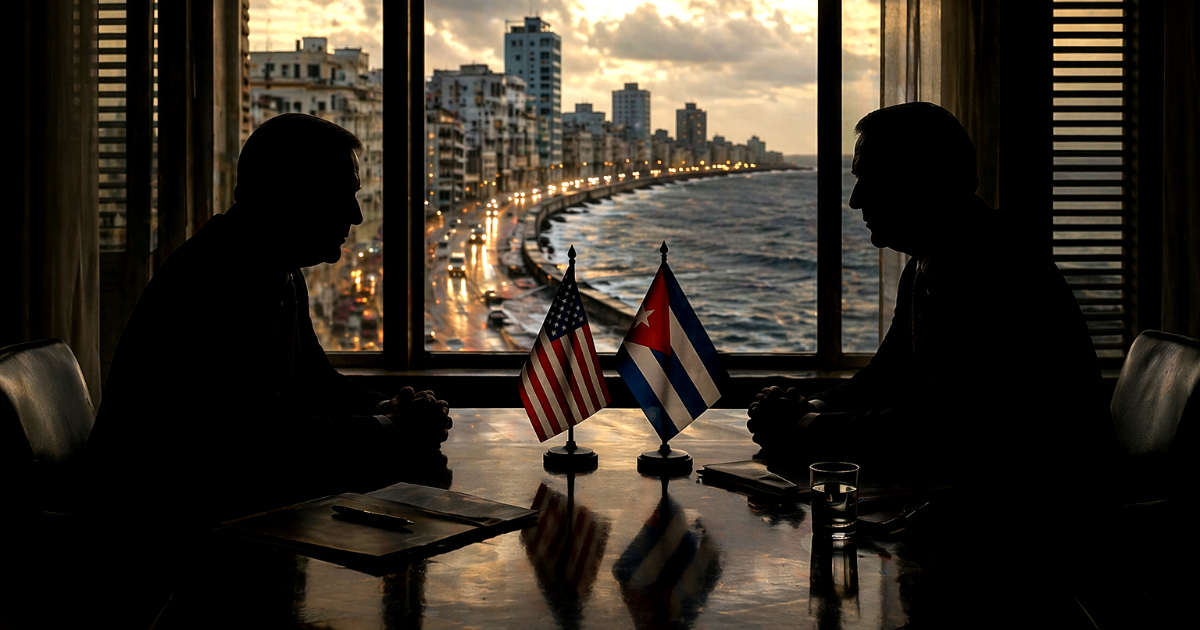
After denying it repeatedly, the Cuban regime has finally acknowledged that there indeed was a meeting with officials from the State Department in Havana.
But far from clarifying the issue, what it has done is deepen the confusion: it confirms one side and, on the other hand, continues to sow doubts even after admitting the fact.
The sequence leaves no room for naive interpretations.
On Monday, April 20, the newspaper Granma, the official organ of the Communist Party of Cuba (PCC), published statements from a government official at the Ministry of Foreign Affairs (MINREX) that left no room for ambiguity.
I can confirm that a meeting between delegations from Cuba and the United States was recently held here in Cuba, admitted Alejandro García del Toro, Deputy Director General for the United States at MINREX.
In other words, the regime itself acknowledged that the meeting took place. Up to that point, the matter should have been clear.
However, after that official confirmation, Razones de Cuba —a platform aligned with counterintelligence and dedicated to combating what it calls “cognitive war”— published a text that not only failed to reaffirm that recognition, but also insisted on discrediting the original information and maintaining a narrative of suspicion.
The contrast is evident and unjustifiable in the eyes of public opinion, but Cubans are well aware of the usual maneuvers of State Security and the confusion, misinformation, and discord sown by its spokesperson, Humberto Dionil López Suárez, a white-collar enforcer of the regime and also a member of the PCC Central Committee.
Instead of taking the confirmation already published by Granma as given, Razones de Cuba discussed "political operations," questioned the international sources (Axios and The New York Times), and went so far as to assert that "there is no secret trip by high-level officials with demands".
But the most revealing aspect is not what he denied, but how he did it: introducing an evasive formula —“let’s assume that this meeting took place”— which neither confirmed nor denied the fact, leaving it in a kind of discursive limbo.
And all of this happened after the official apparatus itself had already acknowledged the meeting.
It is not, therefore, a matter of initial confusion or developing versions. It is a deliberate strategy: the regime acknowledges the inevitable in its official organ, but at the same time keeps its propaganda channels active to dilute, relativize, or reinterpret that very fact.
It is a dual narrative in real time.
On one hand, it is acknowledged that a meeting took place. On the other hand, the context is discredited, implications are denied, and there is an avoidance of offering verifiable information. The result is a fragmented communication that aims not to inform but to control the political impact of the news.
"Cuba responds to the false leaks from Axios and NYT: it does not accept conditions, nor the release of prisoners, nor compensations. Díaz-Canel sets the terms of the dialogue: respect, equality, and an end to the blockade," stated Razones de Cuba in an attempt to minimize the impact of statements reporting on a two-week deadline set by the Trump administration for the release of high-profile political prisoners, among other matters that have shaken the regime's board.
But that "damage control" has limits and contraindications that time will reveal to the "strategists" of the dictatorship.
If the Cuban government has already confirmed that there was a meeting with officials from the State Department, the question is inevitable: why doesn't it disclose everything? Who were those officials? What positions did they hold? Who participated from the Cuban side beyond generalities? What was actually discussed?
None of this has been answered. Instead of transparency, there is opacity. Instead of concrete information, there are slogans. And instead of a direct explanation to the public, what is offered is a conflicting narrative where one part of the media apparatus contradicts or at least blurs the other.
That is not serious institutional communication. However, something similar is not expected from Humberto Dionil and his masters.
In a context of deep crisis and overwhelming frustration, where any negotiation with the United States has direct implications for millions of Cubans, the least that can be demanded is clarity. No pamphlets. No theories about "subversive clusters." No discursive maneuvers to buy time or confuse.
The confirmation already exists. What is lacking is the complete truth.
Because half-hearted acknowledgment is not informing; it is managing information, manipulating, sowing doubts, and undermining the potential of an informed citizenry. And this practice, repeated for 67 years, is precisely what has led the vast majority of Cubans to not believe a single word of the official press, and to the prevailing sentiment that the so-called "revolution" and its leaders do not represent their aspirations.
The regime now has a straightforward opportunity: stop playing with ambiguity and speak clearly. Assign names. Explain the content of the meeting. Publicly acknowledge what has already been partially recognized.
The opposite—continuing to navigate between confirmation, misinformation, and propaganda—only reinforces the feeling that, even when it tells the truth, it does so partially.
And it does so deliberately because the regime does not care at all about the fate of the nation or the common good of Cubans, but rather about its own interests, its millions from GAESA, and its attempt to perpetuate itself in power.
Filed under: