
Related videos:
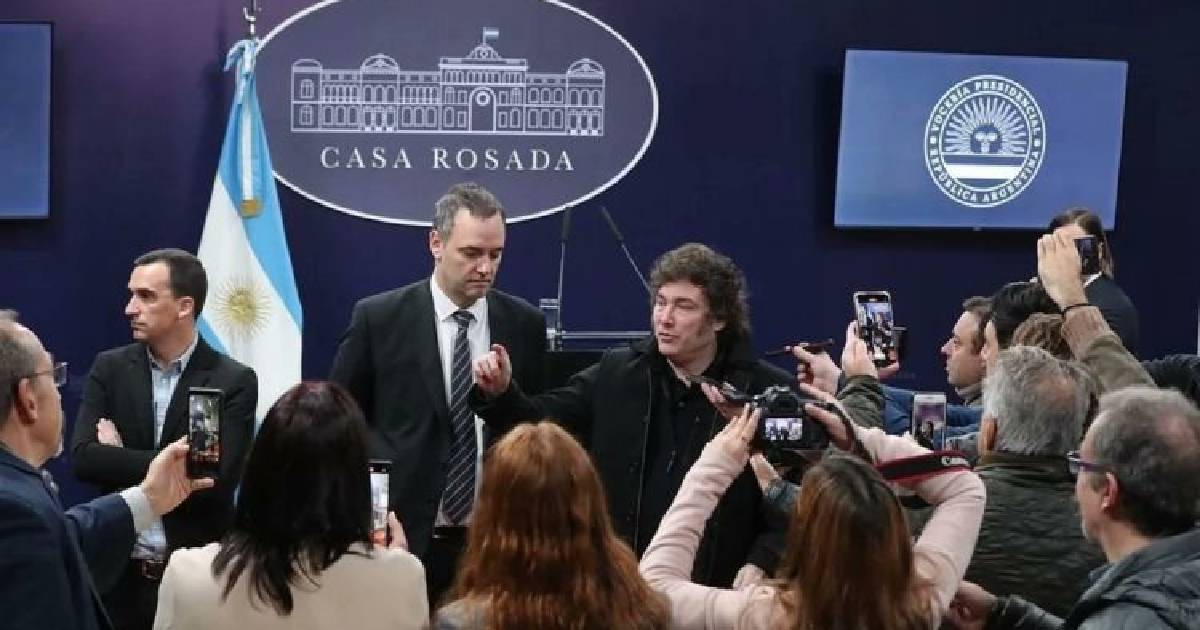
The government of Javier Milei banned all accredited journalists from accessing the Casa Rosada on Thursday and closed the press room of the Argentine executive headquarters, in a move described as the first of its kind in the country's democratic history.
According to the agency AP, the Secretariat of Communication, led by Javier Lanari, executed the decision by removing the fingerprints of around 60 journalists from the biometric access system and indefinitely suspending the extension of accreditations that were valid until this month.
The immediate trigger was a criminal complaint filed by the Casa Militar before Federal Court No. 4, headed by Judge Ariel Lijo and Prosecutor Gerardo Pollicita, against journalists Luciana Geuna and Ignacio Salerno, from the program ¿Y mañana qué? on the TN (Todo Noticias) channel.
Last Sunday, both released footage captured with smart glasses—spectacles equipped with state-of-the-art cameras—in the internal hallways of the Casa Rosada, showcasing the Chief of Cabinet Manuel Adorni. The Military House filed the complaint ex officio the following Monday.
The government described the recordings as "illegal espionage" and a potential disclosure of state secrets that could compromise the president's security. Spokespersons from the Communication Secretariat justified the prohibition of entry with a single statement: The only purpose is to ensure national security.
TN, for its part,
Milei reacted with a message on X filled with aggression: "Disgusting trash. I would love to see those filthy scoundrels who carry press credentials (95%) come out to defend what these two criminals did. I hope this reaches the highest authorities. CIAO!" The president also described the closure of the press room as an "excellent" measure.
The decision did not come out of nowhere. Approximately three weeks before the total closure, the government had already revoked the accreditations of journalists from C5N, A24, El Destape, Ámbito Financiero, Tiempo Argentino, and Radio La Patriada, linking them to a supposed Russian intelligence operation of 2024 aimed at discrediting the government, a narrative revealed by an international journalistic consortium but not yet proven in court.
The conflict between Milei and the press has been escalating since his assumption of office in December 2023. In March 2024, during an interview with the Financial Times, the president accused accredited journalists and photographers of being infiltrated agents from Cuba and Venezuela disguised as photographers.
According to the Argentine Journalism Forum (FOPEA), by the end of 2025, 67 journalists had lost their permanent accreditations at the Casa Rosada. The Argentine Association of Press Entities (ADEPA) filed a complaint with the Inter-American Commission on Human Rights in November 2025, denouncing "censorship."
The closure this Thursday also coincided with the visit of tech entrepreneur Peter Thiel to the Casa Rosada. Euronews described the event as the first access veto for journalists in Argentina's democratic history, and affected journalists pointed out that the measure is unprecedented, even when compared to the military dictatorship from 1976 to 1983. An affected journalist summed up the sentiment of the union: very bad for Argentine democracy that the work of accredited journalists is prohibited in the Casa Rosada.
Filed under: