
Related videos:
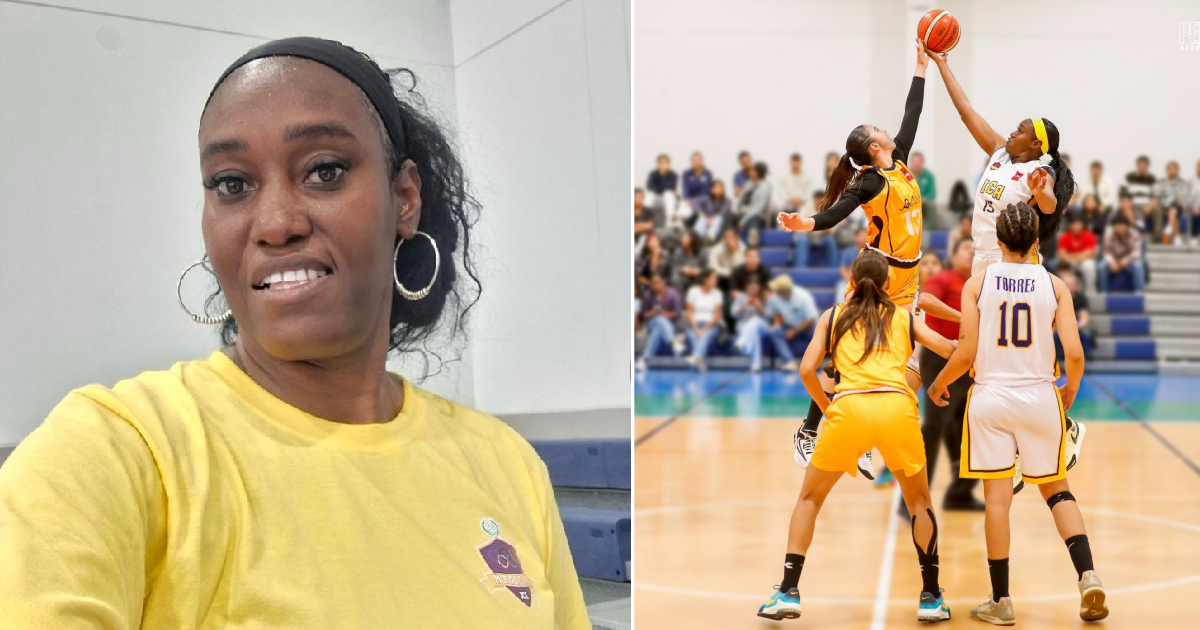
She grew up tall amidst childhood games, with an invisible ball still in her hands and a destiny that was already seeking her out. It was a glance from a coach in the streets of the Plaza de la Revolución municipality in Havana that lit the way.
Since then, every training session, every rebound, every basket, and every decision shaped her not only as a player but also as a woman who understood that the true game is played between the fear and the courage to move forward.
A pleasure to interview again Zuleira Aties, a member of one of the last great teams that Cuban basketball had.
Tell me, girl, what are you doing, how's life treating you?
Delighted to hear from you as well, my friend, and even more to be able to share a bit about my current life. I have been living in Arequipa, Peru, since 2016. I arrived in this country a year earlier to play for a team called Club Universitario. A coach brought me here who liked my playing style and knew me from previous years.
He offered me a chance to play here, I liked it, and here I stayed to build my life. In Peru, I became a coach. I apply my experiences, everything I've learned during my years as an athlete; I accepted the challenge of taking on the job of teaching girls.
Are you with your family?
Yes, I am with my family: my mom Estrella, do you remember her? Always looking out for me, coming to watch me play; and my husband Yosmel.
My happiness is completed by staying active, playing maxibasket, you know? Basketball for veterans. I went to a World Championship in that category last year in Switzerland, and now, in February, I played in the Pan American over 40 years, representing Peru.
Zule, let's let our minds and hearts soar, and take those first steps together in basketball, when you first stepped onto a court. Let's talk about your beginnings in the exciting sport of basketball.
Let’s see, I stepped onto my first court at the age of eight in the Plaza de la Revolución municipality. My discoverer was Professor Lázara. She saw me in the street with my mom; I have always been tall since I was little. Then, she asked my mom and me if I wanted to practice or if I liked the sport.
I said yes, and that's how I started training, training, training at the school where I studied... I began to enjoy putting the ball through the hoop, and by the time I was nine, I joined the EIDE and stood out. Just look at how it turned out; I have dedicated my entire life to this sport.
Zuleira Aties took her first steps at the EIDE "Mártires de Barbados," and then, at the age of 14, moved on to the national ESPA, where she stayed for three years. During that time, she participated in Central and Pan American tournaments, as well as in a World Championship, all in the youth category. In those competitions, Cuba achieved second, fourth, and ninth places, respectively.
With international experience already under his belt, he joined "Cerro Pelado," the national basketball team's training facility, at just 17 years old.
I joined the national team in 1998 and resigned in February 2003. The 1990s were a remarkable decade for Cuban women's basketball.
What times they were! We had enough talent to form two teams, A and B, and we constantly played against each other. From those matches and trainings, a strong team emerged that brought women's basketball to elite positions, such as the bronze medal at the 1990 World Championship in Malaysia and the fourth place in Barcelona '92.
In addition, there was a host of capable coaches eager to achieve the best result.
Speaking of that, my first coach in high-level national performance, the one who had the most impact on me, as he spent years teaching me basketball and guiding me, was Márgaro Pedroso, who accompanied me during the four years I was in the youth national team.
I also remember Eduardo Moya from those early days and, of course, Miguel del Río on the main team, although it was for a short time because he made way for the experienced Pepito Ramírez. I spent two and a half years with the latter.
Are you always cheering for Team Cuba?
Although I was initially considered a pivot, in the national team there were taller players than me, such as Yudith Águila, Milaida Enrique, and Yamilé "La Peca" Martínez, who were very effective in that position. Additionally, there was the extraordinary Yaquelín Plutín—who was similar in height and age to me, but with a stronger build—who also played as a "five."
So, to find me a position, Pepe Ramírez placed me as a wing. My characteristics suited that role very well: I was tall, skilled, had pretty good shooting accuracy from the perimeter, and I was also fast. Do you remember how well I used to “steal” balls?
I went for offensive rebounds with a lot of intensity. In the 2002 World Cup in China, I played as a center in the last few games. After that, as a professional, I stayed in that position, which I enjoy the most: playing under the basket, the rough play... in short, I love that adrenaline.
Main events with the national team?
Look, for me, attending that World Cup in China in 2002 was like reaching for the sky. You were there. We lost games that we still feel the pain of. But sharing the experience with my teammates, playing against the extraordinary American players, seeing the Great Wall of China, which I will never forget, we went thanks to your insistence… For my résumé, that tournament marks a turning point!
While being part of the Cuba team, were you never able to sign a contract to play abroad?
Never! When I played in Cuba, I was never able to be signed. Back then, it was difficult to play professionally. If you chose to play professionally, they would punish you for five years, but not by keeping you away from the national team; they wouldn't let you leave the country. In other words, you lost your athletic career: no competition, no training, no practice matches.
I was lucky enough to leave at the age of four. Years have gone by, and I still don't understand why if a player from the national team was contracted to play professionally… it couldn't happen! If that was a plus for the team: it's an athlete who is developing at a higher level, in better conditions, and who ultimately benefits when called to play for Cuba.
The level in Cuba is not the same as that in Europe, for example. As a professional, there's more interaction with players from various nations, especially Europeans, where basketball has many followers; players with higher technical and tactical skills, which helps you think better. There's not as much physical contact as is played in America: in Cuba, in Brazil, in the U.S.
Europe doesn't play that way; technique and tactics, strategies are drawn out… you think more! It's not the same to be ahead or behind on the scoreboard, and that’s what you train for.
Fortunately, in Cuba that issue of not being able to hire you has changed; but in my time, it was impossible.
And when you made your decision, what did you do, who did you talk to?
It was in February 2003. I decided to part ways with the national team in February 2003. I approached Professor Pepe Ramírez and told him that I did not want to continue. I explained that I wanted to grow... to grow as a player!
I felt like I would get stuck on the national team because, you know, in Cuba there’s always a struggle for position: you can get penalized for anything. If they don’t want you, even if you’ve excelled, they won’t give you a chance to travel. If you miss a meeting, you get punished.
In other words, there is a lot of bureaucracy and, at times, a lot of injustice. You know this as well as I do, because you experienced it and debated it extensively in your segments on the news. Those who don’t remember it, well, I haven’t forgotten.
And you know, Julita? I started to see beyond, I began to connect with a friend of mine who lives in Italy. She would send me videos, I watched how the game was played, and I said to myself, "I can do this." So, I decided to carve my own path, no matter the cost, I wanted to be myself.
I wanted to see how far I could go as a player; I wanted to help my mom, my dad... and the only way I could do that at that moment was by playing professionally!
Can you say that you made your dreams come true?
Yes! I headed to Hungary thanks to the invaluable support of Milaida Enrique, who believed in me and introduced me to the ideal person. "Milo" was the key factor that allowed me to play in Europe, in this case, in Hungary. We were four players: Lisset "La Ardilla" Castillo, Milaida herself, María Elena "La Lupe" León, and me.
I have a special memory of when I played alongside Lisset Castillo in Hungary. I learned a lot from her; I spent two years with her in that strong European league. The Hungarian land was my first destination after leaving Cuba.
Later, I played in one of the major leagues in the world, the A1 of Italy's top league, with the club Pozzoli. That was my best experience in terms of professionalism. I faced world-class players, many of whom were from Russia and played in the WNBA.
It was a wonderful experience that marked my career: being able to rub elbows with basketball players like the amazing American Diana Taurasi, who was playing in the Italian league at that time. I shared time with many players, and several of them became great friends of mine.
You had the opportunity to play with some of the greats of Cuban basketball. From those you saw, which ones are your favorites?
Honestly, I have four names: Yamilé Martínez, Lisset Castillo, Dalia Henry, and Jacqueline Plutín.
The "Locomotive of Majagua," as you called Plutín, was very smart; he knew how to position himself for rebounds, had "sweet hands," the rebounds came right to him, he made the shot, knew when to pass, and knew when to cut. He understood basketball very well; he was very intelligent.
"La Peca" Martínez had a rough, very strong, and effective style of play. She is one of the best centers in the history of Cuban basketball and in her time, she stood shoulder to shoulder with the best in the world.
Lisset was a total warrior, very competitive, she had a great three-pointer; I thought she was left-handed because she had a lethal left hand.
Dalia Henry was very effective; any ball you passed to Dalia Henry was guaranteed to score. She had a powerful roll that always went in.
Those are players I saw and shared the court with. There are others who were excellent as well. Just to name two examples, Mrs. Leonor Borrell, elevated to the Hall of Fame of universal basketball, and Margarita Skeet, an incredible and spectacular player—small but skillful, accurate in her shots, and a hard worker for the team. I hardly saw them play, but they are great among the greats.
And internationally?
In the international arena, there are many, but watching the American players Dawn Staley, a defender, and Lisa Leslie, a center; the former having become an excellent coach and manager, and the latter considered by many to be the greatest of all time, exceeds all my expectations.
Happy and fulfilled, Zuleira Aties?
Yes, how could I not be? Day by day I live my dreams; I do what I love, I am surrounded by love. Yes, Julita, I am happy.
Today, her story is not measured solely by tournaments, leagues, or names shared with figures like Diana Taurasi or Lisa Leslie, but by the consistency of having followed her own voice.
Zuleira Aties has carved out a path for herself, and amidst obstacles, difficult decisions, valuable lessons, and a genuine passion for basketball, she has become who she is: a woman of courage, passionate about the game she loves and happy in her family environment.
Filed under: