
Related videos:
Ballet is not just a dance: it is a secret language that the soul learns before the body. It is the silent prayer that rises with every arabesque, the ancient memory that vibrates at the tips of the toes when the world seems to stand still. A dancer is never not a dancer, because ballet does not reside solely on illuminated stages, but in the very breath, in the delicate yet strong way she faces life, in the invisible music that accompanies her even in silence.
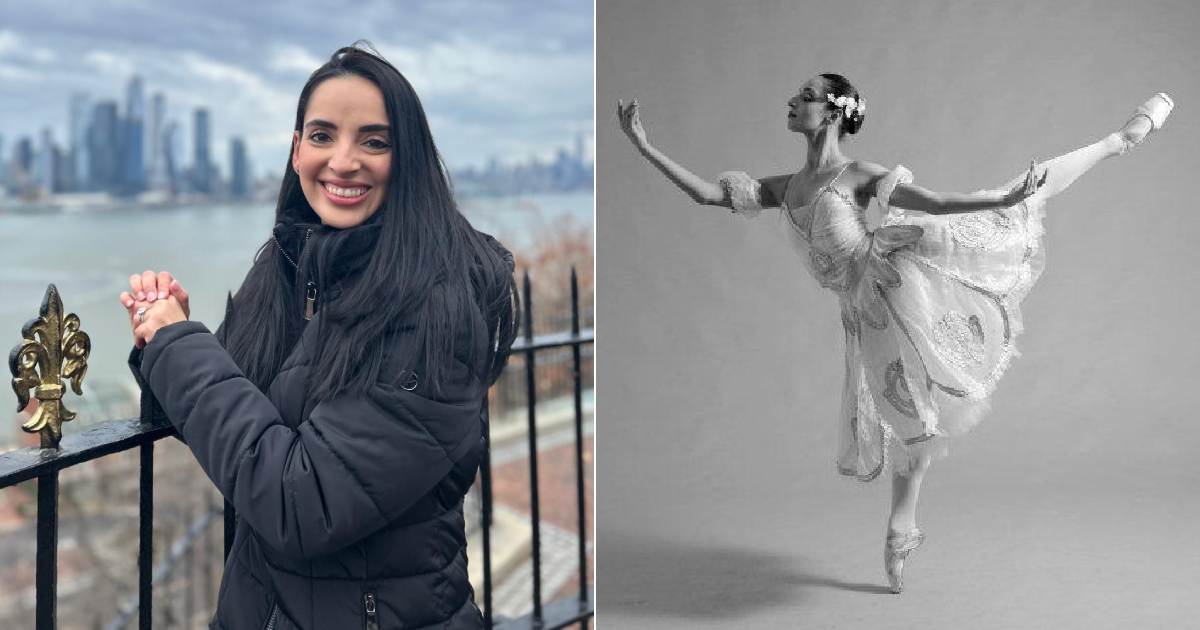
That is why our guest today, the soloist Yanlis Abreu, carries it in her soul like a sacred fire, in her heart like a heartbeat that sets eternal rhythms, and even when the curtains fall and the shoes rest, her spirit continues to dance, because true ballet is not abandoned: it is embodied, it is breathed, it is lived... for all eternity!
Nine years with the National Ballet of Cuba and with her Giselle as a hallmark, the dancer gives us insight into her current life.
I live in Florida with my partner, a two-year-old boy who drives me crazy, and my parents. I arrived nine years ago; I had a visa and came after returning to Cuba from a tour that included several cities in the United States, including Washington.
I work in financial institutions in the U.S., specifically in banking, but I do not give up ballet; I teach young girls, and it brings me great joy to see them grow in the art of dance that I love so much.
Are you going to see ballet currently? Do you miss the stage a lot?
Whenever I get the chance, I go to see ballet performances. In addition to my work in the financial world, as I mentioned before, I teach classes to young girls who are preparing to enter art schools. I have several groups that I work with, creating choreographies.
Watching ballet, whether it's professional or from a school, still excites me immensely. I love seeing the results of my work and watching my students grow professionally. It fills me with passion to see them, just like when I go to watch great performances with the New York City Ballet and American Ballet Theater, as I reminisce about my moments as a dancer.
Let's explore your early steps in dance, which were very precocious
Well, yes, I started when I was three years old; I felt a special attraction to dance, to ballet, to art in general. I didn’t start with classical ballet but with Spanish dance, in the workshops at the "García Lorca" theater.
How did you become interested in the classics at such a young age?
Look, for being so small, I was certain that it wasn’t Spanish dance but classical. I told my mom with great confidence. I saw the girls in the next room practicing classical ballet and I knew that was what I wanted. I loved the little tutu, the classical music. I respect Spanish dance. I believe they are two beautiful dances, two wonderful genres, but my inner self belonged to classical ballet.
Now, after so many years, I can't imagine how I was able to discern that. On top of that, it wasn't easy: the exercises, a lot of pain, fighting for elasticity, flexibility, jumps, maintaining weight, posture, and the sacrifices involved. So, at the age of eight, my teacher sat down with my parents to recommend that they take me to the entrance exams for the National Ballet School "because the girl has talent."
The teacher was right. My parents helped me, I was with teacher Rosa Elena at the National Theater, and thanks to her, I was able to enroll in the National School.
Integrating the National Ballet of Cuba became a pivotal moment for you over the years, although nothing came easy to you before that.
Look, Julita, entering the BNC felt like the sky and the earth united in happiness; it has been one of the happiest moments of my life. I couldn't believe it, I started crying from the emoción. I think it was something that marked a new beginning for me.
It was a dream turned into a beautiful reality. It wasn’t easy, as you say. I went through very bitter moments because, when the final exam at school took place, I couldn’t be seen by the BNC teachers because I fell ill with kidney stones and missed that exam.
I felt frustrated, disappointed. I had one opportunity left, the decisive one.
I never thought I could have fun after my enforced break. It's true that the teachers at school had seen me, but... it wasn’t the same!
And so the day of the audition arrived. I tried to do my best; I had to be at 100 percent to be chosen. I went home with a great sense of hope in my heart because, despite having given it my all, I faced the disadvantage of not having been seen before.
However... I passed! The day I found out I had been accepted into the Ballet Nacional de Cuba, I could do nothing but give infinite thanks to my teachers, to those who believed in me from the very beginning, to the company professors who saw my talent, who gave me the opportunity, who recognized my potential after only one ballet class, as I wasn't able to show them anything else on stage.
That day was lovely; it was the dream of a three-year-old girl come true. What more can I say?
In classical ballet, the relationship between the dancer and her partner is essential. Can you tell me some of your favorites? Did you ever feel scared when you had to "fly" and fall into your partner's arms?
Both in elementary school, at ENA, and at the National Ballet School, I had many partners, and I can't say one stood out above the others. I loved sharing the stage with all of them; I loved dancing with them.
My first partner, no. It’s not just one because in elementary school you have several depending on the choreography, and we always changed performers. Back then, in my year, there were Albertico Terrero, Moisés Noriega, Ariel Mejica, Yasel Roldán.
I remember that we danced "The Magic Flute" when we were in the last year of elementary school. Then, when I entered the ENA, I danced with José Justiz, my dear José Justiz. Nowadays, my brother, I care for him deeply. He is currently dancing in Michigan.
I also danced with Ariel Molina in my second year at ENA, and in my last year, I danced with Ariel México, another brother whom I care for deeply. In general, all the guys from my year were amazing; I love them all so much. They were magical; it felt like being at home.
I never felt afraid with any of them; in general, the male technique and the classic duo we were taught in school were very strong, very good, and the boys represented it very well—they performed it extremely well. I was never afraid on stage with any of them, despite their young age.
We faced the stage with tremendous bravery, and overall, male ballet in Cuba is extremely good. I had wonderful experiences with them. I participated in international competitions with Ariel, with Molina, with Josué, and with Yacet.
As I told you, my first full ballet in elementary school was "The Magic Flute," and it was fabulous. It was the first experience, and it was wonderful; I remember Yacet was magnificent, both in providing you with confidence during the scene and in technique.
You had the experience of dancing when Alicia was still leading the company. What was your relationship like with the prima ballerina assoluta?
During all my years at the National Ballet of Cuba—from the beginning of 2010 until the end of 2018—I had the fortune of having Maestro Alicia by my side. I have millions of memories. I was in two ballets that she choreographed.
I also participated in millions of rehearsals with her. One of my fondest memories is “Giselle,” because for the teacher, “Giselle” was the most treasured gem. I feel that “Giselle” is a masterpiece and that for her, it was her jewel, which she cared for with immense love.
We devoted a lot of time to the table work of the first act of "Giselle." I remember how he took his time with the corps de ballet, with the principal dancers, with the character roles, with everyone. I remember those rehearsals being very beautiful.
She was asking us questions about our characters, and each one had a special moment in the scene. It was very important to her that the scene was narrated in full, so that the audience could absorb everything we were trying to convey.
By chance, your favorite ballet is "Giselle"..
That's right. Giselle is one of the masterpieces of the National Ballet of Cuba. For me, it was an honor to perform "Giselle," as it was her work, in my opinion, her most significant work.
And yes, many times, on the vast majority of the tours we did, she traveled with us and the moment she came out at the end to greet everyone was highly anticipated. I feel that the international audience welcomed her with open arms, and there were minutes and minutes of applause for her.
Alicia was universally beloved, and everyone who knew that the National Ballet of Cuba was going to perform was there, eagerly waiting to pay tribute to her.
I feel that the teacher greatly enjoyed the applause, and that every time her company performed, whether nationally or internationally, she received that applause with immense pride because she knew her company was representing her in the way she wanted, and that the Ballet Nacional de Cuba always set a very high standard in its performances.
In addition to Alicia, other great figures that define you.
For me, key figures are Mirta Plá, Josefina Méndez, Aurora Bosch, and Loipa Araújo, known as the “Four Jewels of the BNC,” along with, of course, stars from around the world who have, both in the past and now, transformed ballet into what it is: a universal dance art.
What was it like for you to stop being part of the dance company and become a soloist?
A step toward the summit, an immeasurable sense of well-being, the ability to prove my worth to myself.
Did you only dance classical?
No. I made forays into contemporary works, for example, "Celeste" by choreographer Anabel López Ochoa. I also worked with prominent choreographers like Cathy Marston and Osnel Delgado.
And about the classic?
There were several, but I lean towards Master Alberto Méndez.
Tours and countries visited?
There were many tours and many countries: from the first trip to South Africa to the last one in the United States, I visited Italy, France, Spain, Ecuador, Canada, the United Arab Emirates, China, Mexico, and Brazil, among others. The National Ballet of Cuba made an impact wherever we went, receiving acclaim, and tickets were always sold out. We always performed to a full house.
I remember a "Don Quixote" in Qatar where we had to dress according to the country, covering our arms and shoulders, but it was incredible.
Have you seen the company perform recently? Could you give me your opinion on the BNC directed by Viengsay Valdés?
No, unfortunately, I haven't seen any of their performances. If I were to give my opinion on the National Ballet of Cuba today, honestly, I would be doing so blindly because I haven't been to Cuba in years nor seen a BNC performance.
I know it is under the direction of the principal dancer Viengsay Valdés, of whom I have the best memories, possessing a strong technique and an unwavering stage presence.
But to give you a current opinion, I can't. I do know that ballet continues to draw from the Cuban school of ballet, which is very strong and globally recognized.
To remember is to live again: it is to open the door of time and allow the soul to walk barefoot along the paths of memory. This is how Yanlis Abreu has entrusted it to us, whose life seems to dance between two worlds: that of reality and that of dreams.
Her story flows like a whisper of wings between the ethereal creature who falls in love with a human — that sylph suspended in the breath of the forest —; like the trembling and enchanted Odette from “Swan Lake,” imprisoned by a spell and redeemed by love; like the radiant and playful Swanilda from “Coppélia”; or like the fragile and eternal Giselle, a loving spirit who forgives beyond death.
In each of those names beats its essence. Yanlis Abreu not only interprets; she inhabits the air, breathes music, and dissolves into light. Thus, when recalling, she not only brings back danced roles but also impossible loves, whispered promises, and invisible wings that still hold her up on the infinite stage of memory.
Filed under: