
Related videos:
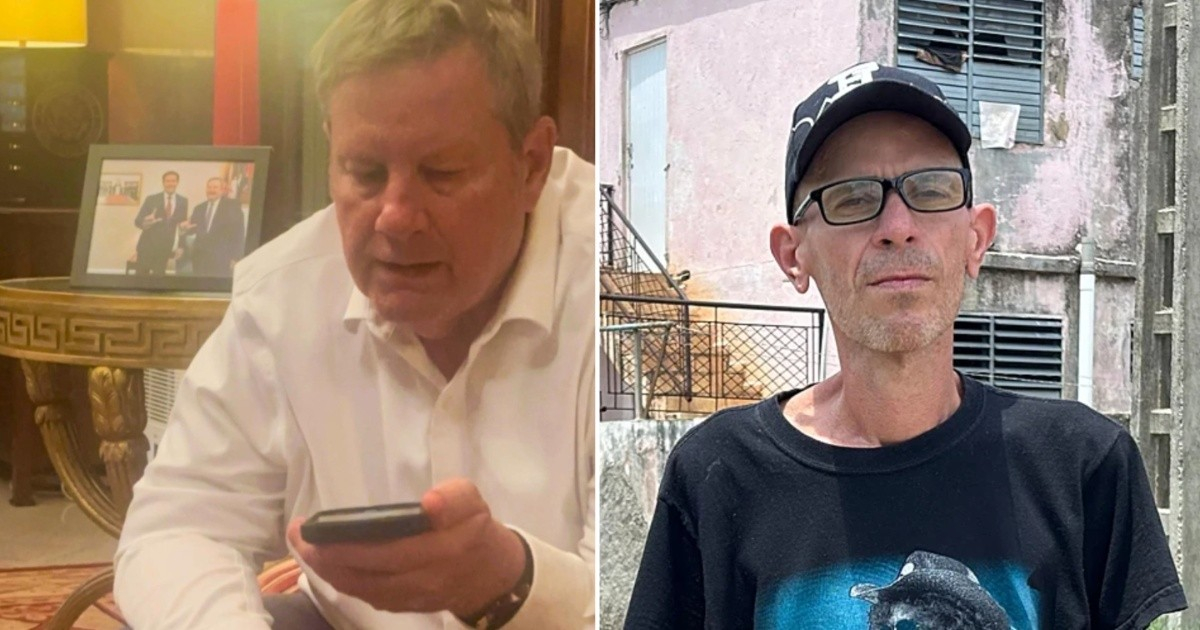
Mike Hammer, Mission Chief of the United States Embassy in Cuba, contacted Alexander Díaz Rodríguez by phone after learning of his release and seeing the images that the Spanish newspaper ABC published on its front page last Tuesday, showing the devastating physical condition of the Cuban political prisoner.
The U.S. Embassy shared the news on its social media and explained that Hammer wanted to personally verify the health condition of Díaz Rodríguez, motivated by the photographs that sparked a wave of international outrage.
"The suffering this man has endured is inexplicable. The United States will continue to insist that all those who remain unjustly imprisoned be released," published the Embassy of the United States in Cuba on its Facebook account.
Alexander Díaz Rodríguez is 45 years old and hails from Cárdenas, Matanzas province. He was arrested during the protests on July 11, 2021 in that city and sentenced to five years in prison on charges of "sedition" and "contempt."
He served his sentence in full, without receiving any form of clemency from the Cuban regime, and was released in early April 2026.
Upon leaving prison, his physical state was devastating. He had gone from weighing between 80 and 90 kilograms upon entering to just between 37 and 55 kilograms upon exiting, with ribs and bones visible under the skin, appearing decades older than his actual age.
During his imprisonment, he was diagnosed with thyroid cancer in 2022 and contracted hepatitis B, amidst reports of severe malnutrition, punishment cells, torture, and systematic medical neglect.
The newspaper ABC de España published last Tuesday a cover with the title "Cuban political prisoner Alexander Díaz, skeletal", featuring photos taken by correspondent in Havana Camila Acosta and Luis Felipe Larrondo. The images, which showcased the contrast between the before and after of the inmate, shocked the international public opinion.
The day before that headline, Díaz Rodríguez himself had described in a video the ordeal he endured over five years: abuse, punishment cells, and medical neglect.
The opponent José Daniel Ferrer, leader of the Unión Patriótica de Cuba (UNPACU), had publicly denounced his condition since the moment of his release, comparing Cuban prisons to "Nazi concentration camps".
The United States Embassy had already announced on April 16 that it was reviewing the case of Díaz Rodríguez and evaluating the possibility of granting him a humanitarian visa so he could receive medical treatment in U.S. territory. His mother, Moraima Rodríguez Batista, had pleaded in May 2025 for her son’s freedom with a heartfelt request that summarized the family’s struggle: "All I want is for my son to be able to live".
The case is part of a broader process: the organization Justicia 11J confirmed 20 political prisoners released in Cuba since March 2026.
However, more than 1,200 cases of political prisoners are documented on the island, a reality that President Miguel Díaz-Canel denied in an interview with NBC on April 13, claiming that there are no political prisoners in Cuba.
The United States maintains its position of maximum pressure on the Cuban regime and continues to explore humanitarian avenues for the most severe cases, such as that of Díaz Rodríguez, whose story has become a symbol of the treatment that the dictatorship dispenses to those who dare to protest.
Filed under: