
Related videos:
Animal Welfare Cuba (BAC) publicly denounced that individuals in Cuba are deliberately blinding jays to make them sing more or better in illegal bird competitions known as "topes," a practice that the organization described as "pure torture."
The report, shared on Facebook, directly points to the group "Tope de Reyes" —a private community with 26,000 members— as one of the places where these mutilated birds are promoted and offered. According to BAC, the birds are also said to be blinded to prevent them from escaping, in addition to supposedly enhancing their singing.
"It is outrageous the cruelty being inflicted on the songbirds in Cuba. In Facebook groups like Tope de Reyes and others dedicated to singing competitions, there are people who are blinding these birds so that they supposedly sing more or better," the organization warned in its post.
BAC was firm in rejecting any cultural justification for the practice: "They deliberately take away their sight, as if suffering makes them more valuable for their purposes. Blinding an animal is not a trick or a tradition, it is pure torture."
The organization also denounced the conditions in which these birds end up: "These birds, which should fly free and sing by instinct, end up confined, mutilated, and exploited just for the entertainment of a few."
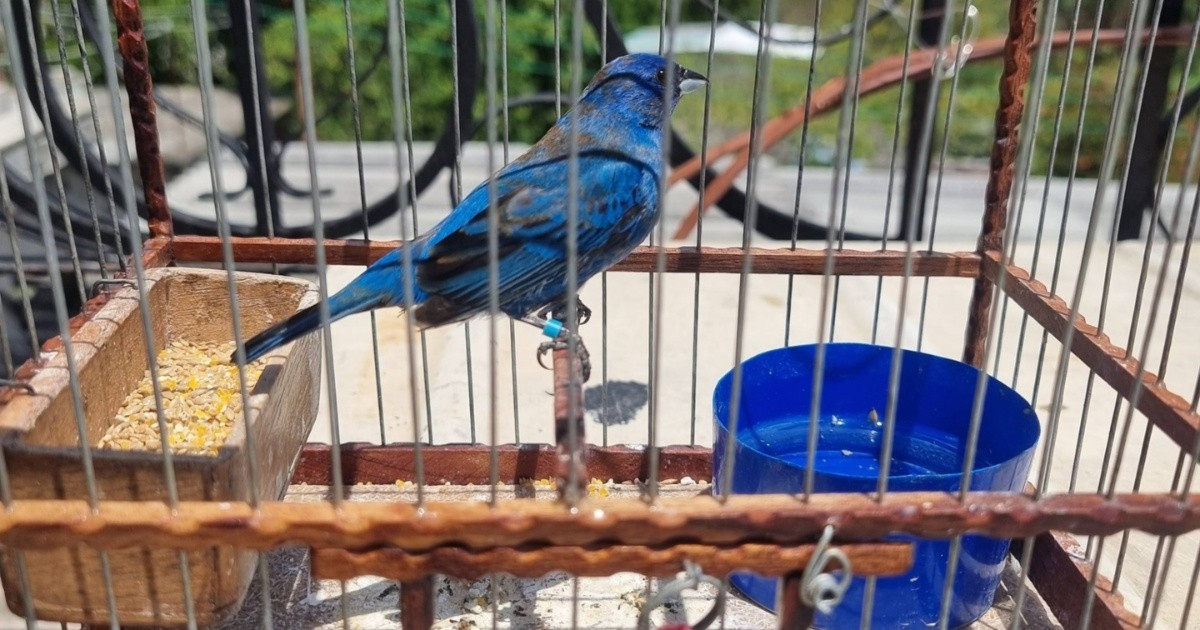
The indigo bunting (Passerina cyanea) is one of the most valued songbirds in Cuba and among the Cuban exile community, especially in Miami.
The males display bright blue plumage and are highly sought after for topes, competitions where owners pit their birds against each other in vocal duels with betting involved, typically held on Sundays in remote locations away from urban centers.
Despite the fact that Cuba has legislation that prohibits these practices —the 2011 Biodiversity Law and the Decree-Law 31/2021 on Animal Welfare explicitly prohibit the capture, mistreatment, and commercialization of wild animals without authorization—, the effective enforcement of these regulations is limited.
Participants in these illegal competitions share images and videos on social media without fear of sanctions.
The illegal trafficking of wild birds in Cuba has been on the rise, with confiscation operations reported in several provinces.
The largest captures of blue jays and other songbirds occur in September, during the migratory season, and adolescents are among the most active in trapping.
The practice of blinding songbirds has also been documented in the Cuban community in Florida, where it was marginally linked to practices of santería, although representatives of that religion clarified that it is not a widespread or representative practice.
Organizations like BAC have intensified their complaints due to the lack of institutional response. "We will not remain silent. We demand that these groups be investigated and that this practice be stopped immediately."
The organization concluded with a direct call to highlight the abuse: "The tiles deserve respect, not to become victims of an alleged competition. Enough with the abuse disguised as enthusiasm."
Filed under: