
Related videos:
A Cuban identified as Darlyn Bustamante reported this Saturday the poor quality of the peas that the government supplies to the population through the bodegas, stating that they are not even suitable for animal consumption.
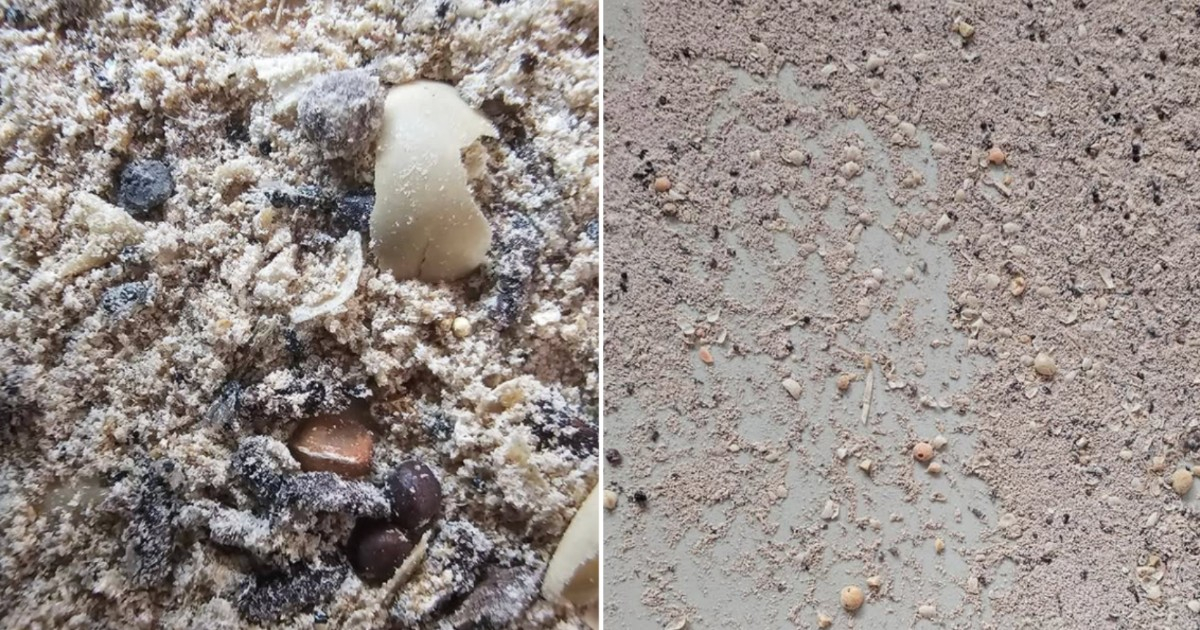
The post in the Facebook group "360 Matanzas Compra y Ventas Cuba," generated over 1,700 reactions after the woman shared that she found her grandmother crying with a bowl of peas in a state of putrefaction taken from the store La Perla, in La Playa, Matanzas.
"I don't usually post these kinds of things, but it breaks my heart," wrote Bustamante. "When I arrived today to visit my grandmother, I found her crying with a bowl of peas that she had just picked up at the La Perla store on the beach, in front of the little baseball field. It's inhumane that such decay is sent to the population; how is it possible that the storekeepers accept a product that isn't even fit for animal consumption?"
The photographs accompanying the publication show the peas reduced to grayish powder, mixed with dead insects, stones, and waste, completely infested and unfit for human consumption.
The report sparked a flood of testimonies from citizens across various provinces confirming that the issue is not isolated.
From Holguín, the user Lilly Díaz Martín reported that "the peas sold in the city's basic basket are parasitized" and that is why she didn't buy them. Her compatriot Yosvanis Rafael Hernandez Brunet added that "it's the same everywhere, here in Holguín they also can't be consumed."
Mirian Acosta described a similar situation at her store La Reforma, on Tirri Street: "It looked like gofio, it was so ground up." She noted that "many families rely on that grain to feed themselves; it is sent very rarely, and when it is sent, it's unfit for consumption."
Yolanda Pérez confirmed that the spoiled peas are arriving "at all the stores," describing them as "stiff as bullets." Fidel Angel Carrazana recounted that his 10 ounces of peas had no visible weevils, but that his family suffered from diarrhea for three days, which he attributed to a possible fumigation of the product.
The problem is neither new nor exclusive to Matanzas. In November 2025, residents of Havana and Guanabacoa already reported peas "full of bugs and a bad smell." In March 2026, residents of Artemisa reported that it was the third consecutive month that the peas arrived damaged and with weevils at the La Legal store.
The pattern repeats itself with other products from the rationing system: moldy rice in December 2025, rotten ground beef distributed to vulnerable groups in Santiago de Cuba in November 2025, and spoiled eggs that poisoned a family in Artemisa in April 2025.
The outrage in the comments is directed straight at the regime. "That doesn't hurt or interest them; they're busy with the new version of the Economic and Social Government Program 2026 and the signatures, they have no time or eyes for this," wrote Emilio Lozano. Rebeca López Crespo was more direct: "Because that is what the government believes the population deserves."
The context further exacerbates the situation. Since April 2026, the regime has eliminated general subsidies for the basic food basket, focusing them only on vulnerable individuals, while in Santiago de Cuba that same month, only 1 pound of sugar was distributed per person and 500 grams of pasta for children aged zero to 13 years.
"It's what we are experiencing in Cuba, poor our children and vulnerable people," summarized user Estrella Romero. "Our children and the elderly need better care and better attention."
Filed under: