
Related videos:
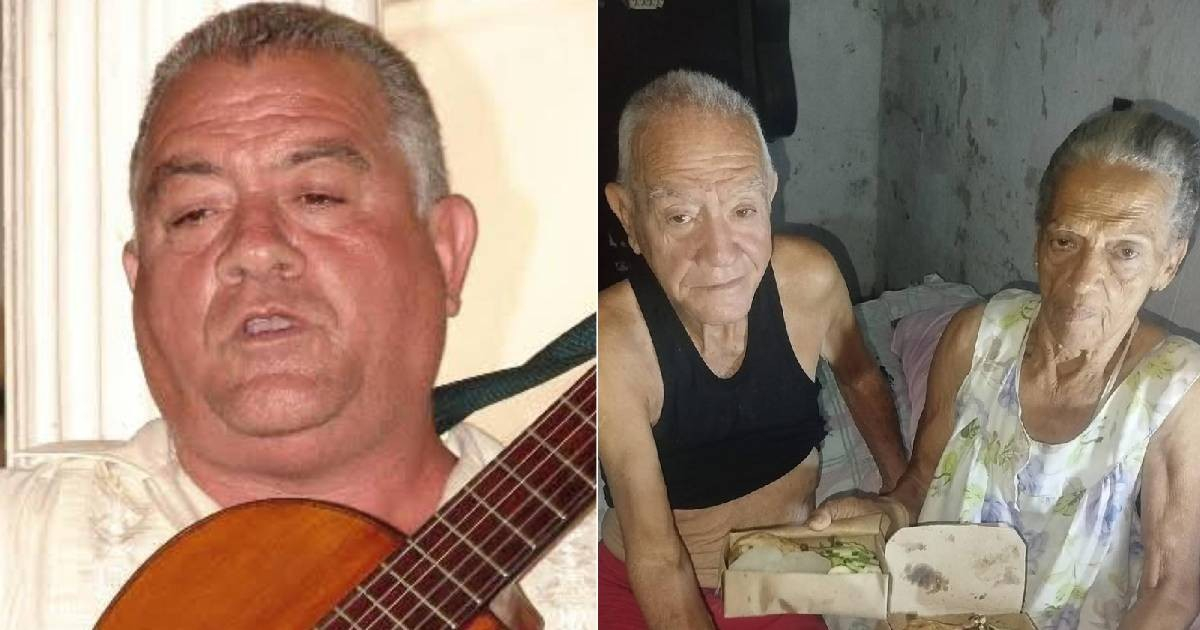
A photograph published on Facebook by the writer and academic Yanetsy Pino Reina has sparked outrage in Cuba and among the diaspora: the troubadour from Sancti Spíritus, José Ezequiel Cardoso, known as "Lalito," is shown alongside his wife Matilde—both very thin and advanced in age—in a room with deteriorating walls, holding boxes of food. The contrast with a previous image, where he appears robust and with his guitar, encapsulates in two photos the neglect to which the Cuban regime condemns its cultural creators.
Lalito is the founder of the Trío D'Gómez, a group created in 1994 alongside Carlos M. Gómez and Edelberto Rodríguez with the aim of reviving the anthology pieces of espirituana and Cuban trova. Recognized as the "Encyclopedia of Trova Culture" and "eternal chronicler of traditional espirituana music," he also founded the duo Colonial in 1963 and was a member of the Trío Cardoso along with his father and his brother Lázaro. An illness sidelined him from the stage, but his presence continued to be a living reference of the culture of Sancti Spíritus.
Pino Reina, born in Sancti Spíritus in 1977, posted the complaint on Facebook with a tone that mixes pain and indignation: "In Sancti Spíritus, there is a lot of talk about culture, events are organized, recognitions are given, and speeches are repeated about the importance of preserving our traditions, while in real life, something like this happens."
The writer left no room for ambiguity in pointing out those responsible: "The obese leaders of the party and the government, the president of the UNEAC, the lady who runs the music company: they are all guilty of this neglect."
Pino described the situation as "structural violence" and warned that it is "an abandonment that kills slowly, it settles in silently and ultimately seems normal until someone decides to name it."
The case of Lalito is no exception. The foreign press highlighted just two days prior the widespread abandonment of elderly Cubans, at a time when this humanitarian crisis is receiving maximum visibility.
A survey by the Independent Trade Union Association of Cuba (ASIC) of 506 retirees in five provinces, published last Sunday, revealed that 98.8% feel institutional abandonment and 99% state that their pension does not cover basic needs. Cuba has 1,774,310 registered retirees, with a minimum pension of 1,528 Cuban pesos per month—less than 10 dollars at the informal exchange rate—and the Ministry of Labor itself admitted in March that "there are no resources for the vulnerable."
The UNEAC, founded in 1961 and recognized as primarily responsible for protecting creators, has been repeatedly criticized for its indifference to the precarious situation of older artists. Retired musicians from EGREM protested in January 2024 over pensions of just 2,000 to 3,000 pesos, receiving no public response from the organization.
Sancti Spíritus is considered the second most troubadour province in Cuba, with a tradition that dates back to 1910 with the founding of the first trío espirituano. This century-old story is what the regime showcases in ceremonies while allowing its living protagonists to age in misery.
The troubadour Eduardo Sosa passed away in February 2025 at the age of 52 following a stroke, another name added to a growing list. An elderly graduate of the San Alejandro school of art was seen selling drawings on the street to feed himself, an image that captures the same logic of neglect.
"I'm not talking about charity or pity," wrote Pino Reina. "I'm talking about dignity, about moral coherence, and about respect for those who built the cultural prestige that is still presumed today."
Filed under: