
Related videos:
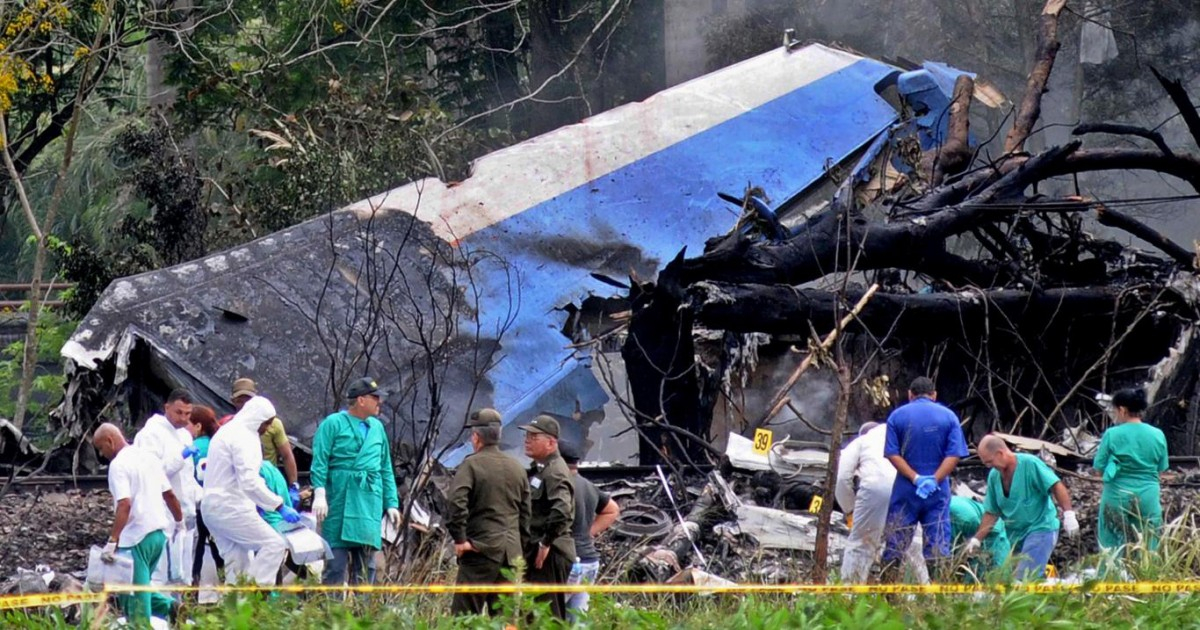
Almost eight years have passed since the tragedy of the flight 972 of Cubana de Aviación, the worst air disaster on the island in three decades, and the families of the victims remain trapped in pain, uncertainty, and a lack of justice. Without compensation and without those responsible prosecuted in Cuba, a recent ruling in Mexico has restored some hope to those who have continued to demand answers.
In April, a Mexican federal judge ordered the airline Global Air to pay 124.2 million Mexican pesos —about 7.1 million dollars— to the families of four crew members who lost their lives in the Boeing 737-200 accident that occurred on May 18, 2018, in Havana. The aircraft crashed just 35 seconds after taking off from José Martí International Airport en route to Holguín.
Of the 113 people on board, 112 died: 101 Cubans, six Mexican crew members, and five foreign passengers. Only one person survived.
The ruling marks a turning point because, for the first time officially, it establishes that the disaster was not an accident, but rather the result of serious negligence. According to the ruling, Global Air operated the plane without adequate maintenance and despite an existing flight ban due to a damage that the company itself was aware of and concealed.
For Noelia García López, who lost her daughter and granddaughter in the accident, the judicial decision comes after years of frustration. From Florida, where she currently resides, and in statements to Martí Noticias, she recalls that she tried to seek justice in Cuba without any response. “I went to seek this justice in my country, but my country did not give me that possibility,” she lamented. Nevertheless, she never stopped insisting: “What I wanted was to clarify what happened and to see justice done.”
The Spanish lawyer Carlos Villacorta Salis, representing more than 50 Cuban families and the sole survivor, Mailén Díaz Almaguer, described the ruling as a significant breakthrough after years marked by silence. He explained that the decision also sets a key precedent: a preliminary compensation of between 1.7 and 1.8 million dollars per victim, which could serve as a basis for future claims by the Cuban families.
But the decision also highlights the actions of Cubana de Aviación, which subcontracted Global Air under a wet lease. For Villacorta, it is clear that there was a lack of rigor in that process, with a minimal safety review sufficing to avoid the contracting.
Meanwhile, the legal battle continues on several fronts: class action lawsuits in Mexico, criminal charges against those responsible at the airline, and proceedings in international jurisdictions. However, the path is far from straightforward.
Global Air is facing a bankruptcy process initiated in 2024, raising doubts about the real possibility of families receiving compensation. This is compounded by another significant obstacle: the lack of cooperation from the Cuban government. The Mexican Prosecutor's Office has sent more than eight formal requests for information, but the island's authorities have not provided the necessary documents to advance the criminal investigation.
In the midst of this situation, the voice of Mailén Díaz Almaguer, the sole survivor of the accident, continues to resonate. Just a few weeks away from marking another anniversary of the tragedy, she reiterated her call for justice: "Let JUSTICE be the word that honors the coming May 18, after 8 years of so much suffering and uncertainty."
For families, that word remains an outstanding debt.
Filed under: