
Related videos:
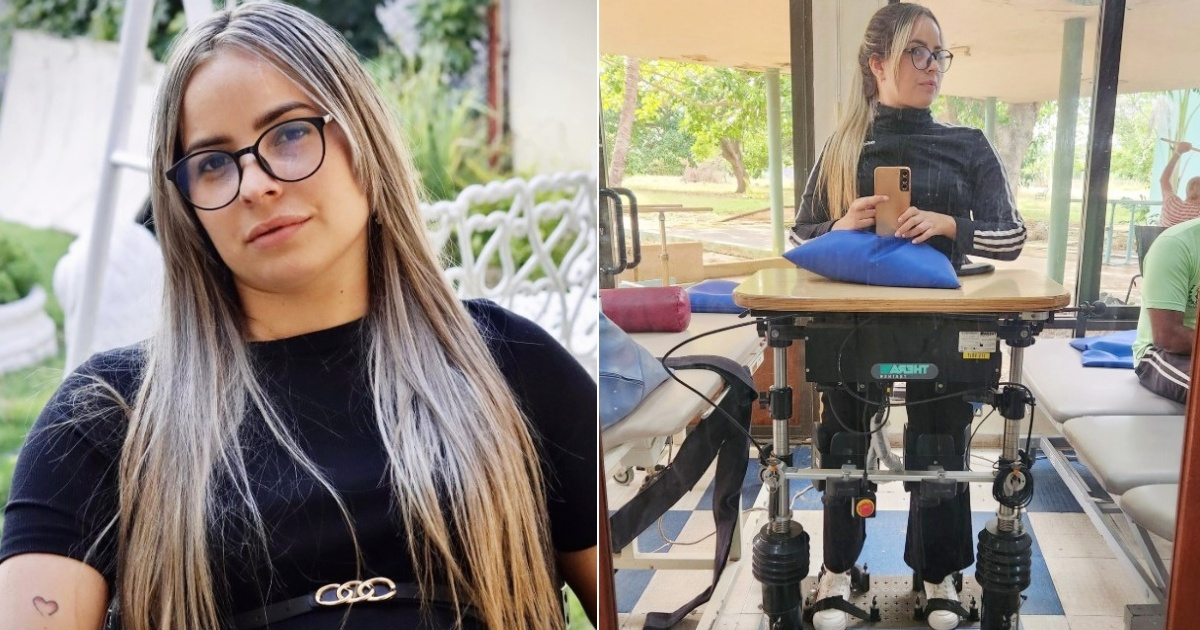
The young Cuban Mailén Díaz Almaguer, the only survivor of the plane crash that occurred in Havana in May 2018, shared an emotional reflection after she stood up again with the help of a standing frame, following nearly a year without being able to perform that action—an experience she described as painful yet revealing in her recovery process.
In an emotional post on Facebook, Mailén recounted how this experience, lived amidst her rehabilitation routine, ended up becoming a personal lesson that transcends the physical and can resonate with the everyday life of anyone.
“I could only stand for an hour… and it hurt, so then I understood something: when we stop doing something for a while, it’s hard to pick it back up. It’s like starting over,” he wrote.
The return to the bipedestator—a therapeutic device that allows individuals with motor difficulties to maintain an upright position—was not easy.
As he explained, what he used to accomplish for hours without discomfort now felt like the first attempt.
“What I used to do with ease -without pain, without fatigue, for hours- felt again like the first time,” she confessed.
Beyond its specific case, the experience leaves a clear lesson: any pause, in any area of life, requires effort to get back on track. There are no shortcuts to starting over.
Mailén took that idea further by comparing it to spiritual life, but her reflection can also be applied to habits, relationships, or personal projects.
“I thought the same happens with spiritual life… we stop seeking God as we did before… and when we decide to return, it hurts. It’s difficult. It feels strange. But it's not the end”, he reflected.
In that message lies a central idea: the pain of returning does not signify failure, but rather adaptation.
Trying again is, itself, part of the reconstruction process.
"Just resume the habit... so that little by little everything starts to align again," he asserted
Adapting to move forward
Despite the initial pain, her body began to respond over time, confirming another of the lessons her experience teaches: persistence transforms difficulty.
"The longer I stood, my body began to adapt... and I realized that if I continued, I could not only return to where I was... but become even better," he noted.
The lesson is clear: perseverance not only allows one to regain what has been lost but also to grow from the experience.
Discomfort is also part of
Another key takeaway was related to posture during exercise, a physical detail that led to a broader reflection.
“To stand up straight, I had to constantly correct myself. And correcting myself hurt,” he explained.
However, she accepted that discomfort as necessary: “Correction hurts, but it is necessary… not only in the physical sense, but in all areas of life.”
In his message, correction appears as a tool for growth, even if it involves discomfort or confrontation.
"If something hurts today... it may lead to correction. And although it may not feel good at the moment, it will bear fruit in due time."
In her latest publication, she found meaning once again in the everyday: “I love discovering how God speaks in the simple… in what seems routine.”
And it left a conclusion that summarizes not only its history but also the lesson it seeks to convey: “And in light of that, only one decision remains: to move forward.”
In that decision—to persist despite the pain, the pauses, the setbacks—lies the main lesson from Mailén Díaz: it is always possible to start again, even if it hurts.
A testimony that transcends its history
Mailén Díaz has documented her recovery process for years following the plane crash on May 18, 2018, which resulted in the deaths of 112 people. Since then, she has undergone multiple surgeries, faced the amputation of one leg, and experienced paralysis in both.
In March of last year, he had already shown progress in his rehabilitation, including the use of a standing frame as part of a key therapy to improve circulation, strengthen the muscles, and prevent complications.
His evolution has also been spiritual. In 2025, he announced the beginning of his Bachelor's studies in Theology at the Methodist Seminary of Havana, solidifying a path that, as he has explained, has allowed him to find meaning in his experience.
Over the years, Mailén has also reported on the difficulties of accessing medical supplies in Cuba, making it clear that her process has not been without shortages and obstacles.
However, your message emphasizes something deeper than adversity: the ability to learn even from pain.
Filed under: