
Related videos:
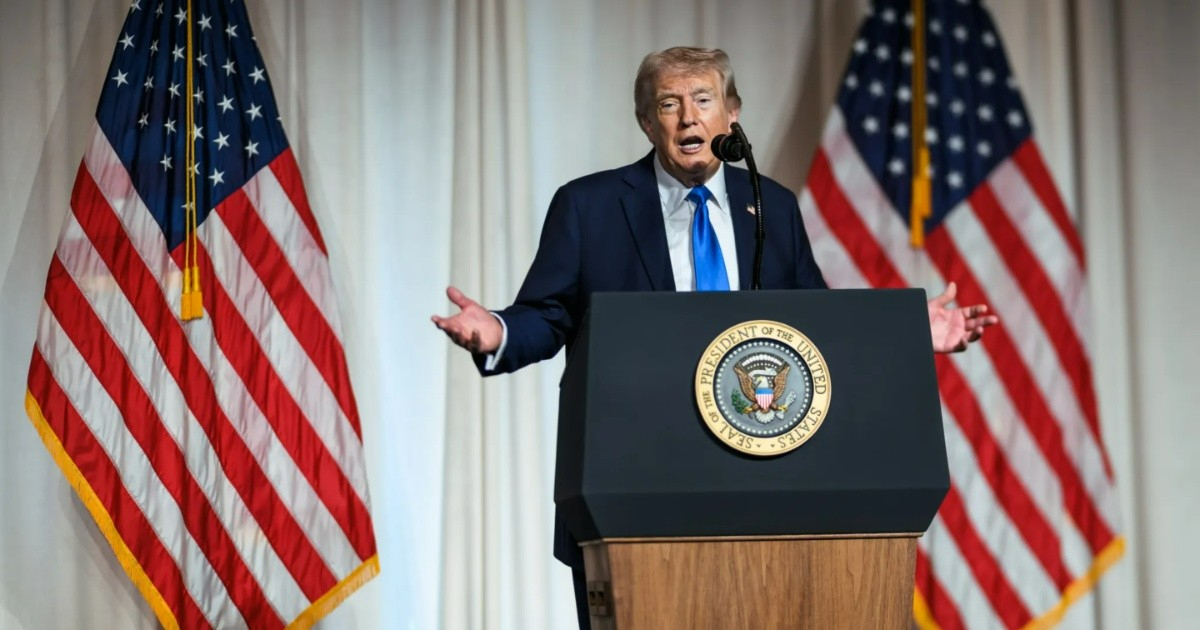
President Donald Trump announced this Friday that next week he will raise tariffs on imported cars and trucks from the European Union to 25%, in an escalation that threatens to shake the global economy at an already fragile moment, according to The Associated Press via Telemundo.
Trump posted the announcement on his social media platform Truth Social, where he accused the EU of "not fully complying with our fully agreed trade deal," without specifying in the message what his particular objections are.
The measure breaks with the so-called Turnberry Agreement, negotiated in July 2025 between Trump and the President of the European Commission, Ursula von der Leyen, at Trump's golf course in Scotland, which set a tariff ceiling of 15% on most European goods.
That agreement had already suffered its first blow in February of this year, when the U.S. Supreme Court ruled that Trump lacked the legal authority to impose tariffs under the economic emergency law, which effectively lowered the ceiling to 10% and forced the government to seek new legal avenues to reinstate them.
Following that ruling, the European Parliament suspended the ratification votes for the agreement, while the European Commission demanded that Washington honor its commitments: "An agreement is an agreement. As the largest trading partner of the United States, the EU expects the U.S. to fulfill its obligations outlined in the Joint Declaration."
The new 25% tariff directly impacts major European manufacturers: Volkswagen, BMW, Mercedes-Benz, Porsche, and Audi, among others. European stock markets reacted immediately with declines: Daimler fell 3.64%, Volkswagen 2.83%, Porsche 2.76%, BMW 2.28%, and Mercedes-Benz 1.66%.
The EU estimated that the Turnberry Agreement would save its car manufacturers between 500 and 600 million euros per month. In 2024, the bloc exported vehicles worth 50.889 billion euros to the United States, with Germany accounting for 64% of the total.
The total trade between both economies reached 1.7 trillion euros in 2024, according to the statistical agency Eurostat, averaging 4.6 billion euros per day.
The new tariffs will not apply to vehicles produced in American plants, which incentivizes European manufacturers to relocate their production to the United States.
This is not the first time Trump has threatened drastic measures against the bloc. In May 2025, he announced a 50% tariff on all European products, which was postponed after talks with Von der Leyen, and in January of this year, he threatened a 25% tariff on eight European countries to press on the sale of Greenland.
The Trump administration is also being investigated for trade imbalances and national security risks, which could put the Turnberry Agreement at additional risk of violation.
The European Commission had clearly warned in February: "EU products must continue to benefit from the most competitive treatment, without increases in tariffs beyond the clear and globally agreed limit."
Filed under: