
Related videos:
The European Union and the United States have officially signed a trade agreement that reconfigures transatlantic economic relations, following weeks of tense negotiations to avoid a tariff war.
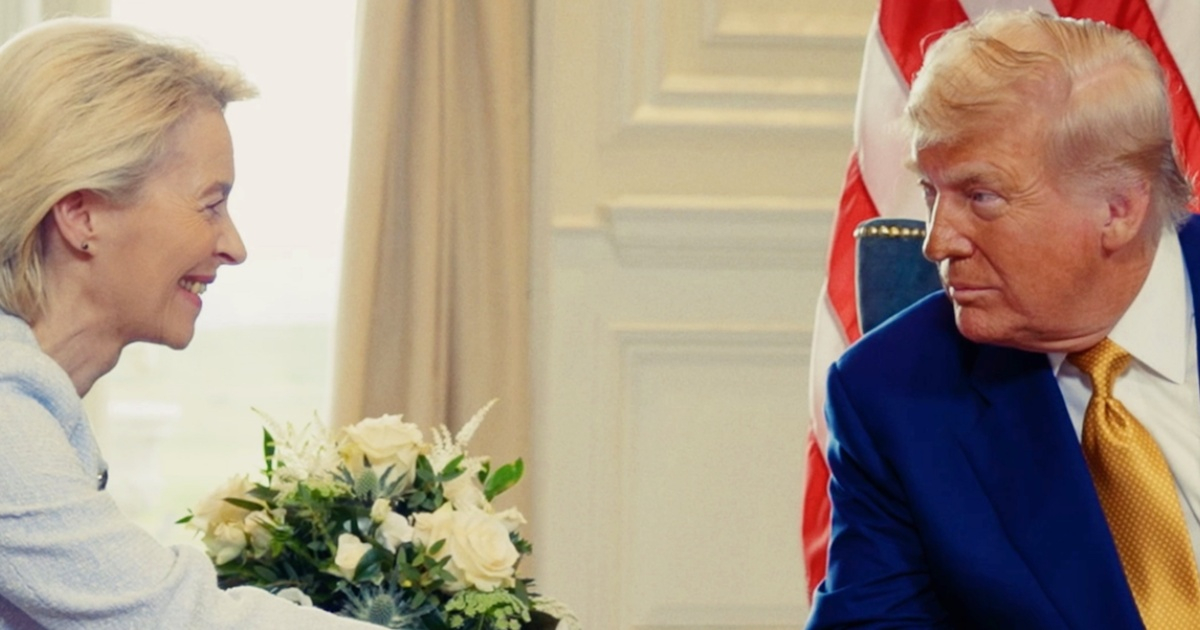
The document, which formalizes the political agreement reached between President Donald Trump and the President of the European Commission, Ursula von der Leyen, at the end of July in Scotland, includes high-impact economic measures in both blocs.
Among them, there is a notable 15% tariff on most European imports in U.S. territory, as well as the European commitment to make multi-million dollar purchases of energy and technology from American companies until 2028.
15% tariffs: an “acceptable” solution to avoid trade war
The center of the agreement is the imposition by Washington of a generalized tariff of 15% on approximately 70% of European imports.
The measure, effective from August 7, replaces previous taxes of up to 27.5% in key sectors such as automotive.
“The agreed burden is acceptable”, community sources have indicated, emphasizing that “the worst possible scenario” has been avoided, referring to the threat of an open trade war with tariffs of 30% or more.
In the automotive sector, which is highly sensitive for countries like Germany or France, the new 15% tariff represents a significant decrease compared to the previous 27.5%.
However, its effective implementation is contingent upon the moment Brussels begins to fulfill its part of the agreement.
This was explained by the European Commissioner for Trade, Maros Sefcovic, who clarified that there is a "commitment to apply the 15% cap on cars and car parts" from the first day the EU implements the agreement, with the possibility of retroactivity to August 1 if the planned schedule is met.
European millionaire commitment: energy, military, and technology purchases from the U.S.
In exchange, the European Union has made an unprecedented commitment to purchase from the United States in several strategic sectors. Among them:
Energy: Brussels will purchase liquefied natural gas (LNG), oil, and nuclear energy products from American companies for an estimated total value of 640 billion euros through 2028. This measure is part of the community goal to reduce its energy dependence on Russia.
Military material: The EU is also committed to acquiring weaponry and defense technology from American companies, although the total amount allocated for this chapter has not been specified.
Artificial intelligence chips: Europe has committed to importing AI chips for at least 40 billion euros, in an effort to close the technological gap with China and the United States in the field of advanced computing.
Benefited sectors and sensitive exceptions
The document also includes a list of products that will be exempt from the new tariffs or will benefit from reduced rates of "zero or near zero." Among them are:
-Planes and aircraft parts.
-Generic medications and their ingredients.
- Chemical precursors.
Natural resources not available in the U.S., such as cork.
In contrast, other sectors that have traditionally been strong in European exports, such as wine or spirits, have been excluded from the agreement for now.
"We have not been able to bring them in yet," Sefcovic acknowledged, although he assured that "the doors are not closed forever."
Internal criticisms and final political support
Although the initial reception of the political agreement was lukewarm in several European capitals - with Spanish Prime Minister Pedro Sánchez describing it as "not very enthusiastic" - the final signing of the document was preceded by a meeting of ambassadors to the EU, during which the text was evaluated "positively," according to diplomatic sources.
The moment of consolidating the pact was also symbolic: just three days prior, Von der Leyen, Emmanuel Macron, and German Chancellor Friedrich Merz were at the White House supporting Ukrainian President, Volodymyr Zelensky, in an event that also helped strengthen the united front with Trump.
Trump, true to his style, did not hesitate to reference the agreement in public.
"We have just finalized a major agreement with the German company", he said during one of his speeches.
During the negotiations, he had threatened several times to raise tariffs to 35% if a favorable consensus for the United States was not reached.
A roadmap for the "Trump era"
Although the document is not legally binding, it does serve as a clear roadmap for the commercial relations between both powers.
In the words of Von der Leyen: "The agreement represents a concrete demonstration of our commitment to fair, balanced, and mutually beneficial trade and investment. Predictability for our businesses and consumers. Stability in the world's largest trading relationship and security for European jobs and long-term economic growth."
The text also includes an open clause for future expansions.
"The U.S. and the EU agree to consider other sectors and products that are important to their economies and supply chains for inclusion in the list of products to which only 15% tariffs apply," the document reveals.
Sefcovic himself summarized the situation with a warning about the future: “This is not the end, just the beginning.”
Filed under: