
Related videos:
There is an uncomfortable truth that the Cuban regime has never been willing to confront directly, and which its spokespersons disguise with euphemisms whenever reality corners them: the Cuban Revolution, from its very first foundational act, decided that Cuba would live on handouts. It is not a consequence. It is not an accident of history. It is not the fault of the embargo. It is a structural decision made more than six decades ago and maintained with an ideological stubbornness that has condemned entire generations to a life of begging.
The deliberate destruction of the economic base
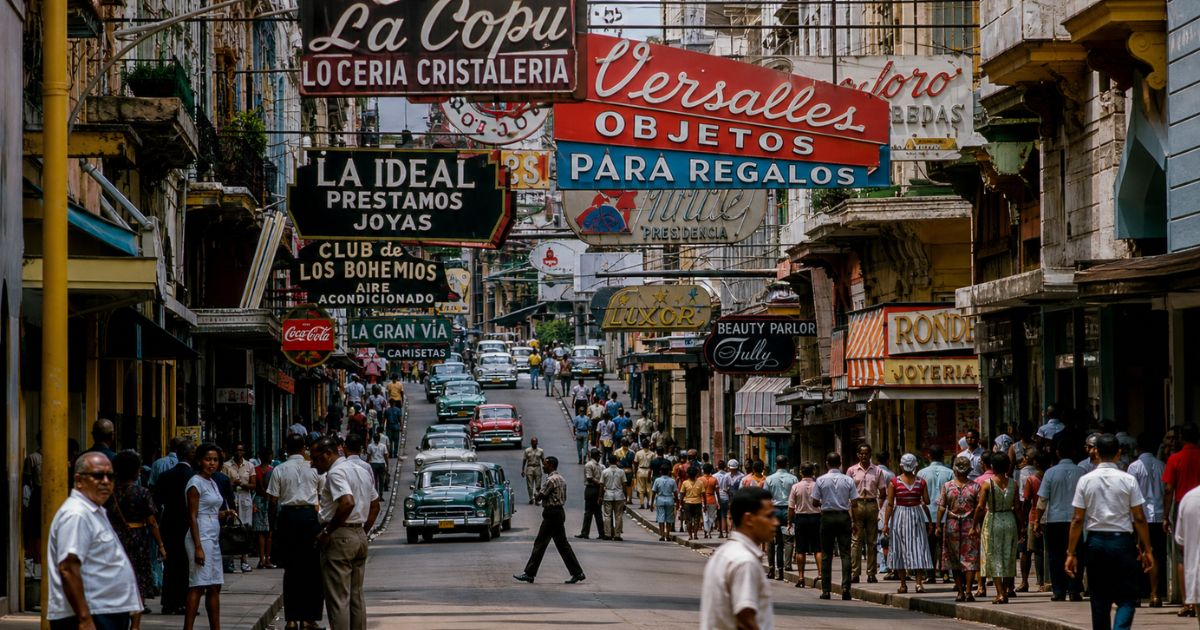
When Fidel Castro came to power in 1959, Cuba was the pearl of the Caribbean: a functioning capitalist economy with a real productive base—sugar mills, light industry, trade, a hardworking middle class—and small businesses that sustained entire neighborhoods. Within months, the nationalization of American companies began. But the regime did not stop there. In 1968, with the misnamed "Revolutionary Offensive," Castro wiped out even the last fritas stand run by the Chinese man on the corner: barber shops, street vendors, cafes, workshops, peanut stalls. Everything.
As long as the regime remains in power, Cuba will continue to be what it is today: the beggar of the world
What remained afterwards was not a prosperous socialist economy. It was an emptiness. A country without a business fabric, without the ability to generate its own wealth. And there, exactly at that point, arose a scheme that still persists today: Cuba would never again produce what it needs; Cuba would live off whatever others were willing to give it.
The great Soviet donation
For almost three decades, the Soviet Union supported Cuba with outrageous subsidies. Oil practically given away, sugar purchased at artificially inflated prices, soft loans that were never intended to be repaid, machinery, fertilizers, tractors, Ladas, KamAZ, food. Moscow transferred between four and six billion dollars annually to Havana in the 1980s. An astounding figure for an island of ten million inhabitants.
That was not an economy. It was a fiction sustained by the Kremlin. Cuba did not export products: it exported ideological loyalty, soldiers for African wars, and geopolitical positioning against the United States. In return, it received handouts. Generous, abundant, but handouts nonetheless.
The "Special Period": when the benefactor came to an end
In 1991, the Wall fell, and Cuba was left without a supplier. It wasn't a conventional economic crisis; it was the brutal collapse of a country that had never learned to sustain itself. GDP fell by more than 35% in four years. People ate cats, fainted at bus stops, and lost teeth due to malnutrition.
The regime called it the "Special Period in Times of Peace," a masterpiece of Castro's linguistic cynicism. It was nothing special: it was simply what happens when a country used to begging finds itself without a benefactor.
Venezuela: the leech in action
As soon as Cuba caught wind of the opportunity, it latched on to Hugo Chávez like a leech. For almost two decades, it drained Venezuelan oil, leaving Venezuela in ruins: over 100,000 daily subsidized barrels in exchange for "doctors" whose salaries were confiscated by the regime, for advisors in repression, and for intelligence to perpetuate Chavismo in power. Cuba did not save Venezuela: Cuba devoured it.
When the Venezuelans awoke, it was already too late for them. Then the regime hopped to Mexico, to Russia again, to anywhere it could reach out its hand.
Remittances: the charity of the everyday Cuban
But there is an even greater, more constant, and more humiliating form of charity: the remittances sent by Cubans in exile. Hundreds of millions of dollars a year in remittances support domestic consumption, fill the MLC, pay for medications that the "free" healthcare system no longer provides, and buy the chicken that the rationing system does not supply. The very people whom the regime labeled as "worms," "scum," and "apatriots" are now the ones keeping the island alive. Without Miami, without Madrid, without Tampa, without Houston, Cuba would have collapsed years ago. The diaspora is, for now, the main supporter of the regime that expelled it.
The present: donation boats and the hat in hand
And we arrive at 2026. The last oil tanker that entered Cuba was a donation from Russia. The one before that was another donation from Mexico. The regime has publicly admitted that it needs eight ships per month to minimally sustain the country, but it has no way to pay for them. What's the official solution? Ask. Ask Mexico, ask Russia, ask China, ask Vietnam, ask the UN, ask the World Food Program. Donated rice, donated powdered milk, donated medicines, donated sugar — donated sugar to Cuba!, the country that for a century was the world's sugar producer.
The pearl of the Caribbean has officially become the world's beggar.
How long?
How long are we going to accept that our government maintains an economic model whose only logic is international begging? How long will "sovereignty" be measured by the number of donated ships that arrive at the port of Mariel?
A hardworking, enterprising, and talented people —Cubans are this, as they demonstrate every day in Miami, Madrid, Quito, Houston, and anywhere they are allowed to work freely— are condemned to destitution because an ideologically fossilized regime refuses to loosen its grip. Maintaining power is deemed more important than allowing production. For the Cuban to thrive within Cuba would mean admitting that sixty-seven years of "revolution" have been sixty-seven years of failure.
The truth is this, without bravado but without euphemisms: Cuba is not poor because of the embargo. Cuba is poor because its regime chose the path of begging over the path of production. And as long as that regime remains in power, Cuba will continue to be what it is today: the beggar of the world.
The question is not whether the model is going to collapse — it has already collapsed. The question is how much longer we Cubans will accept living amidst the ruins of that collapse, waiting for the next donated ship, the next remittance, the next handout.
Filed under:
Opinion article: Las declaraciones y opiniones expresadas en este artículo son de exclusiva responsabilidad de su autor y no representan necesariamente el punto de vista de CiberCuba.