
Related videos:
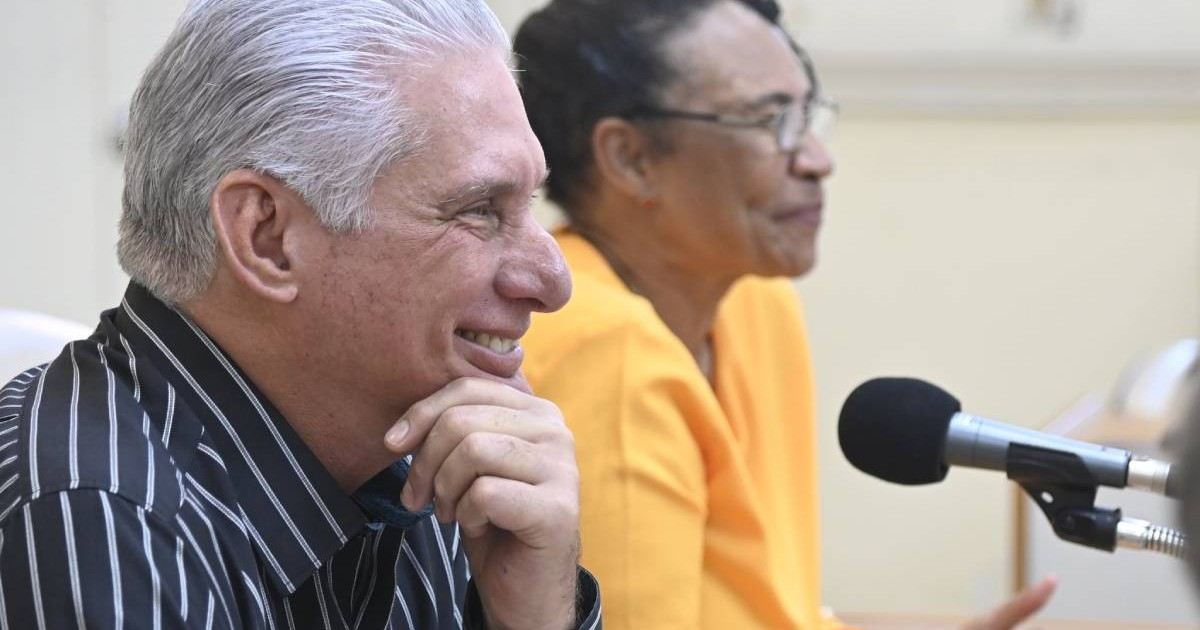
Miguel Díaz-Canel visited the University of Havana on Wednesday to engage in a dialogue with researchers and professors working on Artificial Intelligence projects.
The Presidency of Cuba announced on the social network X that in the meeting with the ruler, there were professors from the faculties of Physics, Mathematics and Computing, and Social Communication, along with authorities from the Ministry of Higher Education, the Ministry of Communications, and executives from the university itself.
Several academic projects were presented, and topics that the regime considers strategic were addressed. Among them are the management of national data, the transformation that AI implies for the education sector "from primary levels to university," and the need to foster a culture around these issues in society.
The official discourse sounds extremely disconnected from reality, as these "debates about AI" come amid an energy crisis that has the country paralyzed. The supposed outcomes must be applied in universities with technological obsolescence and in destroyed schools where there aren't even enough pencils and notebooks for the students.
The Presidency of Cuba only mentioned one aspect of self-criticism, the academy-business relationship in AI development which is «not always successful», an admission that reflects the structural difficulties Cuba faces in translating "research" into concrete applications.
Furthermore, they assert that Cuban universities are already collaborating with sectors such as health, education, energy, industry, and transportation "in order to streamline and optimize processes." However, the statement itself acknowledged that the country is "still far from what it needs."
This visit is part of a series of initiatives that Díaz-Canel has promoted regarding AI in recent months. In April, the leader met with scientists to review AI projects applied to health, including the CARDENT project, aimed at predicting cardiovascular diseases.
In November 2025, during the Havana International Fair, the Consortium of Artificial Intelligence of Cuba was established with 22 founding members, including the University of Havana, the University of Computer Sciences, ETECSA, and BioCubaFarma.
In April 2025, Díaz-Canel signed an agreement with Russia to create a joint AI laboratory during the XXII Cuban-Russian Intergovernmental Commission, adding Moscow as a technological partner in an area that the regime declares as a priority.
The Faculty of Mathematics and Computer Science at the University of Havana also developed CecilIA, a language model in Cuban Spanish trained with 2.7 gigabytes of national data, including press, laws, literary works, and political speeches.
The contrast between the regime's technological ambitions and the reality of the country is striking.
Cuba experiences power outages of more than twenty hours a day and has limited connectivity, conditions that complicate any real strategy for digital transformation in the country.
Díaz-Canel's visit to the University of Havana serves only to present him smiling, dreaming of a better future, in a country that is crumbling and on the brink of military confrontation with the United States.
At the end of April, the U.S. government announced the establishment of the SOUTHCOM Autonomous Warfare Command (SAWC), a new military structure dedicated to the deployment of unmanned, semi-autonomous, and autonomous systems throughout the region.
The term "autonomous warfare" refers to the use of military systems capable of operating with a high degree of human independence, relying on artificial intelligence, advanced sensors, and automation.
Filed under: