
Related videos:
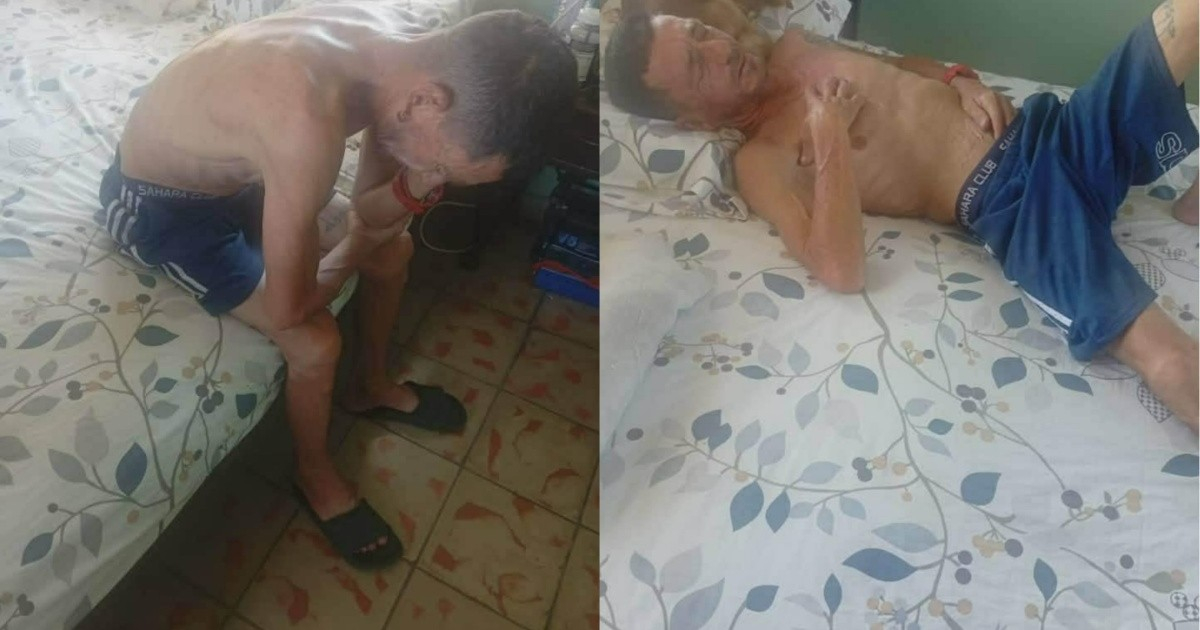
Juan Carlos Méndez, a Social Assistance worker from the Ministry of Labor in Placetas, Villa Clara, publicly denounced on Facebook the critical situation of Yoel Galíndez Jiménez, a patient diagnosed with esophageal carcinoma who is being denied the minimum necessary care by the Cuban healthcare system to begin treatment.
According to his wife, Ámbar Vargas Casas, the family has made four trips to the Celestino Hernández Robau Oncology Hospital in Santa Clara, without managing to have a CT scan performed, a crucial examination to determine the stage of the illness.
The institutional response has always been the same: the study can only be conducted through admission, but when they attempt to admit the patient, they are informed that there are no beds available.
Meanwhile, time passes and the family barely has resources to feed him and cope with the situation.
Méndez, who due to their position has direct knowledge of the institutional workings and vulnerable cases in the municipality, warns that this is not the first time they have faced abandonment situations in Placetas.
"It seems that when the problem becomes public and the world starts to pay attention, that's when the leaders, the inspections, and the promises appear," wrote the whistleblower, recalling that previous photos of the local hospital went viral and led to government visits that did not address the underlying issues.
He also reported having arranged a visit from Mike Hammer, the head of the U.S. Embassy mission in Cuba, to another critical case in Placetas, which led to the immediate involvement of social workers.
"At the end, they didn't solve anything. Absolutely nothing," he declared.
In the same post, Méndez denounces a corruption network within the hospital itself: he claims that they charge 200 dollars for an ultrasound, that the head of radiology is behind a scheme where iodine "shows up" when money is involved, and that even hospital beds are being sold.
"Everything operates like a mafia, and the head of radiology is behind all of this," he wrote, citing the case of a relative from Camajuaní who paid 80 dollars for a bed the previous week.
The whistleblower also outright rejected the official argument of the embargo to justify the crisis: "Don't come to me with the 'blockade.' Because when a country is truly blocked, there are no privileges for anyone. So, why does the ruling elite have access to everything?"
He added with irony, "I remember that at school they told me that in capitalism beds were 'resolved' through politics, but today in Cuba they are sold in dollars. That is the 'medical power' they talk so much about."
The case of Galíndez Jiménez is not an isolated incident. Medical negligence in Cuba and the abandonment of cancer patients have been documented in multiple provinces.
In January 2026, a Cuban doctor held the regime responsible for the death of José Jardiel Mejías, a young man from Holguín with facial osteosarcoma who passed away without receiving treatment, stating that "his illness was curable and they did not treat him."
Days earlier, that young Cuban had died after a long battle against cancer with no response from the State.
The Celestino Hernández Robau Hospital itself, a reference oncological center for Villa Clara, was highlighted in 2024 by the ICLEP for lacking swabs for clinical analysis, with a specialist confirming that they only received materials for 20 tests daily.
In Placetas, the second oldest municipality in Cuba, the inadequacy of the healthcare system hits particularly hard on a population that relies on it with no alternatives.
Méndez concluded his statement with a warning that encapsulates the tragedy: "It is sad that in this country, demanding to live makes you a target, but silence is complicit in abandonment and lies."
Filed under: