
Related videos:
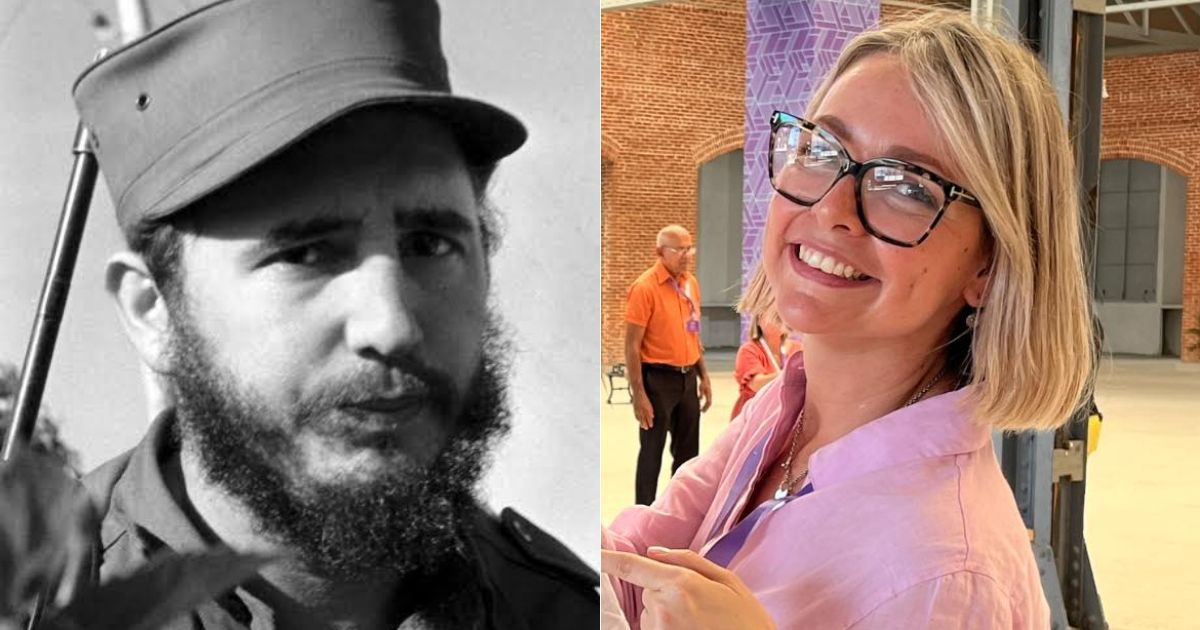
Marxlenin Pérez Valdés, Doctor of Philosophical Sciences, host of the state program "Cuadrando la Caja" and wife of Fidel Castro's grandson, published this week on Facebook a new installment of her devotion to the Commander, recalling a phrase from 2008 that, according to her, "18 years later is still relevant": "How difficult it is to be brief in the battle of ideas!"
The irony is so great that it almost requires its own four-hour speech to explain itself. That phrase comes from a reflection that Castro titled "No making concessions to the enemy ideology," with which he closed that text on April 15, 2008. The man who wrote it is the same one who holds the record for the longest speech in the history of the UN General Assembly: 269 minutes delivered on September 26, 1960, according to United Nations documents.
But that's not all. Castro also spoke for seven continuous hours on television in January 1959, following his entry into Havana, in what was described as a possible world record. He granted a 17-hour interview to Italian journalist Gianni Miná, one of the longest in history. A man who understood very well the challenge of being brief because he never really tried too hard.
Castro was so aware of his own verbosity that in some of his reflections, as he often did in his speeches, he promised to "be brief" so as not to tire his audience. A promise that, like so many others from the regime, remained unfulfilled: between 2008 and 2016, he wrote over 500 "Reflections" published in Granma and Cubadebate; some of which contained inconsistencies that, apparently, no one was authorized to correct.
Marxlenin, true to form, does not hold back in his analysis. In his post, he warns that "virtuality and its codes" complicate the "battle of ideas of dignified peoples." The culprits, of course, are "the owners of the world" who "invent trendy consumer fantasies" so that their "ideological battle goes unnoticed while it infiltrates the minds of our people." He concludes with a Castro-style warning: "We must be very careful not to play into the hands of the enemy ideology."
It is not the first time that the academic has turned to the "horse" to confront the crisis. In November 2025, she published in Cubadebate "It was worth being born and living in Fidel's century," urging to seek in the dictator's legacy the answers to current problems. Users responded with their own summary: "The horse left a debt that even a goat can't leap over."
Her name—a combination of Karl Marx and Vladimir Lenin—was chosen by her parents while they were studying philosophy at the University of Havana, where she herself eventually became a full professor of Marxism. She is married to Fidel Castro Smirnov, the grandson of the dictator, which places her at the center of the Cuban political-ideological elite.
The context in which this new praise appears is, at the very least, striking. This week, blackouts in Cuba continued to worsen with a power generation deficit nearing 1,900 MW, with outages of up to 24 hours daily in eastern provinces such as Granma, Holguín, and Santiago de Cuba.
The food situation is equally serious: 33.9% of Cuban households reported experiencing hunger in 2025, an increase of 9.3 percentage points compared to 2024, while 96.91% of the population lacked adequate access to food in April 2026. 80% of Cubans believe the current crisis is worse than the Special Period of the 1990s.
In that scenario, invoking Castro as an ideological compass and warning about the "enemy ideology" is precisely the kind of exercise that the Commander himself described as "the battle of ideas": long, repetitive, and completely disconnected from the reality experienced by Cubans. Castro was right that it is difficult to be brief in that battle.
Filed under: