
Related videos:
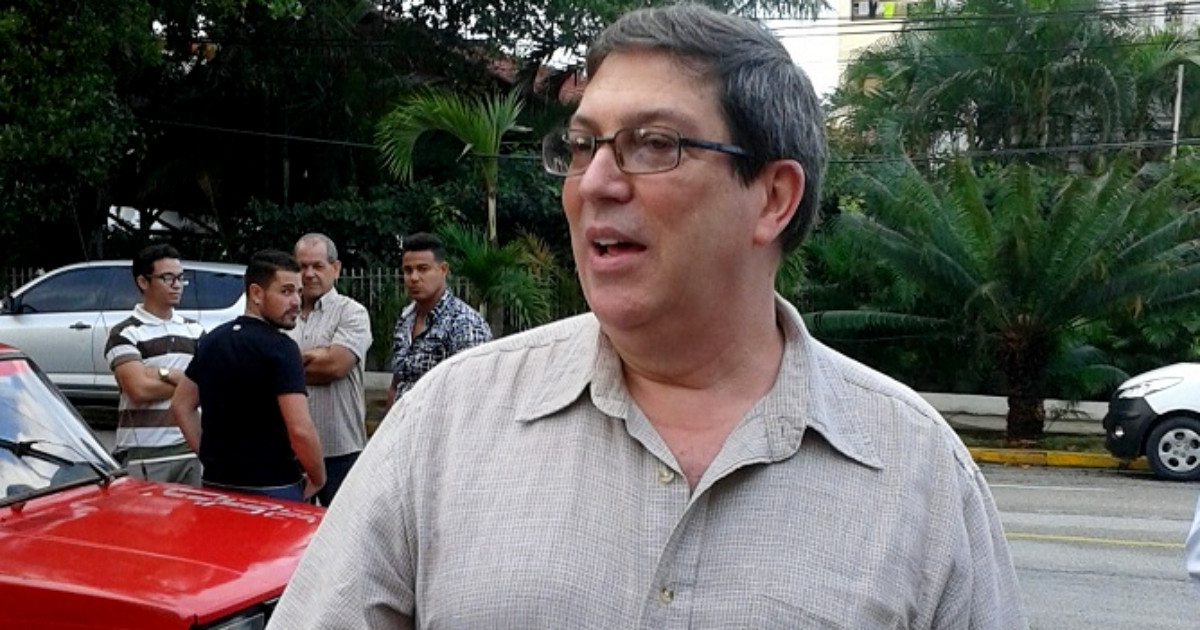
Cuban Foreign Minister Bruno Rodríguez Parrilla described the offer of 100 million dollars in humanitarian aid announced by U.S. Secretary of State Marco Rubio as "cynical." However, he ultimately faced a flood of criticism from citizens who returned the label to the Cuban regime.
Rodríguez accused Rubio of "fabricating" a "tale" to justify "the criminal abuse against the Cuban people," after the U.S. official
It requires a high degree of cynicism to make a statement, without feeling any shame and in such a misleading way, about alleged assistance," stated the Cuban Foreign Minister, who even questioned whether Rubio "was being truthful at the Holy See," referring to his visit to the Vatican and meeting with Pope Leo XIV.
The reaction on social media was immediate and particularly harsh against the regime itself. Many Cubans recalled the history of official lies and the contradictions of a government that constantly blames the United States while the country sinks into blackouts, inflation, and shortages.
"Cynicism is something you all know a lot about," wrote Teresa Menéndez. Others went further by recalling one of the most controversial denials of Cuban diplomacy: the military presence of the island in Venezuela.
"I don't know how it's possible for our foreign minister to accuse someone of lying when he didn't hesitate to lie to the entire Cuban people about the military presence of Cubans in Venezuela," commented Iván Salazar.
The criticism directly targets a public statement made by Bruno Rodríguez himself in May 2019, when he asserted that “there are no Cuban troops in Venezuela; nor are there Cubans participating in military or security operations there.”
However, the official newspaper Granma acknowledged in January 2026 the death of 32 Cuban soldiers in operations on Venezuelan territory as part of Nicolás Maduro's escort.
“Cynical is the same one who swore there were no Cuban soldiers in Venezuela,” Wichy Suárez summarized.
Other comments focused on the regime's economic priorities and the deterioration of living conditions within Cuba.
Mirell Piloto questioned how the government has built dozens of hotels while the electrical system collapses. "There are 20 new hotels that have been constructed in the last 10 years and not a single thermoelectric plant to provide power to the people," she contrasted.
Criticism against the Business Administration Group S.A. (Gaesa) has also resurfaced, the military conglomerate that controls a significant part of the Cuban economy. "I would like a face-to-face conference to see where Gaesa invests the money," wrote Gustavo García.
The controversy arises amidst another uncomfortable contradiction for the official discourse. While the Ministry of Foreign Affairs denounces that U.S. aid seeks to provoke “an explosion” in Cuba and regime officials label it as “handouts” and a “dirty political scheme,” Caritas Cuba reported that it has already executed 82% of an initial donation of three million dollars sent from the United States for families affected by Hurricane Melissa in the eastern part of the country.
According to the organization, the aid benefited 8,800 families in Santiago de Cuba, Holguín, Las Tunas, Granma, and Guantánamo.
The dispute occurs in a context of increasing economic deterioration and heightened pressure from Washington. Since January, the Trump administration has imposed more than 240 sanctions against Cuba and intercepted at least seven tankers linked to the island's energy supply, while the Intelligence Unit of The Economist projects an economic decline of 7.2% for Cuba in 2026.
Amid the political clash between Havana and Washington, many Cubans once again voiced the feeling of abandonment of a population caught between sanctions, propaganda, and a permanent crisis.
“The ordinary people are the ones paying for the ills,” summarized Regina Puente Téllez.
Filed under: