
Related videos:
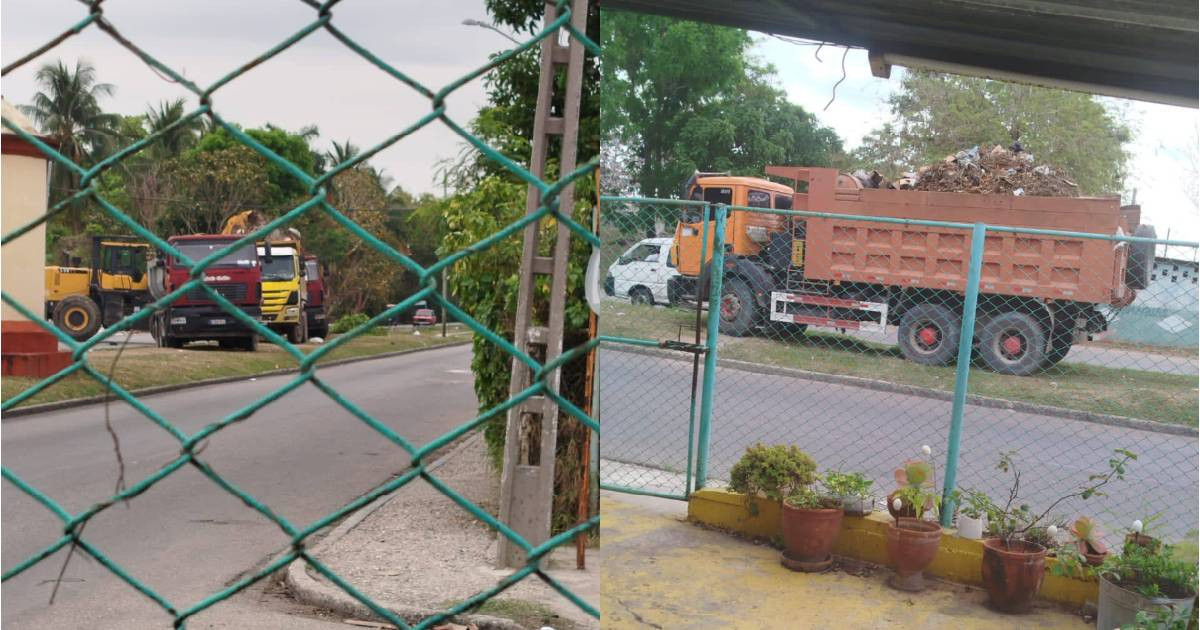
Residents of the section of Vento Street near the Casino Deportivo in the Havana municipality of Cerro reported on Friday that dump trucks and front loaders used in garbage collection operations are driving and operating on the central divider that covers the Albear canal, the 19th-century hydraulic work that still supplies water to part of the Cuban capital.
The author of the publication, Mario Hui, warned through his Facebook profile that this area "is not intended for traffic, parking, or operations with heavy equipment, due to the significance of the ancient and delicate construction built almost two centuries ago by the engineer Francisco de Albear."
The alarm escalated with the testimony of neighbor Herminia Watson Brown, who confirmed that there is already a hole in the area from which the hydraulic canal can be seen.
“If they continue, they are going to break it, and now the trucks are going over it as well; there is negligence all around,” Watson noted in the comments on the post.
Hui posed the question that encapsulates the collective fear: "Can you imagine if a collapse of this hydraulic canal were to happen... how many hundreds of thousands of consumers in this large city would be left without the precious liquid?"
The Albear Aqueduct was designed by the Cuban engineer Francisco de Albear y Lara (1816-1887); construction began in 1861 and it was officially inaugurated in 1893. It operates by gravity, without mechanical pumping, capturing water from the Vento springs and transporting it about 20 kilometers to Havana.
It has been declared a National Monument, is one of the Seven Wonders of Cuban Civil Engineering, and is part of UNESCO's Global Network of Water Museums. It currently supplies approximately 15% of the water needed by the capital.
The report comes amid an unprecedented water crisis in Havana. According to official data from Aguas de La Habana, around 200,000 residents of Havana, approximately 10% of the capital's population, are experiencing some form of water-related issue, a figure that citizens themselves consider to be greatly underestimated.
The pattern of destruction is neither new nor isolated. In La Lisa, a backhoe from Comunales Services broke a main pipeline during trash collection, recently leaving families without supply for over 10 days with no institutional response.
In the Martí neighborhood, near the reported section, heavy machinery created makeshift "pools" at the corners where water collects with solid waste.
Neighbor Libertad González Lajara reported that garbage trucks knocked down and cut telephone cables right on the Vento roadway, and "they just left them there," with no one having repaired them.
Several citizens directly pointed to the regime as responsible. Frank Alberto Hernández stated, "It's the fault of the government—local, provincial, and national. It’s a chain of blame that has been dragging on for years. The one in charge is a 'cadre' appointed by someone for their political merits, but not for their knowledge."
Abel Del Pino Fernández encapsulated the citizens' outrage with a widely circulated phrase: "It’s unbelievable that no one cares about this or that someone's common sense suggests that one of the seven wonders of Cuban engineering passes underneath... and is still in service. This happens when everything belongs to no one."
The Food Monitor Program NGO documented that the black market for water in Havana has reached extreme levels: illegal pumps known as "water thieves" are being sold for up to 36,000 Cuban pesos, while private water trucks cost between 18,000 and 26,000 pesos per load.
87% of the supply system depends on the national electrical grid, which makes it vulnerable to chronic blackouts, while the Albear channel, functioning by gravity, is one of the few components that operates independently.
Filed under: