
Related videos:
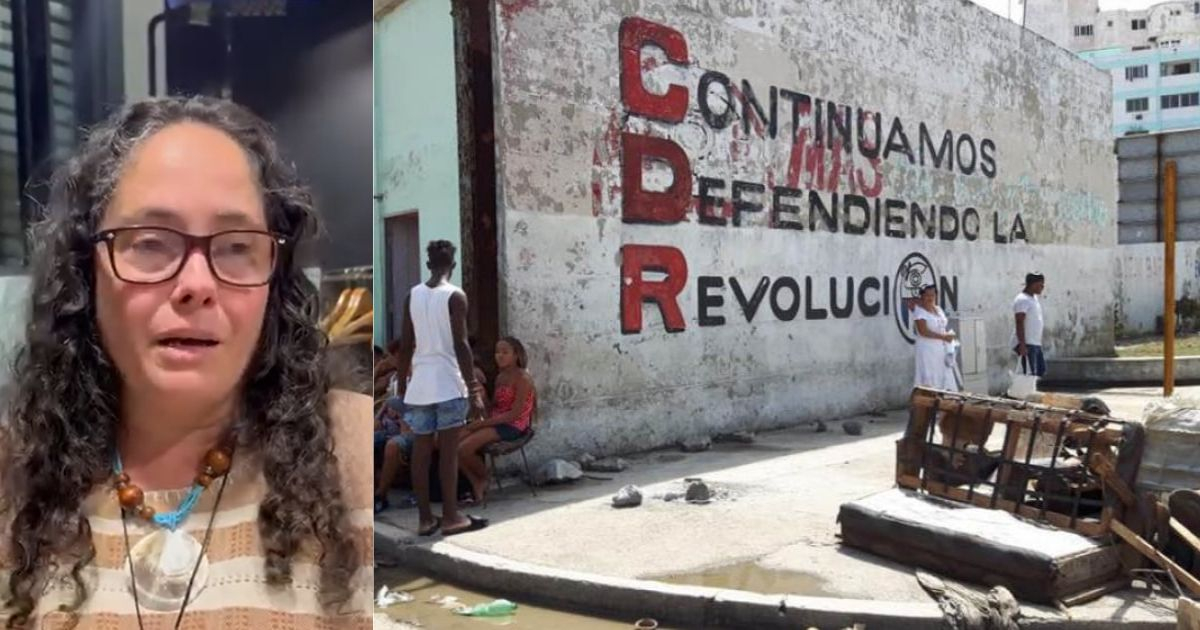
The Cuban essayist and researcher Hilda Landrove published on Friday in Rialta Magazine the essay “Cuba: the totalitarian vise and the desire for change that is sabotaged yet intact”, a text that dismantles the meta-narrative of the heroic revolution and analyzes the structures that have kept the Cuban regime standing for more than six decades, amid the unprecedented systemic crisis facing the Island in 2026.
The essay has a revealing origin: it was written for a progressive European magazine and rejected for two reasons that Landrove uses as the starting point for his analysis.
The first was that the publication required condemning Donald Trump's policies before allowing any criticism of the regime. The second was that the editors feared the Cuban government would feel "disrespected," with possible repercussions for individuals connected to the organization.
"Cubans are constantly pushed to first make a kind of confessional acknowledgment of the evil of imperialism before daring to take a critical look at the Cuban regime," writes Landrove, who sees this rejection as an expression of widespread self-censorship in media and organizations around the world that has contributed to sustaining the revolutionary myth and denying "its long history of human rights violations."
One of the central themes of the essay is the distinction between "revolution" and "regime." For Landrove, what is currently waning in Cuba is not a revolution—an transformative event that concluded decades ago—but a specific political regime, solidified at the First Congress of the Communist Party of Cuba in 1975 and endorsed in the 1976 Constitution, modeled after the Soviet Stalinist framework: a single party, a centralized economy, and the suppression of civil rights.
"2026 could be the year —several analysts indicate— for the end of the Cuban regime," writes Landrove, in a context where Cuba has experienced an economic contraction of -23% since 2019 and faces blackouts of up to 30 hours a day affecting 64% of the territory, with a projected GDP decline of -7.2% for this year.
The essay outlines the history of external economic dependencies that have sustained the regime: first the USSR, whose collapse triggered the Special Period in the 1990s; then Venezuela from 1999, when Hugo Chávez's victory allowed the model to be resumed without any democratization.
That second dependency was abruptly cut off on January 3, 2026, with the capture of Nicolás Maduro by U.S. forces. “Venezuela's dependency seems to have ceased suddenly [...] closing a second period of economic subordination that, at this point, shows no signs of being replaced by any other,” writes Landrove.
Venezuela used to supply up to 100,000 barrels of oil per day to Cuba; by 2025, that figure had fallen to 16,000. Following Maduro's capture, Trump declared: "There will be no more oil or money for Cuba - ZERO."
In parallel, Landrove points out how the 1990s saw the emergence of the business conglomerate of the Revolutionary Armed Forces —GAESA—, which became a monopoly under state control and accelerated the concentration of power in an elite connected to the Castro family, shaping an extractive economy that exploits the resources of the diaspora. Leaked documents from 2025 estimate GAESA's liquid assets at over 18 billion dollars.
Meanwhile, the regime responds to the crisis with triumphalist rhetoric: Miguel Díaz-Canel stated that the Revolution eliminated "all miseries" and grants "more rights than ever", while overseeing military maneuvers. Cubalex documented 246 violations with 540 repressive incidents in March 2026 (based on information from the previous semester), affecting organizations such as the Ladies in White, UNPACU, and the United Antitotalitarian Front.
Despite the systematic repression, Landrove argues that the desire for change within Cuban society —which reached a peak moment on July 11, 2021— remains intact. This desire, sabotaged yet alive, is what the title of the essay seeks to reclaim in front of those who prefer to look away rather than accurately name what is happening on the Island. Other analysts are currently debating the need for a radical de-communization as a solution for the day after the transition in the country.
"The Cuban regime claims its right to exist as such without external intervention while denying the right of its own society to exist and govern itself," summarizes Landrove in the phrase that permeates the entire essay, and whose extensive and intense content could serve for many necessary debates.
The author, according to the Rialta website, is a Cuban cultural promoter based in Mexico. She holds a PhD in Mesoamerican Studies from the National Autonomous University of Mexico (UNAM) and is a Chair Professor at the Monterrey Institute of Technology (Querétaro campus).
Filed under: