
Related videos:
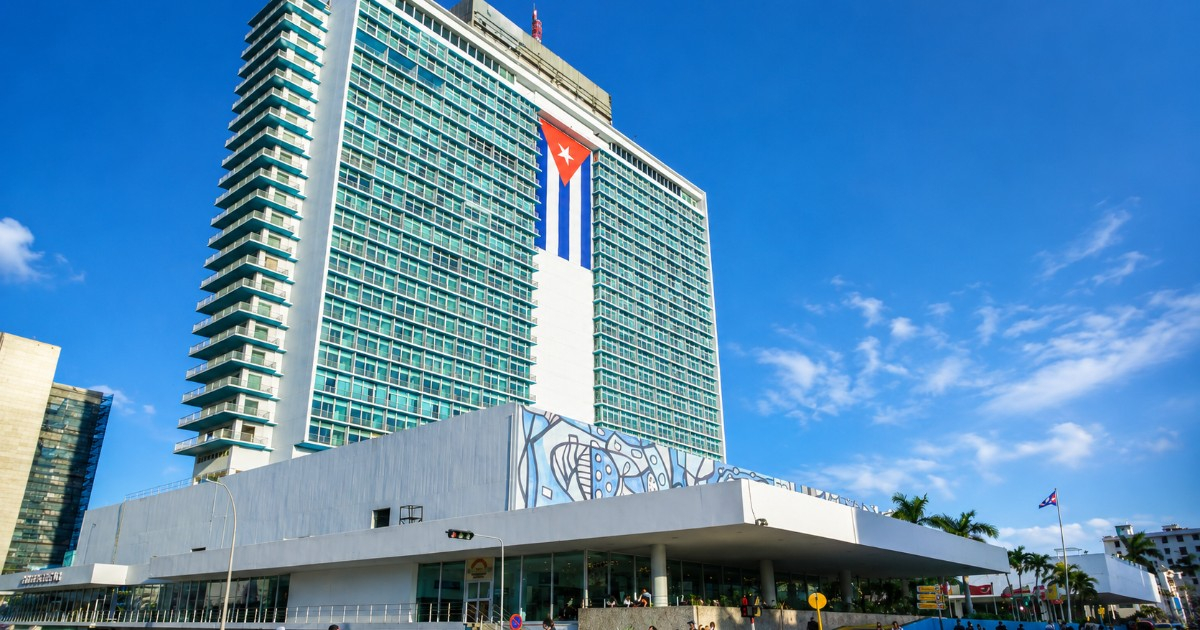
Alejandro Rodríguez Cuervo, host of Ruta10Oficial, of the Aló Cubano program on Cuba's Educational Channel, and sports journalist at Canal Caribe, reported on Facebook that upon arriving at the lobby of the Hotel Habana Libre, he was informed that in order to have a coffee, he needed to pay in dollars, which the staff described as a "restructuring of prices."
“I was just told in the lobby of the Hotel Habana Libre that I had to pay in dollars to get a coffee. Just like that, with remarkable ease, but be careful, with a lot of courtesy,” wrote the communicator.
He immediately posed the question that captures the outrage of thousands of Cubans: "Can someone explain to me who directed this guideline? Why do I have to pay at a facility in my country in a currency I do not have?"
Rodríguez Cuervo quickly pointed out the irony of the establishment's name: "The Habana Libre is not free in any sense, not even in its name."
The post sparked an avalanche of comments confirming that the phenomenon goes far beyond that hotel.
Users reported identical experiences at the Hotel Copacabana, where one of them was charged a dollar for a glass of water for his daughter, and where another customer was "held at the bar because he didn't have dollars to pay" for the coffee he had already consumed.
Exclusive charges in dollars were also reported at the Capri Hotel and Meliá Habana —cafeteria, restaurants, and pizzeria— as well as at the Pinar del Río Hotel, which even promoted a Mother's Day dinner exclusively in that currency.
"It seems to be a standard that they are generalizing," warned a commentator. Another was more direct: "A subtle way of telling us once again: 'Cubans, keep out of my tourist facilities!'"
The process of progressive dollarization of Cuban tourism accelerated from August 2025, when hotels belonging to the military conglomerate GAESA (Grupo Gaviota) began to demand exclusively cash in dollars or international cards, rejecting both the Cuban peso and the MLC.
In February 2026, the regime further formalized currency control through the Agreement 10216 of the Council of Ministers, which centralizes the supervision of electronic commerce platforms operating in foreign currency under the Central Bank of Cuba.
The economic context makes the situation particularly harsh: the Cuban minimum wage is around 2,100 Cuban pesos, equivalent to just about four dollars at the informal exchange rate, while the average salary does not exceed 5,000 or 6,000 pesos, which is between ten and twelve dollars.
In April, the Iberostar Parque Central Hotel charged 10,000 pesos —almost five minimum monthly salaries— just to enter the pool.
Rodríguez Cuervo acknowledged that the phenomenon is not new: "it appears in a cyclical manner", he wrote.
And the comments confirmed it: "Everything is cyclical, we've been there before... there was even a long time when you couldn't even enter if you were Cuban," recalled a user.
Another pointed out that the measure responds to the "partial dollarization of the economy" driven by Prime Minister Manuel Marrero Cruz.
The concern about the consequences of raising one's voice was also present: "I hope they don't make you disappear from television, radio, and all media for expressing your feelings, as often happens in Cuban media," wrote a follower.
"Already in many places we have to pay in a currency that we do not earn, our reality is sad," summarized another voice among the hundreds of reactions generated by the post.
Filed under: