
Related videos:
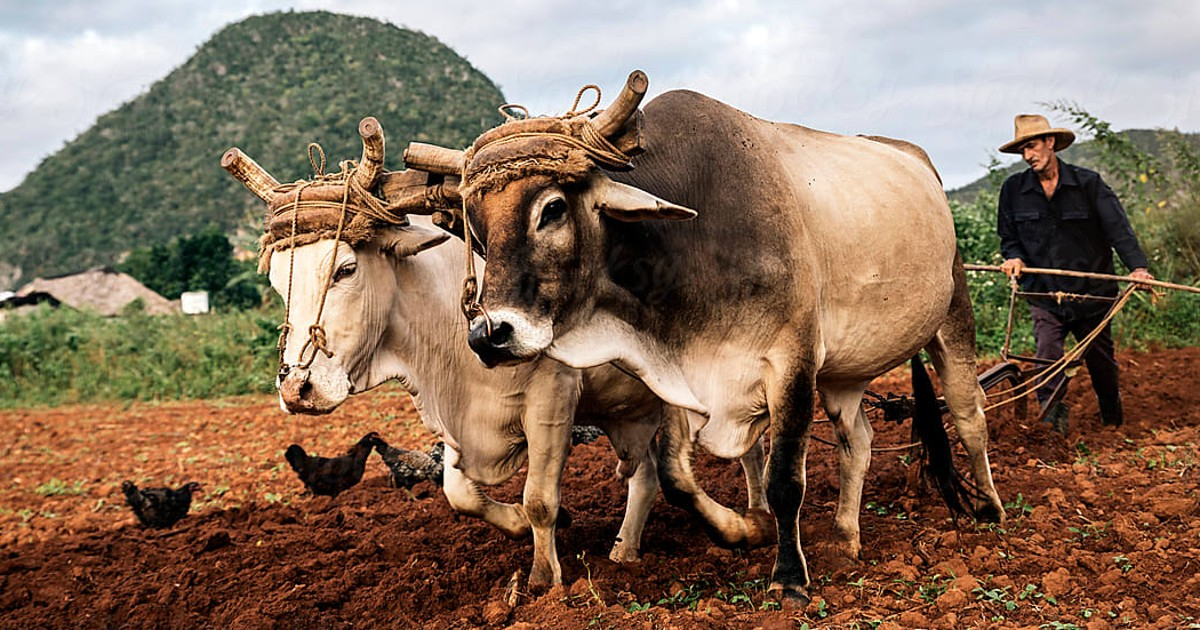
The president of the Agricultural Business Group of Cuba, Orlando Lorenzo Linares Morell, acknowledged that the island's agriculture has had to revert to 19th-century technologies to survive the energy crisis, promoting the revival of animal traction, windmills, and solar pumps due to the lack of fuel and supplies.
On the occasion of the 65th anniversary of the National Association of Small Farmers (ANAP), Linares Morell detailed the alternatives being promoted in the Cuban countryside in response to the structural fuel deficit that halts agricultural machinery, transportation, and irrigation across the island.
"The topic of recovery is also being encouraged in some way, such as the restoration of wind energy turbines and the use of alternative energy in certain cases, like solar pumps," stated the executive.
One of the central points of his presentation was the revival of animal traction: it's no longer just about working with oxen; there are now experiences involving buffaloes and horses.
In the rice-growing regions of Matanzas, such as the company Fernando Chenick, the picture is clear: "Many producers have incorporated oxen yokes, and today when you arrive in these rice areas, you can see the significant presence of animal traction," described Linares Morell in a romantic manner.
The executive himself acknowledged the underlying contradiction: "There is equipment but not enough fuel."
The crisis is starkly reflected in rice production, a staple of the Cuban diet.
In 2018, Cuba produced 304,000 tons of rice; by 2025, it barely reached 111,000 tons, which is 36% of that level, according to official data presented by Linares Morell himself.
"In the year 2025, we managed to produce 111,000 tons of rice, which is 36% of what we produced in 2018," he acknowledged, adding that this figure "is not significant on the Cuban table" and that "in the food balance of the basic basket, it still has no impact."
By the end of April 2026, the planting campaign was only 70% complete, and agricultural aviation is completely halted, which has necessitated the formation of manual planting and fertilization brigades.
"The blockade has impacted agricultural aviation. Flights are at a standstill," said Linares Morell, noting that companies from Pinar del Río, Camagüey, Sancti Spíritus, and Granma have replaced 100% of aviation operations with manual labor.
This situation is not new: in 2019, José Ramón Machado Ventura was already urging the use of oxen even when tractors were available, and the regime incorporated about 4,000 pairs for sugar cane.
In light of the collapse, the Agricultural Business Group has announced a package of relief measures: the acquisition of 256 pieces of equipment—174 of which are harvesters—through direct import authorization for producers; the leasing of 666 pieces of equipment that were inactive in workshops; and the installation of over a thousand wells with solar submersible pumps in Aguada de Pasajeros (Cienfuegos) and Matanzas.
In terms of energy, the goal is ambitious: currently, only 7% of rice is dried using fuel, and the aim is for 80% to be dried with rice husk as biomass by the end of the first semester.
Fifteen cooperative production contracts have also been signed with small and medium-sized private enterprises (MIPYMES), along with 61 contracts with advanced producers covering approximately 10,000 hectares.
The economist Pedro Monreal has pointed out that the Cuban agricultural crisis is more severe than the Special Period of the 1990s, while the FAO warned last March about the impact of diesel shortages on crop harvesting and food insecurity on the island, where farmers have resorted to exchanging food for fuel out of desperation.
Linares Morell concluded his speech with a call that encapsulates the extent of the setback: "We need to include new areas, new producers, families, and all food production entities."
Filed under: